
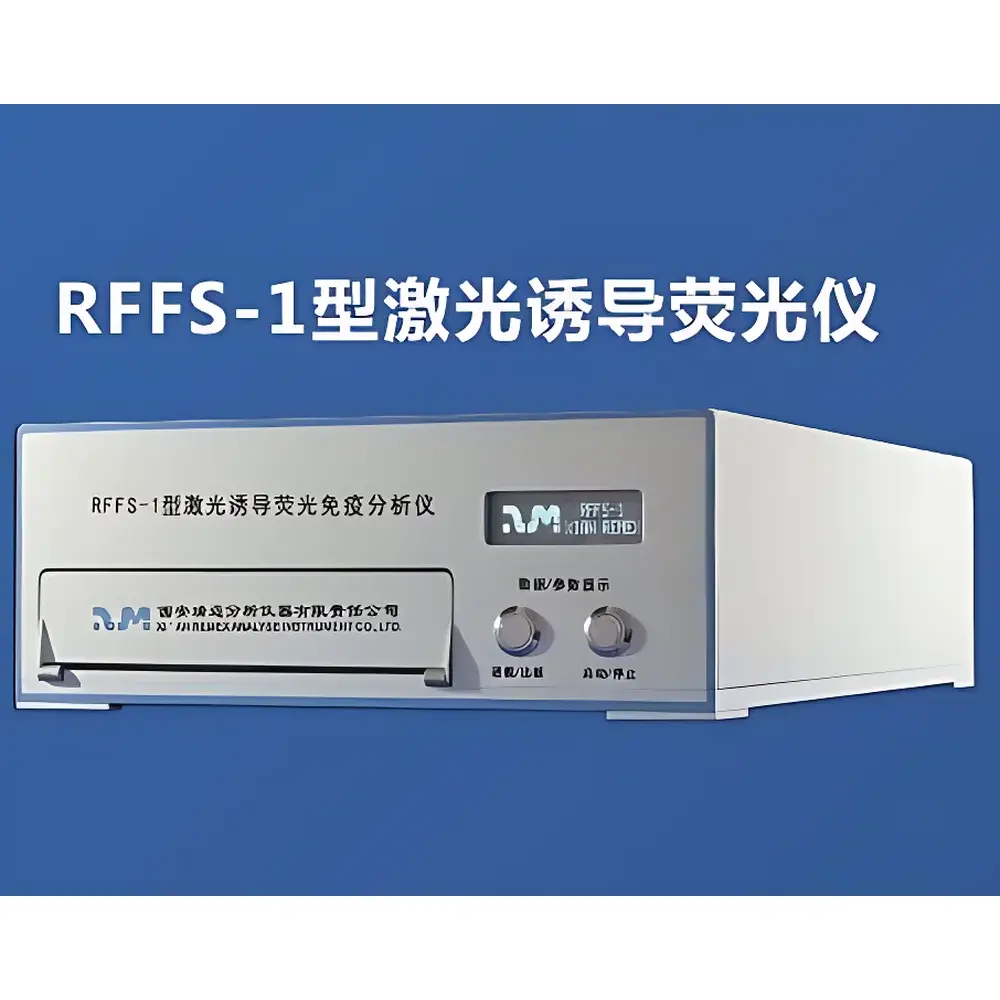
RFFS-1 Laser-Induced Fluorescence Analyzer
| Origin | Shaanxi, China |
|---|---|
| Manufacturer Type | Distributor |
| Origin Category | Domestic |
| Model | RFFS-1 |
| Price | Upon Request |
Overview
The RFFS-1 Laser-Induced Fluorescence Analyzer is a compact, integrated benchtop instrument engineered for high-sensitivity, real-time fluorescence detection based on the physical principle of laser-induced fluorescence (LIF). LIF relies on the selective excitation of fluorescent species—or fluorophore-labeled analytes—using a monochromatic, coherent laser source (470 nm nominal), followed by quantitative measurement of the resultant emission (centered at 525 nm) via a high-gain photomultiplier tube (PMT) with spectral response spanning 230–920 nm. This technique provides exceptional signal-to-noise ratio and sub-picomolar detection limits, offering 2–3 orders of magnitude higher sensitivity than conventional broad-spectrum lamp-based fluorometers. The RFFS-1 is designed for controlled laboratory environments where reproducible, low-volume, high-throughput analysis is required—particularly in life science research, pharmaceutical QC, environmental trace analysis, and diagnostic assay development.
Key Features
- Integrated optical architecture combining solid-state 470 nm excitation laser, precision emission filtering, and PMT-based detection in a single chassis
- Standardized 96-well microplate compatibility enabling parallel processing of up to 96 samples per run with minimal reagent consumption (≤100 µL/well)
- Programmable plate vibration system with three intensity levels (low/medium/high) to ensure homogeneous mixing and reduce settling artifacts
- Adjustable PMT operating voltage (300–1000 V) and six-stage amplifier gain selection (1× to 10⁵×) for optimal dynamic range adaptation across sample concentrations
- Real-time signal acquisition at selectable sampling rates from 10 to 3000 points per second (T/S), supporting kinetic profiling and rapid screening
- Onboard automatic zero calibration and drift-compensated amplification circuitry (<0.05% output drift) ensuring measurement stability over extended runs
- Wide linear dynamic range exceeding five decades (10⁵), validated under controlled reference conditions using NIST-traceable fluorescent standards
Sample Compatibility & Compliance
The RFFS-1 supports aqueous and organic solvent-based samples compatible with standard polystyrene or black-walled 96-well plates. It is routinely deployed for native fluorophore detection (e.g., tryptophan, NADH, flavins), immunoassays with labeled antibodies, nucleic acid intercalation studies, metal ion chelate complexes (e.g., lanthanide tags), and quantum dot–based biosensing platforms. While the instrument itself does not carry CE or FDA 510(k) certification, its operational parameters align with common method validation requirements outlined in ICH Q2(R2), USP , and ISO/IEC 17025 for fluorescence-based analytical procedures. Data integrity features—including timestamped acquisition logs and user-accessible raw signal files—support GLP-compliant documentation workflows.
Software & Data Management
The RFFS-1 operates via a Windows-based control interface that enables full parameter configuration (laser power modulation, integration time, gain, vibration profile, sampling rate) and real-time waveform visualization. All acquired data are stored in open-format ASCII or CSV files containing calibrated intensity values, timestamps, and metadata (well position, gain setting, PMT voltage). The software supports batch export, baseline correction, peak integration, and relative fluorescence unit (RFU) normalization. Audit trail functionality records operator login events, method changes, and instrument status transitions—facilitating compliance with 21 CFR Part 11 when deployed within validated IT environments.
Applications
- High-throughput screening of enzyme kinetics, receptor–ligand binding, and cell viability assays
- Quantitative analysis of amino acids, peptides, proteins, nucleic acids, and small-molecule metabolites in biological matrices
- Trace-level detection of heavy metals (e.g., Pb²⁺, Hg²⁺) via fluorescent chelation chemistry
- Environmental monitoring of polycyclic aromatic hydrocarbons (PAHs), pesticides, and pharmaceutical residues in water and soil extracts
- Development and QC of fluorescent immunoassays, lateral flow diagnostics, and point-of-care test kits
- Fundamental studies in fluorescence quenching mechanisms, Förster resonance energy transfer (FRET), and single-molecule burst analysis (with optional confocal add-on)
FAQ
What is the typical detection limit for fluorescein sodium under standard RFFS-1 operating conditions?
Under optimized settings (470 nm excitation, 525 nm emission filter, 700 V PMT bias, 100× gain, 1 s integration), the limit of detection is ≤50 fM (S/N ≥ 3) in phosphate-buffered saline.
Can the excitation and emission wavelengths be customized beyond 470 nm and 525 nm?
Yes—the optical path accommodates interchangeable bandpass filters and optional laser diodes; custom configurations require factory alignment and recalibration.
Is the instrument suitable for GMP-regulated manufacturing environments?
It may be deployed in GMP contexts provided it undergoes site-specific IQ/OQ/PQ validation, including temperature stability testing, linearity verification, and system suitability checks per USP .
Does the RFFS-1 support kinetic mode for time-resolved fluorescence measurements?
Yes—continuous acquisition at up to 3000 T/S enables millisecond-resolution temporal profiling of fluorescence decay or enzymatic turnover.
How is data security and user access managed?
The software implements role-based login (administrator/operator), encrypted local storage, and export restrictions configurable by administrator to meet internal data governance policies.




