
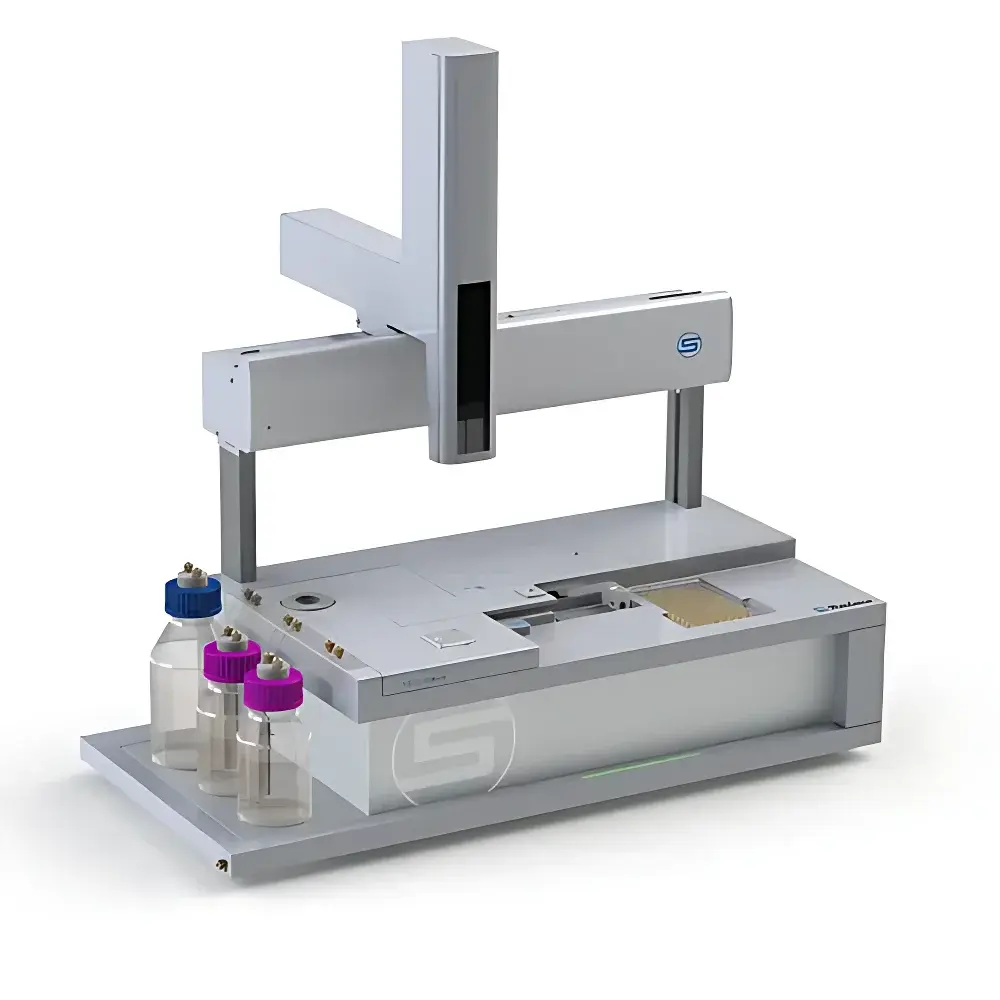
RheoSense VROC Initium Automated Microfluidic Viscometer
| Brand | RheoSense |
|---|---|
| Origin | USA |
| Model | Initium |
| Instrument Type | Portable Microfluidic Viscometer |
| Viscosity Range | 0.2–2000 cP |
| Temperature Range | 4–70 °C |
| Sample Volume per Measurement | <5 µL |
| Shear Rate Range | Up to 10⁶ s⁻¹ |
| Compliance | ASTM D2196, ISO 2555, USP <911> |
Overview
The RheoSense VROC Initium is a fully automated, benchtop microfluidic viscometer engineered for precision viscosity and shear-rate-dependent rheological characterization of small-volume liquid samples. Unlike conventional rotational or capillary viscometers, the Initium employs a proprietary microfluidic Couette geometry—based on the Viscometer-Rheometer-on-a-Chip (VROC) platform—to measure dynamic viscosity under controlled laminar flow conditions. This architecture enables direct, real-time quantification of apparent viscosity across an exceptionally broad shear rate spectrum (up to 10⁶ s⁻¹), making it uniquely suited for both Newtonian fluids and complex non-Newtonian systems—including biologics, polymer solutions, nanofluids, and shear-thinning or shear-thickening formulations. Its compact, portable footprint and integrated Peltier temperature control (4–70 °C) support routine QC testing in regulated laboratories, R&D environments, and even field-deployable settings where space and sample conservation are critical.
Key Features
- Microfluidic Couette cell with precisely defined gap geometry ensures high reproducibility and eliminates wall-slip artifacts common in conventional geometries.
- Automated sample handling with programmable aspiration, priming, and waste disposal—reducing operator variability and enabling unattended operation.
- Ultra-low sample consumption: each measurement requires ≤5 µL, minimizing material cost and enabling analysis of precious or limited-availability samples (e.g., clinical isolates, early-stage drug candidates).
- High shear capability without flow instability: the microchannel design maintains laminar flow up to 10⁶ s⁻¹, avoiding turbulence-induced measurement error and enabling accurate characterization of high-shear processes such as spray drying, microfluidic formulation, or syringe filling.
- Integrated temperature regulation via solid-state Peltier system with ±0.1 °C stability, supporting viscosity profiling across physiologically and industrially relevant thermal ranges (4–70 °C).
- Self-cleaning fluidic pathway with solvent-compatible wetted materials (316 stainless steel, fused silica, chemically resistant elastomers) minimizes carryover and cross-contamination between runs.
Sample Compatibility & Compliance
The VROC Initium accommodates aqueous and organic solvents, protein therapeutics, colloidal dispersions, low-viscosity oils, and shear-sensitive biological matrices—including monoclonal antibodies, mRNA-LNP suspensions, and cell culture supernatants. Its measurement methodology aligns with established industry standards for kinematic and dynamic viscosity assessment: ASTM D2196 (non-Newtonian fluids), ISO 2555 (resin solutions), and USP <911> (viscosity of pharmaceutical liquids). When operated within validated workflows—including instrument qualification (IQ/OQ/PQ), calibrated reference standards traceable to NIST, and audit-trail-enabled software—the system supports GLP and GMP-compliant data integrity requirements per FDA 21 CFR Part 11.
Software & Data Management
The RheoSense VROC Software Suite provides intuitive method setup, real-time viscosity vs. shear rate curve visualization, and automated parameter extraction (zero-shear viscosity, power-law index, yield stress approximation). Raw data files are saved in vendor-neutral CSV format with full metadata (timestamp, temperature, shear rate, pressure differential, calibration ID). The software supports multi-user role-based access control, electronic signatures, and configurable audit trails—ensuring compliance with data governance frameworks. Exported datasets integrate seamlessly with LIMS platforms and statistical process control (SPC) tools for trend analysis and batch release decision support.
Applications
- Formulation development of injectables and ophthalmic solutions requiring low-volume, high-shear viscosity screening.
- Stability assessment of biopharmaceuticals under thermal stress and mechanical agitation.
- Quality control of inkjet inks, adhesives, and functional coatings where shear-thinning behavior dictates print fidelity or film uniformity.
- Rapid screening of crude oil fractions and refinery intermediates during upstream/downstream process optimization.
- Academic research in soft matter physics, microfluidics, and interfacial rheology where sample scarcity and shear-rate resolution are limiting factors.
FAQ
What sample volume is required per measurement?
Each viscosity measurement consumes ≤5 µL of sample—ideal for high-value or volume-constrained materials.
Can the Initium measure yield stress or thixotropy?
While primarily optimized for steady-state viscosity and shear-rate sweeps, time-resolved ramp protocols enable qualitative assessment of structural recovery; quantitative thixotropy modeling requires complementary oscillatory rheometry.
Is the system compliant with 21 CFR Part 11?
Yes—when deployed with enabled audit trail, electronic signature, and user access controls, the VROC Software meets core technical requirements for electronic records and signatures in regulated environments.
How is temperature accuracy verified?
The Peltier module is factory-calibrated against NIST-traceable RTD probes; users may perform periodic verification using certified reference oils at defined temperatures.
What maintenance is required?
Routine maintenance includes quarterly cleaning of the microfluidic cell with recommended solvents and annual recalibration of pressure transducers and temperature sensors by RheoSense-certified service engineers.



