
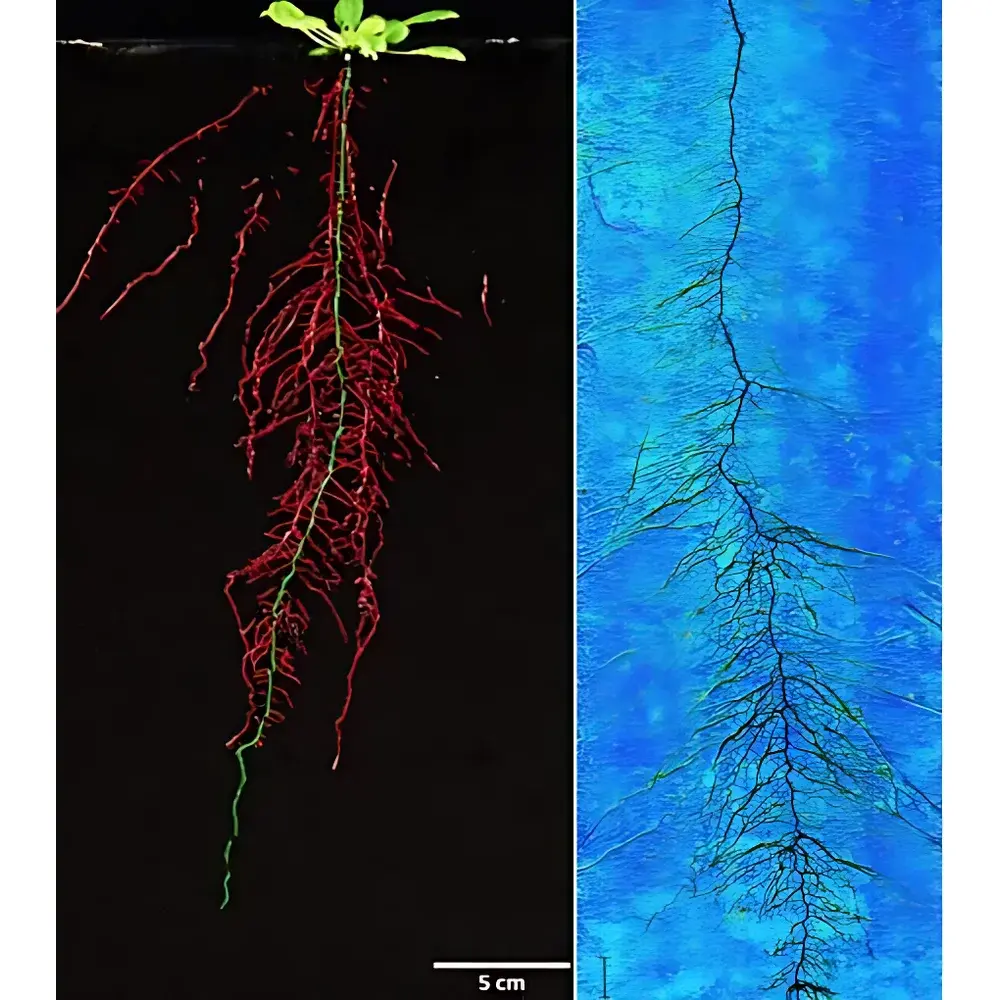
RhizoTron® Rhizosphere Phenotyping System
| Origin | Beijing, China |
|---|---|
| Manufacturer Type | Authorized Distributor |
| Origin Category | Domestic (China) |
| Model | RhizoTron |
| Pricing | Upon Request |
Overview
The RhizoTron® Rhizosphere Phenotyping System is a modular, research-grade platform engineered for non-invasive, high-resolution, longitudinal observation of root architecture and rhizosphere dynamics under controlled or semi-field conditions. It implements standardized root-window methodology—distinct from minirhizotron approaches—enabling full-field-of-view imaging across customizable root-box dimensions. The system integrates optical phenotyping (RGB, multispectral, and hyperspectral scanning), environmental monitoring, and physiological sensing to quantify structural, functional, and biochemical traits of roots and their surrounding soil matrix. Designed for reproducible experimental design in plant science, it supports hypothesis-driven studies on root development, stress responses (drought, salinity, nutrient deficiency), symbiotic interactions, and genotype–phenotype mapping in both model species and crops.
Key Features
- Modular root-box design (RhizoBox™) with customizable width (standard 30 cm) and depth (up to 100 cm), enabling scalable experimental setups aligned with root growth profiles of diverse species.
- Multi-modal imaging capability: high-resolution RGB scanning (up to 4800 dpi, A4 format), visible–near-infrared (VIS-NIR: 400–1000 nm) hyperspectral imaging, and optional short-wave infrared (SWIR: 900–1700 nm or 1000–2500 nm) spectral bands for enhanced chemical trait discrimination.
- Centralized control unit supporting synchronized acquisition across 10–100 independent root-window modules—ensuring temporal alignment for time-series analysis without physical disturbance.
- Integrated environmental monitoring: real-time soil moisture, temperature, electrical conductivity (EC), O2, CO2, pH, and dissolved O2 at root-zone level; optional automated weighing for transpiration and biomass estimation.
- Optional LED cultivation platform (222 × 86 × 66 cm external; 180 × 80 × 55 cm internal) delivering uniform photosynthetic photon flux density (PPFD) up to 250 µmol·m−2·s−1, with 0–100% dimming and programmable photoperiods to emulate diurnal cycles.
- Complementary sensing modules: chlorophyll fluorescence imaging (Fv/Fm, NPQ), thermal infrared (TIR) imaging for root-zone heat dissipation mapping, and multi-spectral fluorescence for secondary metabolite profiling (e.g., in medicinal root crops).
- Water-culture compatible configurations available for hydroponic root phenotyping, including spectral analysis of root exudates and oxygen gradients in nutrient solution.
Sample Compatibility & Compliance
The RhizoTron® system accommodates a broad range of plant species—from Arabidopsis thaliana and maize to perennial trees and medicinal herbs—across growth stages from germination through maturity. Root-box substrates include soil, sand, agar, hydroponic media, and custom composite matrices. All hardware and software components comply with international laboratory instrumentation standards for data integrity and traceability. Data acquisition workflows support GLP- and GMP-aligned documentation requirements, including audit trails, user authentication, and metadata embedding per image frame (timestamp, sensor ID, calibration status). Hyperspectral data formats adhere to ENVI-compatible BIL/BIP conventions, facilitating interoperability with ISO/IEC 17025-accredited analytical pipelines.
Software & Data Management
RhizoTron® Analysis Suite provides end-to-end processing—from raw scan ingestion to quantitative trait extraction. Core algorithms include Savitzky-Golay smoothing for spectral noise reduction and Spectral Angle Mapper (SAM) classification for pixel-wise tissue segmentation (e.g., young vs. senescent roots, root–soil interface). The software enables batch processing of time-lapse sequences, generating time-resolved metrics such as root elongation rate, lateral root initiation frequency, fine-root turnover, and spatial distribution of water content or redox-active compounds. Customizable export options include CSV, HDF5, and GeoTIFF for integration with R, Python (scikit-learn, hylite), or commercial platforms like ENVI and MATLAB. Optional cloud synchronization and role-based access control ensure secure collaboration across distributed research teams.
Applications
- Quantitative root phenotyping for QTL mapping and genome-wide association studies (GWAS) in breeding programs.
- In situ assessment of root responses to abiotic stresses—including drought-induced hydraulic redistribution, salt-induced cortical aerenchyma formation, and hypoxia-triggered ethylene signaling.
- Soil–root interface characterization: mapping spatial heterogeneity of organic carbon, iron oxides, and microbial hotspots via spectral unmixing.
- Phytochemical phenotyping of medicinal roots (e.g., Panax ginseng, Astragalus membranaceus) using fluorescence and SWIR signatures correlated with saponin or flavonoid accumulation.
- Validation of root architectural models (e.g., CRootBox, OpenSimRoot) using empirically derived growth trajectories and branching angles.
- Long-term monitoring of mycorrhizal colonization dynamics and rhizobial nodule development under variable nitrogen regimes.
FAQ
What root-box dimensions are standard, and can they be customized for deep-rooted species?
Standard RhizoBoxes measure 30 cm wide × up to 100 cm deep; custom fabrication is available for specialized applications, including tree seedling studies requiring >150 cm depth.
Is hyperspectral data acquisition compliant with ASTM E1777 or ISO 18562 standards for spectral imaging validation?
While RhizoTron® does not carry formal certification, its calibrated light sources, NIST-traceable reference panels, and documented spectral response functions enable users to implement ASTM E1777-compliant validation protocols internally.
Can the system operate in greenhouse or field-deployable configurations?
Yes—the portable hyperspectral scanner variant includes integrated push-broom mechanics, touchscreen GUI, and onboard GPU-accelerated preprocessing, meeting IP54 environmental rating for semi-field use.
Does the software support FDA 21 CFR Part 11 compliance for regulated preclinical research?
The enterprise version offers optional 21 CFR Part 11 modules—including electronic signatures, audit trail logging, and permission hierarchies—validated per user-defined SOPs.
How is root–soil boundary segmentation handled in heterogeneous substrates?
Segmentation leverages combined spectral indices (e.g., Normalized Difference Root Index, NDRI) and machine learning classifiers trained on ground-truthed root masks, with manual correction tools for operator validation.



