
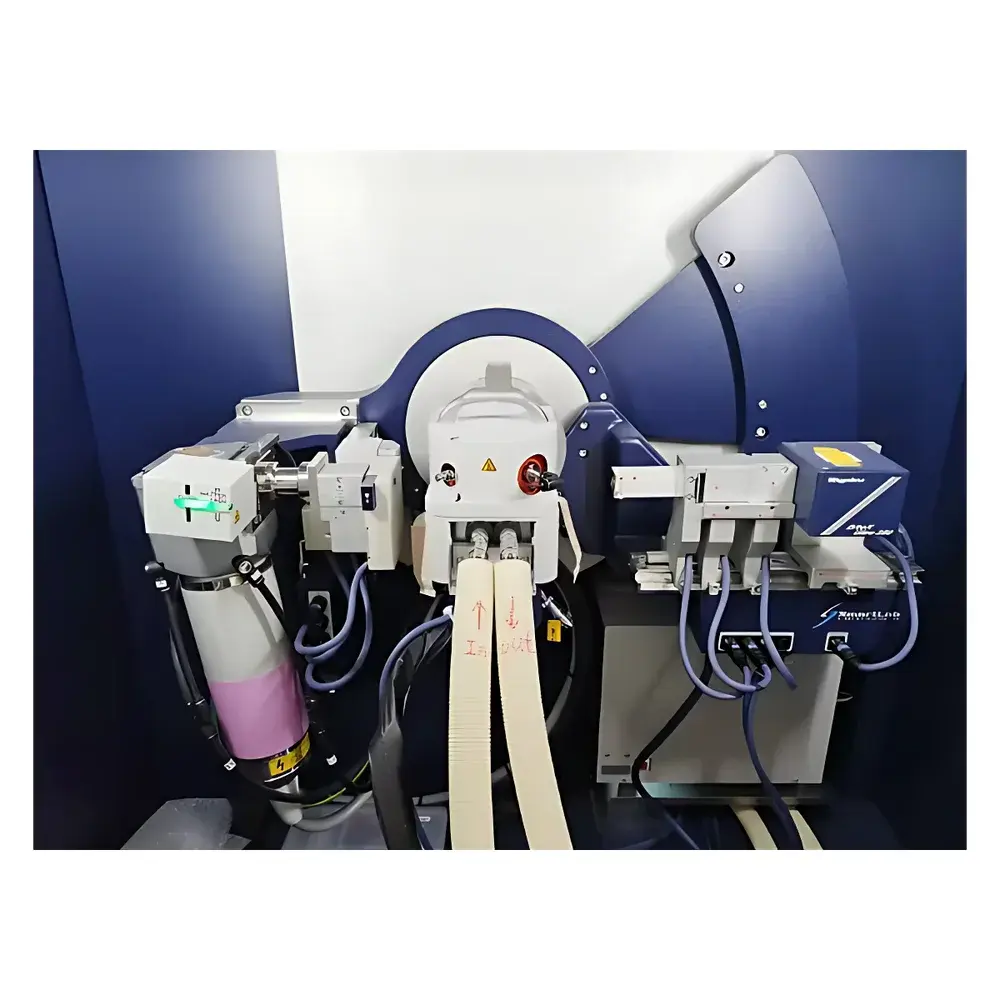
Rigaku DSC-XRD Simultaneous Thermal Analysis and X-ray Diffraction System
| Brand | Rigaku |
|---|---|
| Origin | Japan |
| Model | DSC-XRD |
| Configuration | θ–θ goniometer geometry |
| Coupling Type | Synchronized in-situ DSC–XRD |
| Atmosphere Control | Programmable gas environment (N₂, Ar, air, O₂) |
| Temperature Range | RT to 1200 °C (DSC sensor dependent) |
| X-ray Source | Cu Kα (standard), optional Mo or Co anodes |
| Detector | High-speed 1D/2D pixel array detector (e.g., HyPix-400) |
| Data Synchronization | Sub-second temporal alignment of thermal and diffraction signals |
Overview
The Rigaku DSC-XRD Simultaneous Thermal Analysis and X-ray Diffraction System is an integrated in-situ analytical platform engineered for concurrent measurement of thermal events and structural evolution in solid-state materials. It combines a differential scanning calorimeter (DSC) module with a high-resolution θ–θ geometry X-ray diffractometer within a single, thermally stabilized chamber. This architecture enables true simultaneous acquisition—where heat flow, temperature, and X-ray diffraction patterns are recorded under identical thermal history, atmospheric conditions, and sample positioning. Unlike sequential or loosely coupled systems, the DSC-XRD delivers time-synchronized data streams, allowing direct correlation between enthalpic transitions (e.g., melting, crystallization, solid–solid phase transformations) and real-time changes in crystallographic parameters (lattice constants, phase fractions, microstrain, crystallite size). The system is fundamentally designed for mechanistic studies in materials science, pharmaceutical development, battery electrode research, and ceramic processing—where understanding the kinetic and thermodynamic drivers of structural change is essential.
Key Features
- True in-situ synchronization: Hardware-level triggering ensures DSC thermogram and XRD patterns share identical timestamps with ≤100 ms latency.
- θ–θ goniometer configuration: Eliminates sample displacement artifacts during heating; maintains precise Bragg angle integrity across temperature ramps up to 100 °C/min.
- Integrated atmosphere control: Mass-flow-controlled gas delivery (N₂, Ar, synthetic air, O₂) with optional humidity module; compatible with sealed quartz or alumina sample holders.
- High-fidelity thermal sensing: Platinum resistance thermometer (Pt100) embedded in the DSC sensor stage, calibrated traceably to NIST standards.
- Modular X-ray optics: Adjustable divergence and receiving slits, incident beam monochromator (graphite or multilayer), and selectable anode options (Cu, Mo, Co) for optimal signal-to-noise and resolution trade-offs.
- Thermally compensated optical path: Active stabilization of X-ray beam height and angular alignment over full temperature range to preserve diffraction peak position accuracy.
Sample Compatibility & Compliance
The DSC-XRD accommodates standard DSC pans (aluminum, gold-plated, hermetic) and custom-designed XRD-compatible crucibles with low X-ray absorption and high thermal conductivity. Sample mass range: 1–50 mg (optimized for signal-to-noise balance in both modalities). The system complies with ISO 11357 (plastics – DSC), ASTM E1269 (heat capacity by DSC), and ISO 17882 (XRD qualitative/quantitative analysis). All thermal calibration procedures follow Rigaku’s certified protocol aligned with EURAMET cg-18 guidelines. For regulated environments, the instrument supports 21 CFR Part 11-compliant software audit trails, electronic signatures, and secure user role management when operated with PDXL or SmartLab Studio II v4.x or later.
Software & Data Management
Data acquisition and analysis are managed through Rigaku’s unified PDXL software suite, which provides synchronized visualization of heat flow vs. temperature overlaid with time-resolved XRD pattern stacks. Real-time Rietveld refinement (using TOPAS or GSAS-II integration) enables quantitative phase tracking during dynamic heating. The software exports time-stamped .csv files for thermal data and .xye/.raw formats for diffraction frames, fully compatible with third-party tools (MATLAB, Python SciPy, DIFFRAC.SUITE). Raw datasets include metadata tags for temperature, gas flow rate, ramp rate, and detector exposure—ensuring FAIR (Findable, Accessible, Interoperable, Reusable) data principles. Automated report generation supports GLP/GMP documentation requirements, including calibration logs, system suitability checks, and raw-data archiving with SHA-256 checksum verification.
Applications
- Pharmaceutical solid-form screening: Mapping polymorphic transitions (e.g., amorphous-to-crystalline conversion) while quantifying enthalpy and kinetics.
- Lithium-ion battery cathode degradation: Correlating exothermic side reactions (DSC) with oxygen loss-induced lattice collapse (XRD).
- High-temperature ceramic sintering: Monitoring densification onset, phase nucleation (e.g., mullite formation), and residual stress evolution.
- Metallurgical phase diagrams: Validating eutectic temperatures and identifying metastable intermetallics during controlled cooling.
- Polymorph stability assessment under variable pO₂: Coupling oxidation state changes (via XRD peak shifts) with redox enthalpies (DSC).
FAQ
Can the DSC-XRD perform measurements under reducing atmospheres?
Yes—the system supports programmable H₂/N₂ mixtures and forming gas (5% H₂/95% N₂) using corrosion-resistant gas lines and high-temperature seals.
Is it possible to extract quantitative phase fractions during a heating ramp?
Yes—time-resolved Rietveld refinement on consecutive 2θ scans enables continuous calculation of phase abundances with ±2 wt% repeatability (based on certified reference materials).
What is the minimum detectable enthalpy change for a phase transition?
Under standard operating conditions (10 °C/min, 10 mg Al₂O₃ reference), the DSC module achieves a noise level of <0.1 µW, enabling detection of transitions ≥0.5 J/g.
Does the system support ambient-pressure XRD during gas adsorption experiments?
Yes—optional gravimetric or volumetric gas dosing modules can be integrated to enable in-situ XRD during controlled gas exposure at pressures up to 1 bar.
How is thermal calibration verified across the full temperature range?
Calibration uses NIST-traceable reference materials (In, Sn, Pb, Zn, Al) measured in triplicate per ISO 11357-1 Annex A, with deviation reporting against certified transition temperatures and enthalpies.



