
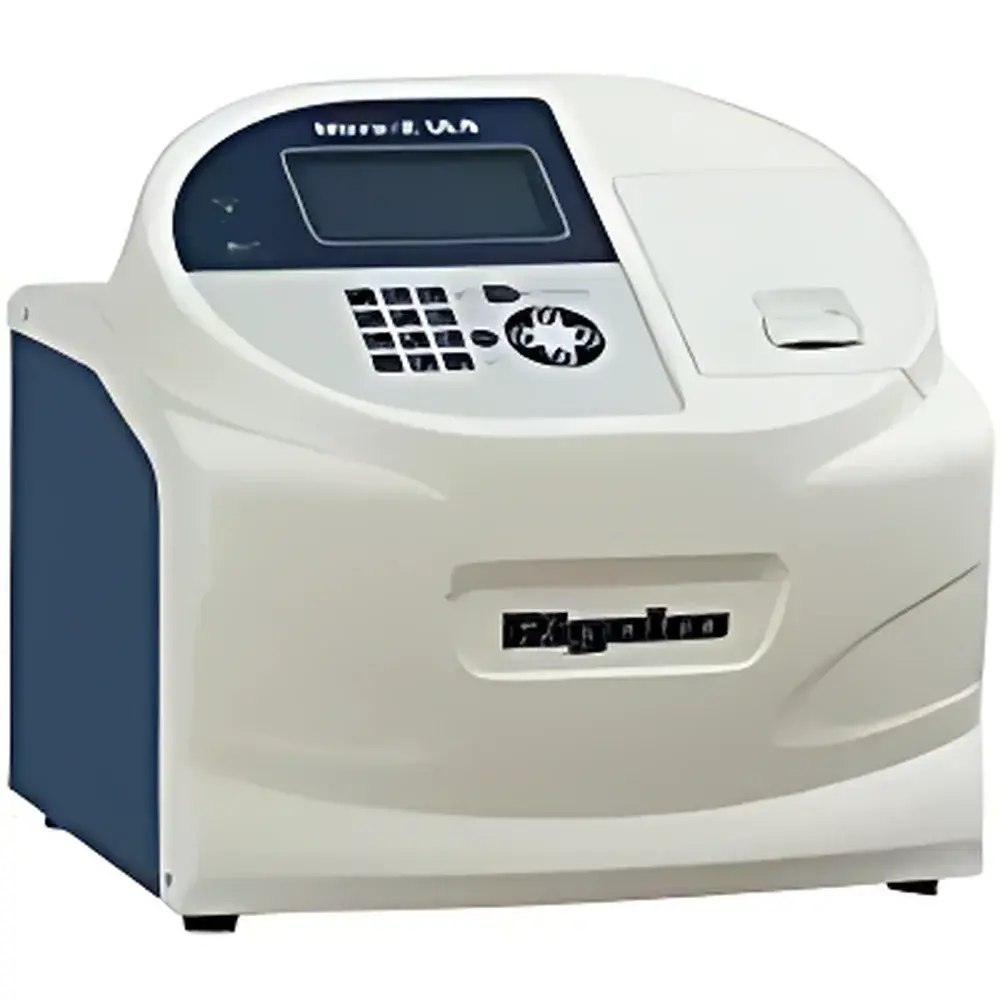
Rigaku Micro-Z Benchtop Wavelength Dispersive X-Ray Fluorescence Spectrometer
| Brand | Rigaku |
|---|---|
| Origin | Japan |
| Model | Micro-Z |
| Instrument Type | Scanning WDXRF |
| X-ray Tube Power | 40 W |
| Elemental Range | S (Sulfur) |
| Compliance | ASTM D2622, ISO 20884, JIS K 2541-7 |
| Cooling | Air-cooled (no water or gas required) |
| Power Supply | 220 V AC, 2 A |
| Sample Preparation | None required |
Overview
The Rigaku Micro-Z is a benchtop wavelength dispersive X-ray fluorescence (WDXRF) spectrometer engineered for high-precision, routine sulfur analysis in petroleum fuels and related hydrocarbon matrices. Unlike energy dispersive (EDXRF) systems, the Micro-Z employs Bragg diffraction from precisely aligned analyzing crystals to isolate characteristic X-ray lines—enabling superior spectral resolution, reduced background interference, and significantly lower detection limits for sulfur (typically sub-ppm level in diesel and gasoline). Its fixed optical path and optimized Johann-type focusing geometry are specifically designed for the Kα line of sulfur (2.307 keV), delivering exceptional peak-to-background ratios and long-term stability without mechanical recalibration. The system operates on standard single-phase 220 V AC power, requires no liquid nitrogen, helium purge, or external cooling water—making it suitable for deployment in refinery laboratories, QC/QA facilities, and mobile testing units where infrastructure constraints limit conventional XRF installation.
Key Features
- Air-cooled, 40 W sealed X-ray tube with stable output and extended service life—no consumable anodes or frequent replacement cycles.
- Dedicated optical configuration for sulfur Kα line detection, incorporating patented crystal positioning and detector alignment per ISO 20884 and JIS K 2541-7 methodologies.
- Touchscreen-integrated control interface with guided workflow navigation—designed for operators with minimal spectroscopy training.
- Zero-sample-preparation operation: direct analysis of liquid fuels, distillates, and lubricants in standard sample cups (e.g., 30 mm diameter polypropylene or Mylar-backed cells).
- High reproducibility (RSD < 1.5% at 10 ppm S level over 24 h) validated under GLP-compliant instrument qualification protocols.
- Embedded spectral acquisition logic that automatically acquires both peak and background intensities at defined angular positions—ensuring compliance with ASTM D2622’s fixed-angle measurement requirements.
Sample Compatibility & Compliance
The Micro-Z accommodates homogeneous liquid samples with viscosity ≤ 8 cSt at 40 °C, including gasoline, diesel, jet fuel (Jet A-1), biodiesel blends (B5–B20), and residual fuel oils (when pre-filtered). It supports analysis across the full regulatory range specified in ISO 20884 (0.5–500 mg/kg S) and ASTM D2622 (0.5–10,000 mg/kg S), with demonstrated linearity (r² > 0.9998) and recovery rates of 98.2–101.7% using NIST SRM 2723a and CRM-101 certified reference materials. All measurement procedures adhere to ISO/IEC 17025 documentation requirements, and audit trails—including method parameters, calibration history, and raw intensity data—are retained in accordance with FDA 21 CFR Part 11 principles (electronic signature support optional via Rigaku QuantExpress software).
Software & Data Management
Controlled by Rigaku’s QuantExpress™ v3.2 platform, the Micro-Z provides fully automated quantification using type-calibrated curves traceable to primary standards. The software includes built-in validation checks for tube stability, detector dead time, and crystal alignment drift; generates ASTM/ISO-formatted reports with uncertainty estimation per GUM (JCGM 100:2008); and exports ASCII, CSV, and PDF outputs compatible with LIMS integration (via ASTM E1382-compliant XML schema). Data integrity safeguards include user-level access control, timestamped audit logs, and immutable raw-data archiving—supporting GMP and ISO 17025 laboratory accreditation.
Applications
- Regulatory sulfur monitoring in refinery product streams per EPA Tier 3, Euro 6, and China VI fuel specifications.
- Quality assurance of marine distillate fuels (ISO 8217 DMX/DMA) and bunker fuels (RMG/RME).
- Verification of desulfurization catalyst performance in hydrotreating units.
- In-process control during blending operations for ultra-low-sulfur diesel (ULSD) and renewable diesel.
- Contractor and third-party lab verification testing under API RP 990 or IP 501 protocols.
FAQ
Does the Micro-Z require helium or vacuum purging for sulfur analysis?
No. The instrument uses air-path optics optimized for sulfur Kα transmission; no gas purge or vacuum pump is needed.
Can the Micro-Z analyze solid or viscous samples?
It is validated exclusively for low-viscosity liquids. Solids, sludges, or fuels > 8 cSt require pre-treatment (e.g., dilution or filtration) and are outside the scope of ISO 20884-compliant operation.
Is method transfer possible from existing ASTM D2622 EDXRF instruments?
Yes—QuantExpress supports import of EDXRF calibration files and provides cross-platform bias correction tools verified against interlaboratory round-robin data.
What maintenance intervals are recommended?
Annual preventive maintenance (PM) is advised, including X-ray tube output verification, detector resolution check, and optical alignment validation using certified reference foils.
Is the Micro-Z compliant with FDA 21 CFR Part 11 for regulated pharmaceutical environments?
While primarily deployed in petrochemical labs, optional 21 CFR Part 11 modules (electronic signatures, audit trail encryption, role-based permissions) are available upon software licensing.





