
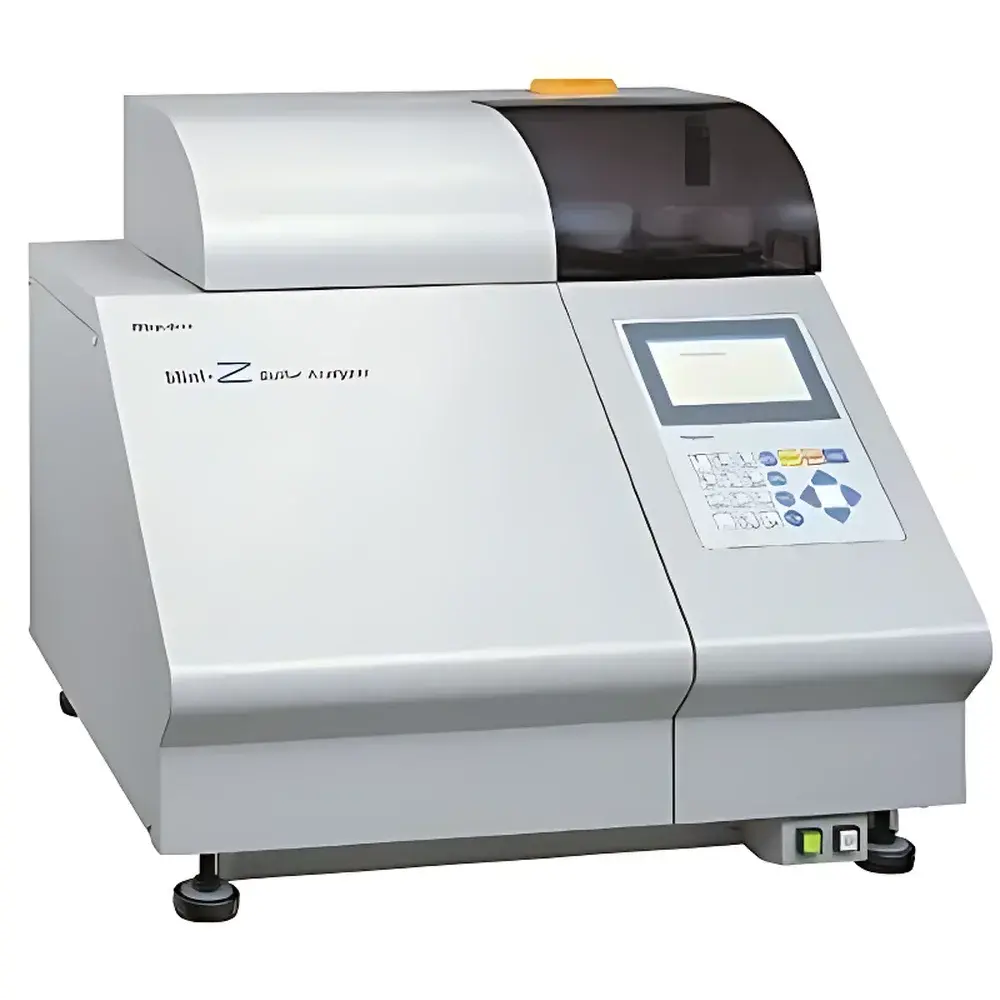
Rigaku Mini-Z Benchtop Wavelength Dispersive X-Ray Fluorescence Spectrometer
| Brand | Rigaku |
|---|---|
| Origin | Japan |
| Model | Mini-Z |
| Detection Principle | Wavelength Dispersive X-Ray Fluorescence (WDXRF) |
| Sample Throughput | 6-position automated sample changer |
| Power Requirement | 220 V AC, 2 A |
| Dimensions | 640 × 580 × 580 mm (W × D × H) |
| Weight | 65 kg |
| Detection Limit for S | 0.3 ppm |
| Precision (S at 10 ppm in gasoline) | σ = 0.17 ppm |
| S Quantification Range | 1 ppm – 4 wt% |
| Compliant Standards | ASTM D2622, ISO 20884, JIS K2541-7 |
| Cooling | Air-cooled (no water or gas required) |
| Operation Interface | Touchscreen control panel |
Overview
The Rigaku Mini-Z is a benchtop wavelength dispersive X-ray fluorescence (WDXRF) spectrometer engineered for high-precision, routine elemental analysis—specifically optimized for total sulfur quantification in petroleum fuels and related hydrocarbon matrices. Unlike energy dispersive (EDXRF) systems, the Mini-Z employs Bragg diffraction from analyzing crystals to resolve characteristic X-ray lines with superior spectral resolution, enabling accurate peak separation and background discrimination critical for low-level sulfur measurement in complex organic matrices. Its fixed optical path and monochromator-based detection architecture eliminate the need for vacuum pumps, cryogenic cooling, or reactive gases—making it uniquely suited for deployment in refinery laboratories, QC/QA facilities, and contract testing environments where operational simplicity, regulatory compliance, and long-term stability are paramount.
Key Features
- Optimized WDXRF optics for sulfur Kα line isolation: Uses a dedicated LiF(200) or PET crystal configuration to maximize peak-to-background ratio and minimize interferences from Cl, Ca, and metal additives commonly present in fuel streams.
- Sub-ppm detection capability: Achieves a practical limit of detection (LLD) of 0.3 ppm for sulfur in gasoline matrix, validated per ISO 20884 protocol using certified reference materials (CRMs) traceable to NIST SRMs.
- High reproducibility: Delivers relative standard deviation (RSD) ≤ 1.7% at 10 ppm sulfur concentration in gasoline—demonstrating robustness across daily operation without recalibration.
- Automated 6-sample carousel: Enables unattended sequential analysis, supporting batch processing for incoming inspection, process monitoring, and compliance reporting workflows.
- Touchscreen-driven user interface: Intuitive icon-based navigation eliminates dependency on specialized spectroscopy training; method setup, calibration, and report generation are guided step-by-step.
- Air-cooled, plug-and-play operation: Requires only standard 220 V AC / 2 A single-phase power—no external chillers, compressed air, or helium purge—reducing infrastructure dependencies and total cost of ownership.
Sample Compatibility & Compliance
The Mini-Z accepts liquid samples in standard 35 mm diameter XRF sample cups (with Mylar or Polyimide film windows), including neat gasoline, diesel, jet fuel, biodiesel blends, and lubricant base oils. Solid samples (e.g., catalysts, ash residues) may be analyzed as pressed pellets or fused beads when appropriate. All measurement protocols adhere strictly to internationally recognized test methods: ASTM D2622 (Standard Test Method for Sulfur in Petroleum Products by Wavelength Dispersive X-Ray Fluorescence Spectrometry), ISO 20884 (Petroleum products — Determination of sulfur content of motor fuels — Wavelength dispersive X-ray fluorescence spectrometry), and JIS K2541-7 (Testing methods for petroleum products — Determination of sulfur content — WDXRF method). Instrument performance verification includes daily drift correction using internal reference standards and periodic CRM validation—fully documented for GLP/GMP audit readiness.
Software & Data Management
The Mini-Z operates under Rigaku’s proprietary WDXRF acquisition and analysis software, compliant with FDA 21 CFR Part 11 requirements for electronic records and signatures. Software features include automated peak integration with dynamic background subtraction, multi-point calibration curve management (linear and quadratic), uncertainty estimation per ISO/IEC 17025 guidelines, and customizable PDF/CSV report templates aligned with refinery LIMS data structures. Audit trails log all method changes, operator actions, and instrument status events with timestamp and user ID. Data export supports direct integration with enterprise laboratory information management systems (LIMS) via ASTM E1384-compliant XML schema.
Applications
- Routine sulfur screening in gasoline, diesel, and marine fuels per Tier 3/ULSD specifications
- Verification of desulfurization unit performance in refineries
- QC release testing of finished fuels prior to distribution
- Analysis of sulfur-bearing additives and contaminants in lubricants and solvents
- Support for environmental compliance reporting (EPA 40 CFR Part 1093, EU Fuel Quality Directive 2009/30/EC)
- Research applications involving speciation-independent total sulfur quantification in novel biofuels and synthetic hydrocarbons
FAQ
Does the Mini-Z require helium or vacuum purging for sulfur analysis?
No. The Mini-Z uses an air-path optical design with optimized X-ray tube output and crystal diffraction geometry, eliminating the need for helium flush or vacuum evacuation—even for light element detection.
Can the system be calibrated using customer-prepared standards?
Yes. Calibration curves may be generated using in-house reference materials, provided they are matrix-matched and certified for sulfur content with stated uncertainty; full traceability documentation is required for regulated environments.
Is remote diagnostics or software update support available?
Rigaku provides secure remote access for technical support and firmware updates via encrypted TLS connection, subject to customer network policy approval and IT security review.
What maintenance intervals are recommended?
Routine maintenance is limited to quarterly X-ray tube output verification and annual crystal alignment check; no consumables (e.g., detectors, filters) require scheduled replacement within first five years of operation.
How does the Mini-Z handle spectral interferences from chlorine or metals in fuel samples?
The WDXRF dispersion system physically separates sulfur Kα (2.307 keV) from Cl Kα (2.622 keV) and Ca Kα (3.690 keV) peaks, enabling interference-free quantification without mathematical deconvolution.




