
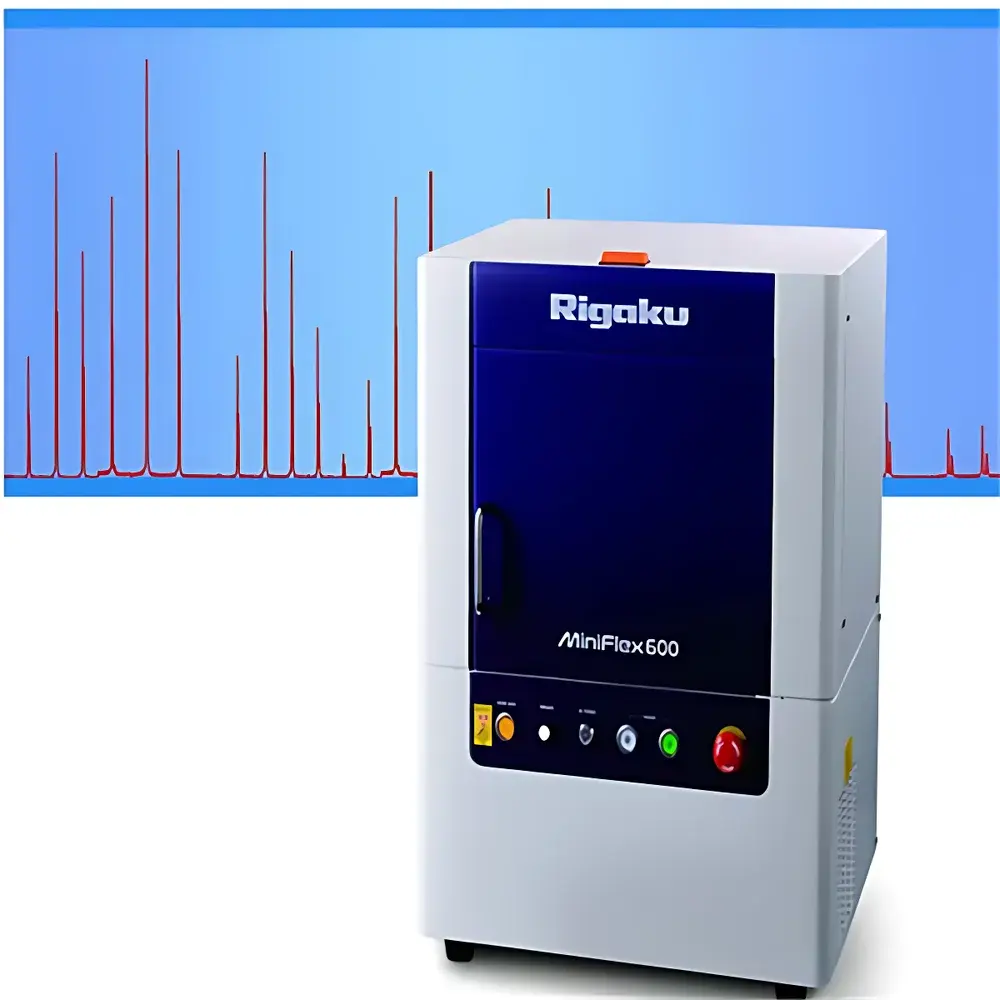
Rigaku Miniflex 600 Benchtop X-ray Diffractometer
| Brand | Rigaku |
|---|---|
| Origin | Japan |
| Model | Miniflex 600 |
| X-ray Tube Power | 600 W |
| Dimensions (W×H×D) | 560 × 700 × 395 mm |
| Weight | 80 kg |
| Goniometer Accuracy | ±0.01° 2θ |
| Safety | Interlocked X-ray shutter with automatic beam cutoff during sample loading |
| Detector | Standard scintillation counter |
| Sample Stage | Manual stage standard |
| Software Suite | PDXL (with ICDD PDF-4+ database), Qualitative & Quantitative Analysis modules, Multi-scan acquisition, Dust-specific quantification (e.g., respirable crystalline silica per ISO 16258-1, NIOSH 7500) |
Overview
The Rigaku Miniflex 600 is a compact, high-performance benchtop X-ray diffractometer engineered for precision phase identification, quantitative analysis, and crystallinity assessment across academic, industrial, and field-deployable environments. Based on Bragg’s law and conventional θ–2θ Bragg–Brentano geometry, the system employs a sealed-tube Cu Kα source (λ = 1.5418 Å) and a precision goniometer to deliver reproducible diffraction patterns from polycrystalline solids, thin films, powders, and bulk materials. With its 600 W X-ray tube output—significantly higher than the prior MiniFlex II (450 W)—the Miniflex 600 achieves improved signal-to-background (S/B) ratio and reduced acquisition times without compromising resolution or angular accuracy. Its fully enclosed, interlocked cabinet meets IEC 61010-1 and IEC 62471 safety standards, enabling safe operation in teaching labs, QC laboratories, and mobile analytical units without dedicated radiation shielding infrastructure.
Key Features
- Compact footprint (560 × 700 × 395 mm) and lightweight design (80 kg) facilitate installation in space-constrained labs, classrooms, or transportable analytical platforms.
- High-accuracy goniometer with ±0.01° 2θ repeatability and programmable variable divergence slits to optimize low-angle background suppression and high-angle intensity retention.
- Integrated safety architecture: X-ray emission automatically terminates upon door opening or sample stage access, compliant with ALARA principles and local radiation safety regulations.
- Modular hardware expansion: Supports optional accessories including a D/teX Ultra2 1D silicon strip detector (enabling rapid data collection with high dynamic range), rotating sample stage for preferred orientation mitigation, inert-atmosphere sample chamber, humidity-controlled stage for hygroscopic materials, and a 6-position automated sample changer for unattended batch analysis.
- Robust mechanical design with factory-aligned optics ensures long-term stability and minimal recalibration requirements—critical for longitudinal studies and GLP-compliant workflows.
Sample Compatibility & Compliance
The Miniflex 600 accommodates a broad range of sample forms—including pressed pellets, loose powders, thin films on substrates, and irregular solids—with minimal preparation. Optional stages enable analysis under controlled environmental conditions (e.g., nitrogen-purged, moisture-regulated, or vacuum-compatible configurations). The system complies with international regulatory frameworks relevant to materials characterization: ASTM E975 (standard practice for XRD phase analysis), ISO 17889-1 (crystalline silica quantification in airborne dust), and USP <467> (residual solvents in pharmaceuticals, when coupled with appropriate calibration protocols). Data integrity adheres to FDA 21 CFR Part 11 requirements through audit-trail-enabled software logging, electronic signatures, and secure user-access controls in PDXL.
Software & Data Management
Powered by Rigaku’s PDXL software suite, the Miniflex 600 delivers comprehensive data acquisition, processing, and reporting capabilities. Core modules include multi-scan acquisition for kinetic or temperature-resolved studies, full-pattern Rietveld refinement (via GSAS-II integration), semi-quantitative phase analysis using internal standardless methods (e.g., Reference Intensity Ratio), and advanced quantitative analysis with matrix correction (e.g., α-quartz in respirable dust per NIOSH Method 7500). The embedded ICDD PDF-4+ database (licensed separately) provides >1,000,000 reference patterns. All reports are exportable in PDF, CSV, and CIF formats; raw data conforms to NeXus/HDF5 standards for interoperability with third-party analysis tools.
Applications
- Academic research and undergraduate teaching: Hands-on crystallography instruction, phase evolution studies, and structure–property correlation projects.
- Industrial quality control: Raw material verification (e.g., polymorph screening in APIs), catalyst characterization, cement/clinker phase quantification (ASTM C1365), and corrosion product identification.
- Occupational health & environmental monitoring: Regulatory-grade quantification of crystalline silica (quartz, cristobalite, tridymite) in workplace dust samples per ISO 16258-1 and OSHA ID-142.
- Field-deployable analysis: On-site mineralogical screening in geotechnical surveys, archaeometric provenance studies, and cultural heritage conservation.
- Failure analysis laboratories: Identification of unexpected phases in fractured components, heat-affected zones, or coating delamination interfaces.
FAQ
Is the Miniflex 600 suitable for regulatory submissions in pharmaceutical or occupational health contexts?
Yes—when operated with validated methods, calibrated standards, and Part 11–compliant PDXL configuration, it supports data packages for FDA, EMA, and OSHA submissions.
Can the system perform Rietveld refinement out-of-the-box?
PDXL includes basic Rietveld functionality; full-profile refinement with constraints and microstructural modeling requires optional GSAS-II or TOPAS integration.
What is the minimum detectable crystallite size using the standard configuration?
Scherrer analysis sensitivity is typically ~3–5 nm for well-crystallized phases, dependent on instrumental broadening and data statistics.
Does the Miniflex 600 support non-Cu radiation sources?
No—the sealed-tube source is fixed at Cu Kα; alternative anodes (e.g., Co, Fe) are not supported in this platform.
Is remote operation or networked data acquisition possible?
Yes—PDXL supports Ethernet-based instrument control, centralized data archiving via network drives, and integration into LIMS environments via configurable API hooks.




