
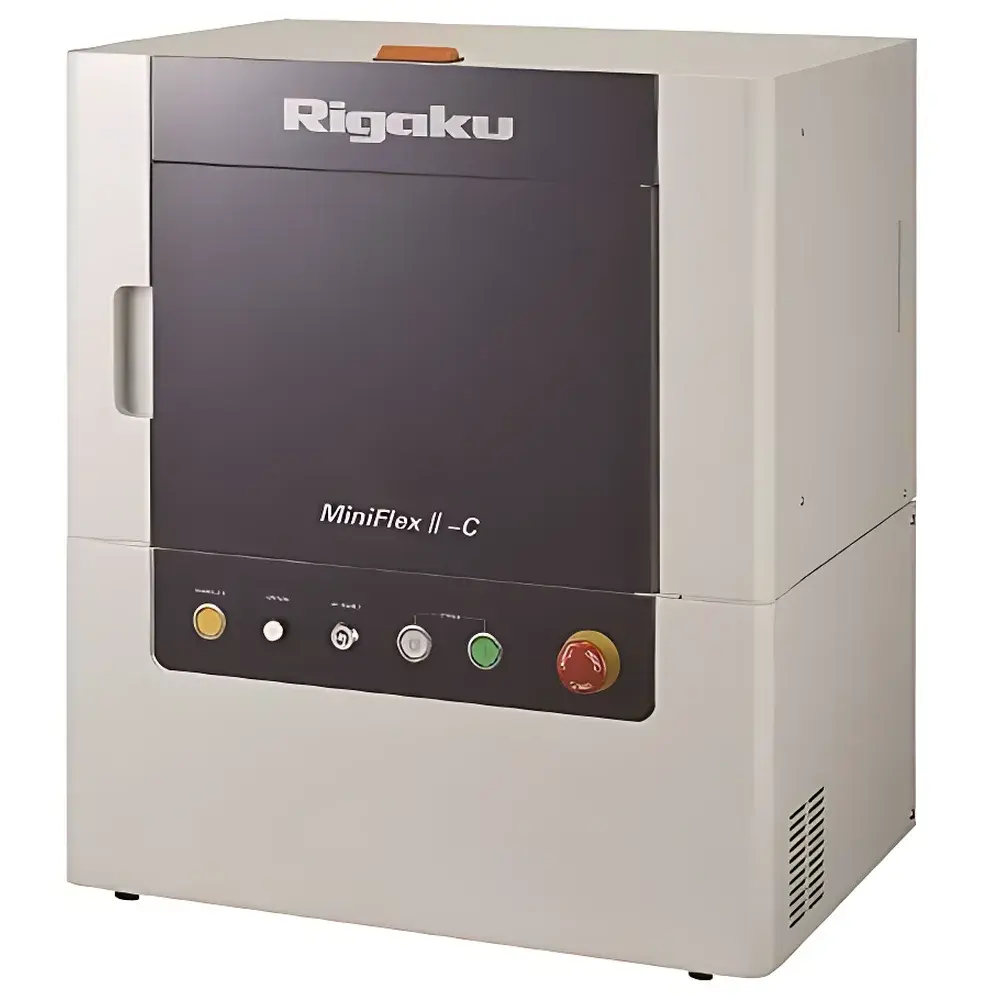
Rigaku MiniFlex600 Benchtop X-ray Diffractometer
| Brand | Rigaku |
|---|---|
| Origin | Japan |
| Model | MiniFlex600 |
| Instrument Type | Powder X-ray Diffractometer |
| Power Rating | 0.0001 kW |
| Dimensions | 560 W × 460 D × 700 H mm |
| Detector Type | Advanced Semiconductor Detector |
| Software Suite | PDXL (Phase Identification, Quantitative Analysis, Rietveld Refinement, Crystal Structure Visualization) |
Overview
The Rigaku MiniFlex600 is a compact, benchtop X-ray diffractometer engineered for high-precision powder X-ray diffraction (XRD) analysis in research laboratories, quality control environments, and educational institutions. Based on Bragg’s law and the principle of constructive interference of monochromatic X-rays scattered by crystalline lattice planes, the MiniFlex600 delivers robust phase identification, quantitative phase analysis (QPA), and semi-quantitative crystallinity assessment—without requiring floor-standing infrastructure or dedicated shielding rooms. Its integrated Cu Kα sealed-tube X-ray source (operating at fixed 40 kV / 15 mA) and high-efficiency silicon strip detector enable rapid data acquisition with excellent signal-to-noise ratio, supporting routine characterization of inorganic compounds, pharmaceuticals, catalysts, geological samples, and battery materials.
Key Features
- Benchtop footprint (560 × 460 × 700 mm) minimizes lab space requirements while maintaining mechanical stability and thermal isolation for long-term angular reproducibility.
- Advanced semiconductor detector with multi-channel pulse processing ensures high count-rate capability, low background noise, and sub-0.02° 2θ angular resolution across the full scan range (typically 5–80° 2θ).
- Fixed-anode Cu Kα X-ray source provides consistent wavelength output (λ = 1.5418 Å) and eliminates the complexity and maintenance overhead associated with rotating anodes or microfocus optics.
- Motorized goniometer with precision stepper-driven θ–2θ scanning architecture enables programmable step-scan or continuous-scan modes, with angular accuracy traceable to NIST-certified reference standards (e.g., NIST SRM 640e Si).
- Integrated collimation system and automatic beam divergence slits optimize intensity and resolution trade-offs per application, conforming to ISO 17873:2014 guidelines for XRD instrument calibration and performance verification.
Sample Compatibility & Compliance
The MiniFlex600 accommodates standard 25 mm diameter powder sample holders (including zero-background silicon or glass substrates), capillary tubes (0.3–1.0 mm ID), and thin-film specimens via optional sample stage accessories. It supports both front- and back-reflection geometries for preferred orientation mitigation and texture analysis. All operational parameters—including tube voltage, current, scan speed, and step size—are configurable within regulatory-compliant workflows. The system meets IEC 61010-1 safety requirements for laboratory electrical equipment and complies with local radiation safety regulations when installed with standard lead-lined housing and interlocked shutter mechanisms. Data acquisition and reporting modules support audit-trail generation aligned with GLP and GMP documentation practices, including user authentication, timestamped metadata, and raw data immutability.
Software & Data Management
PDXL software (v3.x or later) serves as the unified platform for instrument control, real-time visualization, and advanced XRD data interpretation. It includes embedded ICDD PDF-4+ database (2023 edition) for automated phase identification using search-match algorithms compliant with ASTM E1420 and ISO 13126-2. Quantitative analysis employs Rietveld refinement (via TOPAS engine integration), internal standard methods, and reference intensity ratio (RIR) approaches validated against ISO 21379:2020. All reports are exportable in PDF, CSV, and CIF formats; raw .raw and .xy files retain full metadata (scan parameters, calibration offsets, detector gain settings) for third-party reprocessing. Software installation adheres to FDA 21 CFR Part 11 requirements for electronic records and signatures when configured with role-based access control and electronic audit trails.
Applications
- Pharmaceutical solid-state characterization: polymorph screening, hydrate/anhydrate differentiation, excipient compatibility studies.
- Inorganic materials R&D: crystal structure solution and refinement, lattice parameter determination, strain and crystallite size analysis (Scherrer equation).
- Quality assurance in ceramics, cement, and metallurgical powders: phase purity verification, contaminant detection, sintering behavior monitoring.
- Academic teaching labs: hands-on instruction in crystallography fundamentals, Miller index assignment, and Bragg condition validation.
- Regulatory submissions: generation of XRD patterns meeting ICH Q5A(R2) and USP requirements for structural confirmation of active pharmaceutical ingredients.
FAQ
What is the minimum detectable crystallite size using the MiniFlex600?
The practical lower limit for crystallite size estimation via Scherrer analysis is approximately 3–5 nm, contingent upon sample homogeneity, instrumental broadening correction, and peak signal-to-noise ratio.
Can the MiniFlex600 perform in situ or time-resolved XRD measurements?
No—the MiniFlex600 is optimized for static, ambient-condition analysis. In situ heating/cooling stages or gas/liquid cells are not supported due to its sealed optical path and fixed geometry.
Is external calibration required before each measurement?
No—angular calibration is factory-performed using NIST-traceable Si standard; users may verify alignment quarterly using the included Si reference sample.
Does PDXL support batch processing of multiple XRD patterns?
Yes—automated workflow templates allow sequential processing of hundreds of scans for phase identification, peak intensity normalization, and crystallinity mapping.
What radiation safety certifications does the MiniFlex600 hold?
It carries CE marking per EU Directive 2014/30/EU (EMC) and 2014/35/EU (LVD), and complies with Japanese JIS Z 4901:2018 for X-ray equipment safety classification.





