
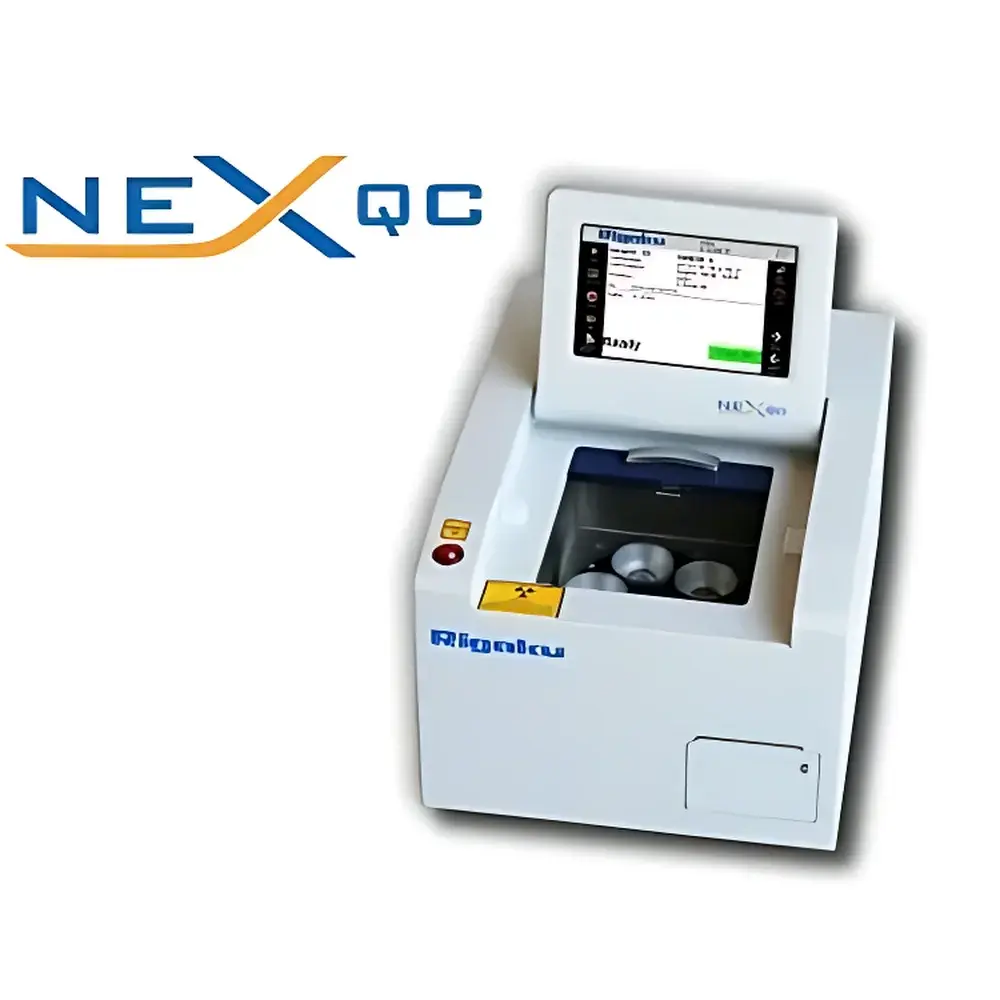
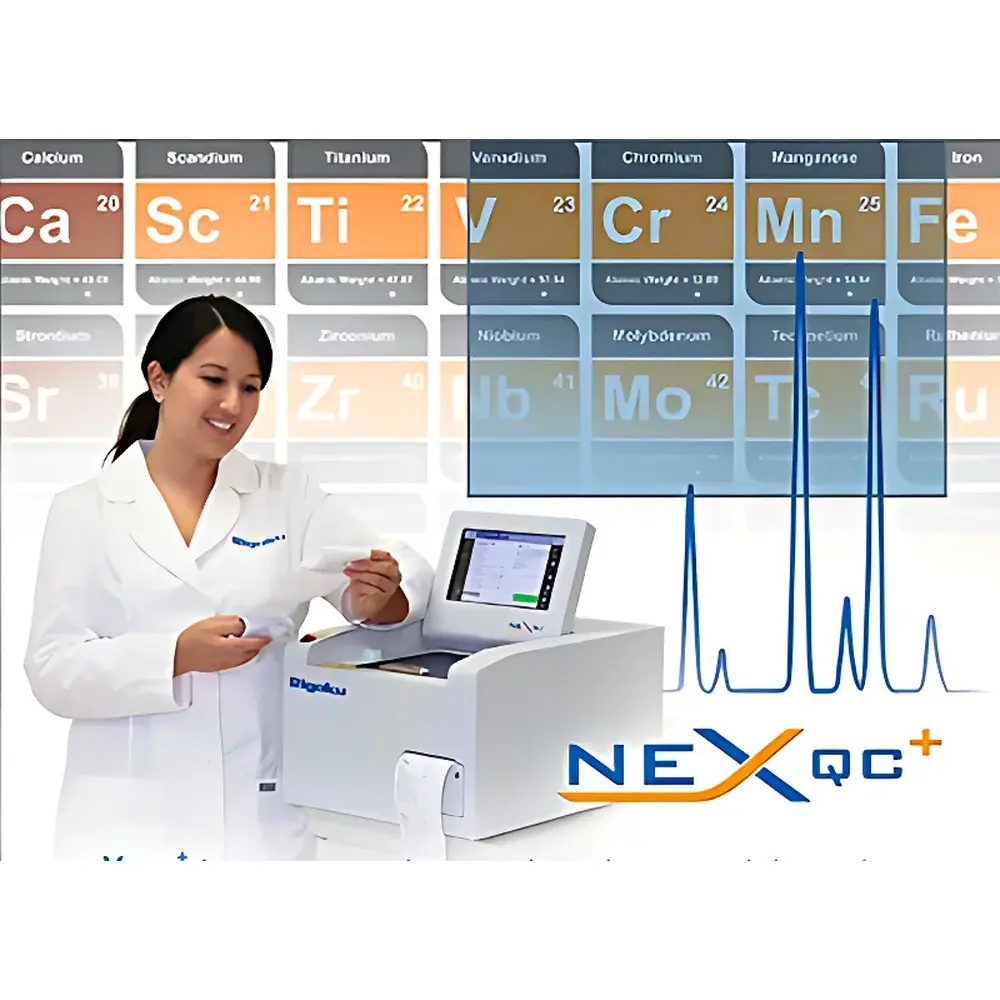
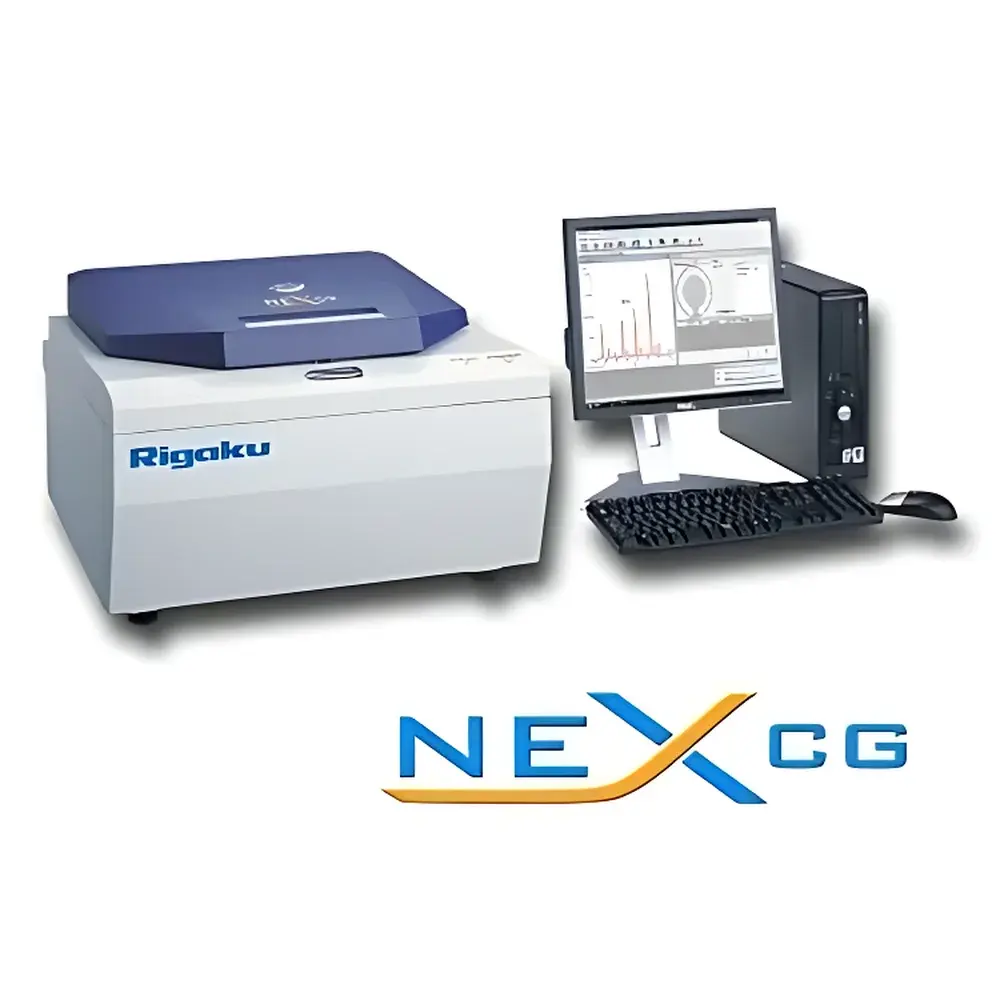
Rigaku NEX QC+ Energy Dispersive X-Ray Fluorescence Spectrometer
| Origin | USA |
|---|---|
| Manufacturer Type | Authorized Distributor |
| Origin Category | Imported |
| Model | NEX QC+ |
| Application Form Factor | Benchtop (Not Handheld) |
| Elemental Range | Na (11) to U (92) |
| Quantitative Range | 0.1 ppm to 100 wt% |
| Energy Resolution | ≤140 eV at Mn Kα |
| Short-Term Repeatability | ≤0.1% RSD (for major elements, 100 s counting) |
Overview
The Rigaku NEX QC+ is a benchtop energy dispersive X-ray fluorescence (EDXRF) spectrometer engineered for high-precision, non-destructive elemental analysis in quality control, incoming inspection, and routine laboratory environments. Operating on the fundamental principle of EDXRF—where primary X-rays from a high-power microfocus tube excite characteristic secondary (fluorescent) X-rays from sample atoms—the instrument detects and resolves emitted photons using a Peltier-cooled silicon drift detector (SDD). This architecture enables simultaneous multi-element detection without mechanical scanning, delivering rapid qualitative and quantitative results with minimal sample preparation. Unlike handheld systems, the NEX QC+ is a fixed-position, vibration-stable benchtop platform optimized for reproducibility, regulatory compliance, and long-term calibration stability—making it suitable for GLP/GMP-aligned workflows where auditability and data integrity are mandatory.
Key Features
- 50 kV, 1 mA high-stability X-ray tube with selectable automatic filter set (Al, Ti, Cu, Mo, Ag) to optimize excitation efficiency across light to heavy elements;
- Peltier-cooled silicon drift detector (SDD) with ≤140 eV energy resolution at Mn Kα (5.89 keV), ensuring clear peak separation for overlapping transitions (e.g., S Kα/Pb Mα, Cl Kα/Ca Kβ);
- “Icon-driven” capacitive touchscreen interface modeled on modern industrial HMI standards—no keyboard or mouse required; all method setup, acquisition, and reporting performed via intuitive graphical workflow;
- Built-in thermal line printer for immediate hardcopy output of spectra, calibration reports, and pass/fail certificates—fully traceable and timestamped;
- Integrated hardware shutter and beam collimation system for precise irradiation area control (standard 10 mm Ø, optional 3 mm Ø);
- Robust mechanical design with temperature-compensated optical path and sealed detector chamber—enabling stable operation under ambient lab conditions (15–30 °C, <80% RH, non-condensing);
- Compliance-ready architecture supporting 21 CFR Part 11–compliant user access control, electronic signatures, and full audit trail logging when paired with optional Rigaku QuantExpress software.
Sample Compatibility & Compliance
The NEX QC+ accommodates solid blocks, pressed pellets, loose powders, liquid cells (with Mylar or polypropylene windows), thin films, and alloy coupons—without requiring conductive coating or vacuum evacuation. Its configurable sample chamber (100 × 100 × 60 mm W×D×H) accepts standard 32-mm or 40-mm sample cups, as well as custom fixtures. The system meets IEC 61000-6-3 (EMC) and IEC 61010-1 (safety) requirements. For regulated industries, it supports ASTM E1621 (EDXRF for RoHS screening), ISO 21043 (elemental analysis of polymers), and USP / (elemental impurities in pharmaceuticals) when configured with certified reference materials and validated methods. Optional helium purge kit reduces absorption of low-energy X-rays (<1 keV), extending reliable quantification down to sodium (Na, Z=11) in air-mode operation.
Software & Data Management
Rigaku’s QuantExpress software provides full spectral acquisition, peak deconvolution, matrix correction (fundamental parameters, FP), and statistical reporting. It includes pre-installed calibrations for common matrices (e.g., stainless steel, aluminum alloys, plastics, soils) and supports user-defined method development with internal standardization, scatter normalization, and inter-element correction algorithms. All raw spectra, processed results, and metadata (operator ID, timestamp, instrument conditions, calibration version) are stored in an encrypted SQLite database with automatic daily backup. Export options include CSV, PDF, XML, and ASTM E1347-compliant analytical data interchange format (ADIF). Audit trail records capture every parameter change, result override, and calibration event—meeting FDA and EU Annex 11 expectations for electronic records.
Applications
- Metals & Alloys: Rapid grade identification, positive material identification (PMI), and trace element verification per ASTM E2926 and ISO 17025;
- Electronics & RoHS Compliance: Screening for Pb, Cd, Hg, Cr(VI), Br (as PBB/PBDE), and other restricted substances in PCBs, connectors, and solder;
- Geosciences & Mining: Bulk geochemical analysis of exploration samples, core logging support, and ore grade estimation;
- Polymers & Consumer Goods: Halogen screening, catalyst residue monitoring (e.g., Ti, Co, Ni in polyolefins), and filler composition (CaCO₃, TiO₂, talc);
- Pharmaceuticals & Catalysts: Quantification of residual metals (Pt, Pd, Rh, Ni) in APIs and excipients per ICH Q2(R2) and USP guidelines;
- Environmental: Analysis of contaminated soils, sediments, and fly ash for As, Se, Sb, and other EPA-regulated elements.
FAQ
Is the NEX QC+ a handheld instrument?
No. The NEX QC+ is a benchtop EDXRF spectrometer designed for laboratory-based, high-reproducibility analysis. It is not portable or battery-operated.
What is the minimum detectable limit (MDL) for sulfur in polymer samples?
Under helium purge and optimized conditions (1000 s live time, 3 mm collimation), MDL for S in polyethylene is typically ≤5 ppm (1σ, n=10). Actual LOD depends on matrix density, homogeneity, and surface roughness.
Does the system support ISO/IEC 17025 accreditation?
Yes—when operated with documented procedures, certified CRMs, and Rigaku’s QuantExpress software with audit trail enabled, the NEX QC+ meets technical requirements for ISO/IEC 17025:2017 clause 7.7 (uncertainty estimation) and 7.8 (reporting).
Can the instrument analyze liquids directly?
Yes—using a sealed liquid cell with 6-µm polymer window and gravity-fed or pipette loading. Viscosity and volatility must be controlled to prevent leakage or evaporation during measurement.
Is FP (Fundamental Parameters) quantification included as standard?
FP-based quantification is available as an optional software module (QuantExpress FP Pack), enabling matrix-independent analysis without empirical calibration curves.





