
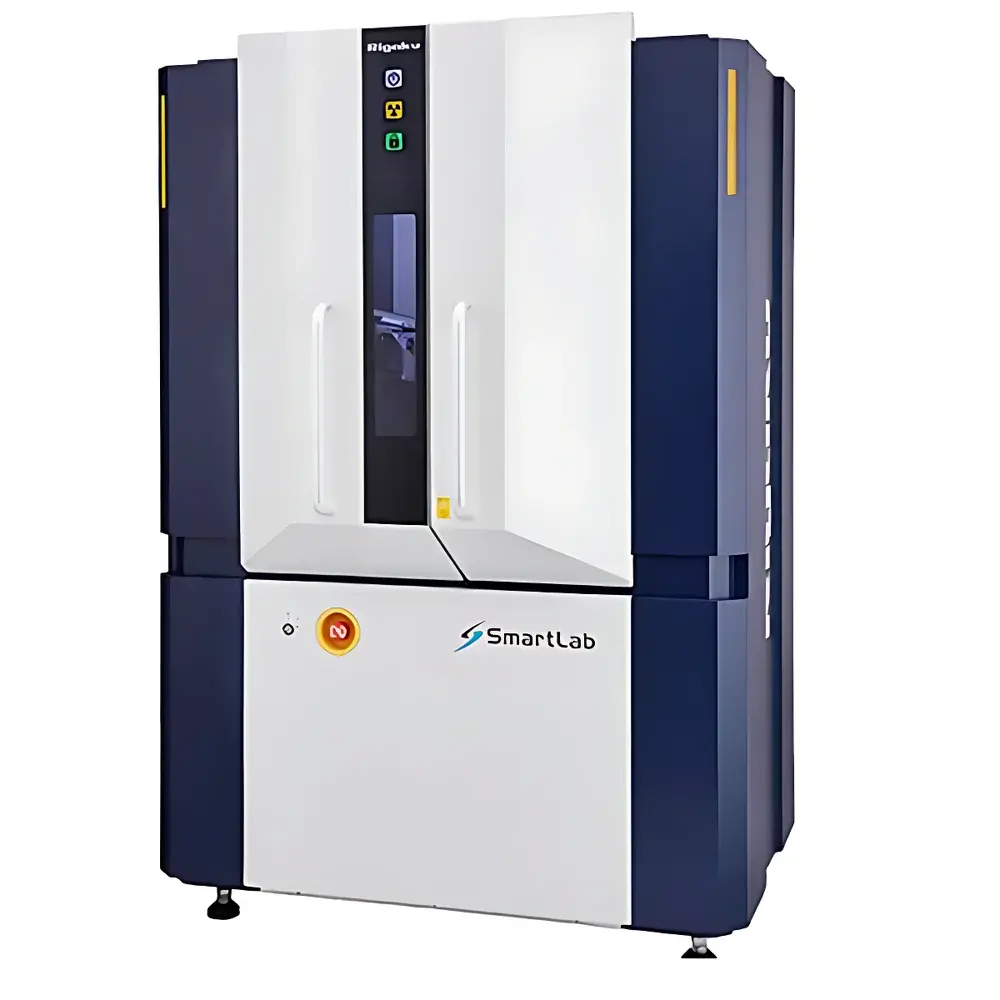
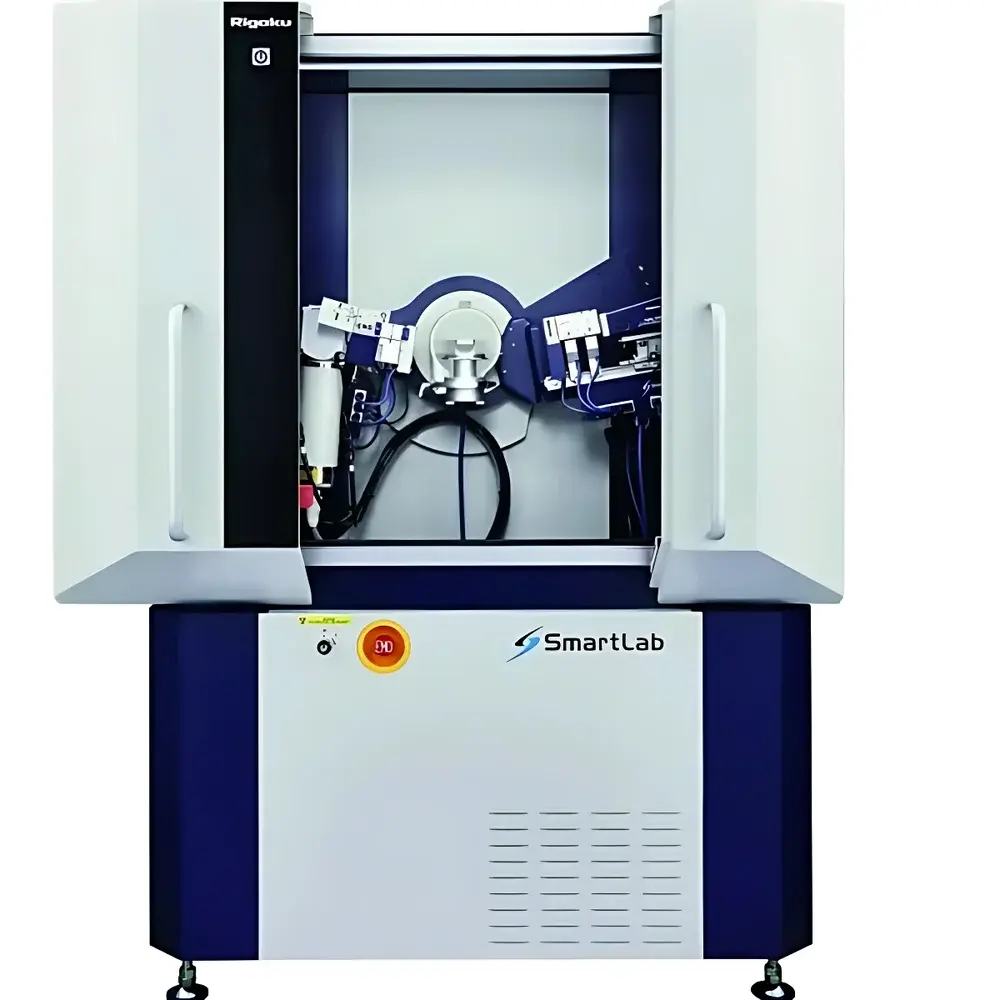
Rigaku SmartLab SE Powder X-ray Diffractometer
| Brand | Rigaku |
|---|---|
| Origin | Japan |
| Instrument Type | Powder X-ray Diffractometer |
| Model | SmartLab SE |
| X-ray Generator Power | 3 kW |
| Goniometer Radius Options | 185 mm (standard), 285 mm (optional), 280 mm (TTR configuration) |
| Optical Configurations | Automated切换 between Bragg-Brentano (focused beam) and parallel-beam geometries |
| Detector | Rigaku HyPix-400 or equivalent high-speed 2D photon-counting detector |
| Safety Enclosure | Interlocked, fail-safe shutter-equipped X-ray housing |
| Goniometer Orientation | Horizontal |
Overview
The Rigaku SmartLab SE is a high-performance, fully automated powder X-ray diffractometer engineered for precision phase identification, quantitative phase analysis (QPA), crystallite size and microstrain determination (via Williamson-Hall or Rietveld refinement), and thin-film characterization. It operates on the fundamental principle of Bragg’s Law (nλ = 2d sinθ), utilizing monochromatic Cu Kα radiation (λ = 1.5418 Å) generated by a sealed-tube 3 kW X-ray source. The instrument integrates a horizontal goniometer architecture—optimized for gravitational stability and minimal sample displacement during scanning—which significantly enhances measurement reproducibility for loose powders, layered materials, and anisotropic samples prone to preferred orientation. Its dual-optics capability enables seamless, software-controlled switching between Bragg-Brentano focusing geometry (for high-intensity, high-resolution bulk powder analysis) and parallel-beam optics (for thin films, multilayers, and grazing-incidence applications), eliminating manual realignment and reducing setup variability across experimental configurations.
Key Features
- Horizontal θ–θ goniometer with 185 mm standard radius (285 mm and 280 mm TTR options available), ensuring mechanical rigidity and thermal stability over extended scan durations.
- Patented automatic slit adjustment mechanism: dynamically optimizes divergence, scatter, and receiving slits in real time based on scan parameters and sample type—maintaining optimal intensity-to-resolution balance without user intervention.
- Self-calibrating X-ray optical path alignment: integrated laser reference system and motorized mirror stages enable fully automated optical centering and collimation verification prior to each measurement sequence.
- Dual-beam optical architecture: programmable, motor-driven switching between crossed-beam (Bragg-Brentano) and parallel-beam configurations within a single measurement session—enabling hybrid workflows such as simultaneous bulk + surface analysis.
- Modular accessory compatibility: supports in situ heating stages (up to 1600 °C), humidity chambers, cryostats, stress/strain rigs, and capillary sample holders—all controlled via unified software interface with hardware interlock validation.
- Rigaku HyPix-400 2D photon-counting detector: delivers >99% counting efficiency at 8 keV, zero readout noise, and sub-millisecond frame rates—enabling rapid acquisition of full Debye-Scherrer rings and high-fidelity reciprocal-space mapping.
Sample Compatibility & Compliance
The SmartLab SE accommodates a broad range of solid-state samples including free-flowing powders, pressed pellets, sintered ceramics, metal alloys, pharmaceutical APIs and excipients, geological minerals, battery cathode/anode composites, and nanomaterials. Its horizontal sample stage minimizes sedimentation effects and enables consistent packing density for hygroscopic or low-density specimens. All operational modes comply with IEC 61000-6-3 (EMC), IEC 61000-6-4 (emissions), and ISO 20647:2020 (X-ray equipment safety requirements). The interlocked enclosure meets FDA 21 CFR Part 1020.40 and JIS Z 4901 standards for diagnostic and analytical X-ray systems. Data integrity protocols support GLP/GMP environments through audit-trail-enabled user authentication, electronic signatures, and secure data archiving per 21 CFR Part 11 guidelines.
Software & Data Management
Operation and analysis are unified under Rigaku’s SmartLab Studio II platform—a Windows-based application built on .NET Framework with role-based access control and configurable workflow templates. The software includes embedded Rietveld refinement (PDXL2 engine), whole-pattern fitting (WPF), crystallite size distribution modeling (Scherrer + Williamson-Hall), and amorphous halo deconvolution. Raw 2D detector images are automatically converted to 1D intensity-vs-2θ profiles with background subtraction, peak search, and phase matching against ICDD PDF-4+ database (licensed separately). All processing steps are logged with timestamped metadata, parameter sets, and version-controlled script history—ensuring full traceability for regulatory submissions and inter-laboratory comparison studies.
Applications
- Pharmaceutical solid-form screening: polymorph identification, hydrate/solvate differentiation, and stability-indicating assay development per ICH Q5A and Q6A.
- Materials science: lattice parameter refinement of doped oxides, texture analysis of rolled metals, and in situ phase evolution monitoring during thermal cycling.
- Geosciences: quantitative clay mineralogy (e.g., smectite/illite ratio), provenance fingerprinting via trace-phase detection, and diagenetic reaction kinetics.
- Battery R&D: cathode structural degradation tracking (e.g., layered-to-spinel transition in NMC), SEI layer composition inference, and lithium-ion diffusion pathway modeling.
- Quality control laboratories: raw material identity verification, batch-to-batch crystallinity assessment, and counterfeit detection in generic drug manufacturing.
FAQ
What X-ray tube options are supported on the SmartLab SE?
The system is factory-configured with a 3 kW sealed-tube Cu anode source; optional Mo, Co, Cr, and Fe tubes are available for specialized wavelength requirements.
Is the SmartLab SE compliant with FDA 21 CFR Part 11 for regulated environments?
Yes—when deployed with SmartLab Studio II in validated mode, it provides electronic signature enforcement, audit trail generation, and secure user-role management required for pharmaceutical and medical device QA/QC.
Can the instrument perform in situ experiments under controlled atmosphere?
Yes—through integration with Rigaku’s Atmosphere Control Unit (ACU) or third-party gas-handling modules, enabling reactive-gas (e.g., H₂, O₂, CO₂) or inert-atmosphere measurements up to 1000 °C.
How does the automatic optical alignment reduce measurement uncertainty?
By eliminating manual centering errors and drift-induced misalignment, the system maintains angular accuracy within ±0.005° 2θ across the full 5–140° 2θ range—critical for precise lattice parameter determination.
What file formats are supported for data export and third-party analysis?
Raw and processed data are exportable in ASCII (.xy), CIF, GSAS, FullProf, and Bruker RAW v4 formats—ensuring compatibility with TOPAS, MAUD, and DIFFRAC.SUITE software ecosystems.
Related Products




