
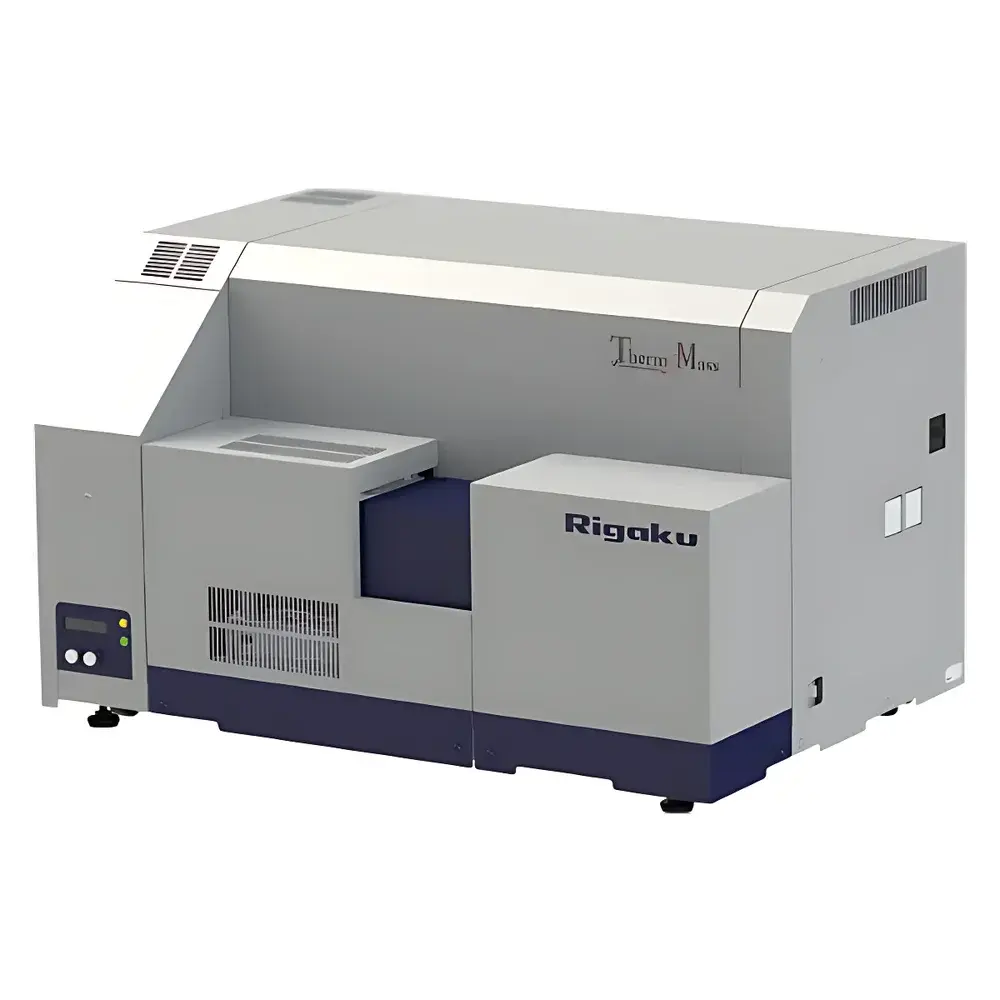
Rigaku Thermo Mass Thermal Gravimetric Analysis–Mass Spectrometry Coupled System
| Brand | Rigaku |
|---|---|
| Origin | Japan |
| Model | Thermo Mass |
| Coupling Type | TGA-MS |
| Mass Range | up to m/z 400 |
| Ionization Method | Fragment-Free Photoionization |
| Interface Technology | Patented Skimmer Interface |
| Real-Time Synchronization | Quadruple Concurrent Measurement (TGA, DTG, MS Total Ion Current, Selected Ion Monitoring) |
| Compliance | Designed for ISO 11358, ASTM E1131, and USP <621> thermal analysis workflows |
Overview
The Rigaku Thermo Mass is a fully integrated thermal gravimetric analysis–mass spectrometry (TGA-MS) coupled system engineered for high-fidelity, real-time correlation between mass loss events and evolved gas composition. Unlike conventional sequential or loosely coupled setups, this instrument employs a proprietary skimmer-based interface that maintains thermal and vacuum integrity between the TGA furnace and the quadrupole mass spectrometer. The system operates on the principle of simultaneous thermogravimetric monitoring—measuring sample mass change as a function of temperature or time—while concurrently acquiring mass spectral data from evolved gases via soft, fragment-free photoionization. This enables unambiguous assignment of decomposition steps, identification of trace volatiles (including H₂, CH₄, CO, H₂O, and organic fragments), and quantification of low-abundance species down to sub-nanogram levels under controlled heating rates (0.1–100 °C/min) and atmospheres (inert, oxidative, or reactive gas environments).
Key Features
- Patented skimmer interface ensures minimal thermal lag and eliminates condensation artifacts during gas transfer from furnace to ion source
- Fragment-free vacuum ultraviolet (VUV) photoionization source (typically 10.0–10.6 eV) preserves molecular ion integrity—critical for distinguishing isomers and identifying hydrogen-containing species such as H₂, NH₃, and H₂S without fragmentation bias
- Real-time quadruple concurrent data acquisition: synchronized TGA mass signal, derivative thermogravimetry (DTG), total ion current (TIC), and user-defined selected ion monitoring (SIM) channels
- Mass range extends to m/z 400 with unit mass resolution, supporting detection of heavy organics, metal carbonyls, and halogenated compounds relevant to polymer degradation, catalyst deactivation, and battery electrolyte stability studies
- Modular furnace design accommodates standard TGA pans (Pt, Al₂O₃, ceramic) and optional high-temperature crucibles (up to 1100 °C), with precise temperature calibration traceable to NIST SRM standards
- Rugged, all-metal vacuum architecture with turbomolecular pumping achieves base pressure <5×10⁻⁸ mbar, ensuring signal stability and low background noise during long-duration experiments
Sample Compatibility & Compliance
The Thermo Mass supports solid, powder, thin-film, and fiber samples weighing 0.1–100 mg, with compatibility across inorganic oxides, pharmaceuticals, polymers, composites, and energy materials. It meets essential regulatory and quality framework requirements for laboratory use: temperature control accuracy conforms to ASTM E1131–22 (Standard Test Method for Thermal Gravimetric Analysis of Reactive Chemicals); mass calibration adheres to ISO/IEC 17025–2017 metrological traceability protocols; and raw data handling—including timestamps, instrument parameters, and audit trails—is structured to support GLP and GMP environments. Optional 21 CFR Part 11-compliant software modules provide electronic signatures, role-based access control, and immutable data archiving for regulated industries.
Software & Data Management
Rigaku’s ThermoAnalysis Suite provides unified control of both TGA and MS subsystems through a single GUI. It enables method-driven experiment definition (ramp/hold/isothermal profiles, gas switching sequences, SIM target lists), automated baseline correction, and multi-dimensional peak deconvolution using built-in spectral libraries (NIST MS Search, Wiley Registry). All acquired datasets are stored in vendor-neutral HDF5 format, facilitating third-party integration with MATLAB, Python (via h5py), or LIMS platforms. Export options include CSV, ASCII, and XML schemas compliant with ASTM E1447–21 for interlaboratory data exchange. Audit logs record every parameter change, user login, and calibration event—fully searchable and exportable for internal QA review or external inspection.
Applications
- Pharmaceutical solid-state characterization: dehydration, solvate loss, polymorphic transitions, and excipient–API incompatibility screening
- Advanced battery research: electrolyte decomposition onset, SEI layer formation, cathode oxygen release, and transition metal volatility under thermal abuse conditions
- Carbon capture material evaluation: CO₂ adsorption/desorption kinetics, amine leaching, and thermal stability of MOFs and zeolites
- Polymer processing safety: identification of volatile organic compounds (VOCs) and toxic pyrolysis products (e.g., HCN, phosgene precursors) during extrusion or molding
- Geochemical and catalytic studies: mineral dehydration, clay dehydroxylation, coke burn-off profiling, and sulfur speciation in hydrodesulfurization catalysts
FAQ
What is the maximum operating temperature of the TGA furnace?
The standard configuration supports continuous operation up to 1100 °C with ±0.5 °C temperature uniformity across the sample zone.
Can the system detect hydrogen gas quantitatively?
Yes—using the m/z = 2 channel with optimized electron multiplier gain and background subtraction algorithms, detection limits for H₂ are typically <100 ppm in carrier gas streams.
Is the photoionization source replaceable in the field?
The VUV lamp module is designed for tool-free replacement and requires no realignment; average service life exceeds 5,000 hours.
Does the system support reactive gas environments such as NO₂ or Cl₂?
With appropriate corrosion-resistant interface components and mass spectrometer tuning, reactive gas analysis is supported per application-specific validation protocols.
How is data synchronization between TGA and MS ensured at the hardware level?
A shared master clock distributes timing signals to both subsystems; all analog and digital acquisitions are triggered and timestamped with ≤100 ns jitter, enabling sub-second event correlation.



