
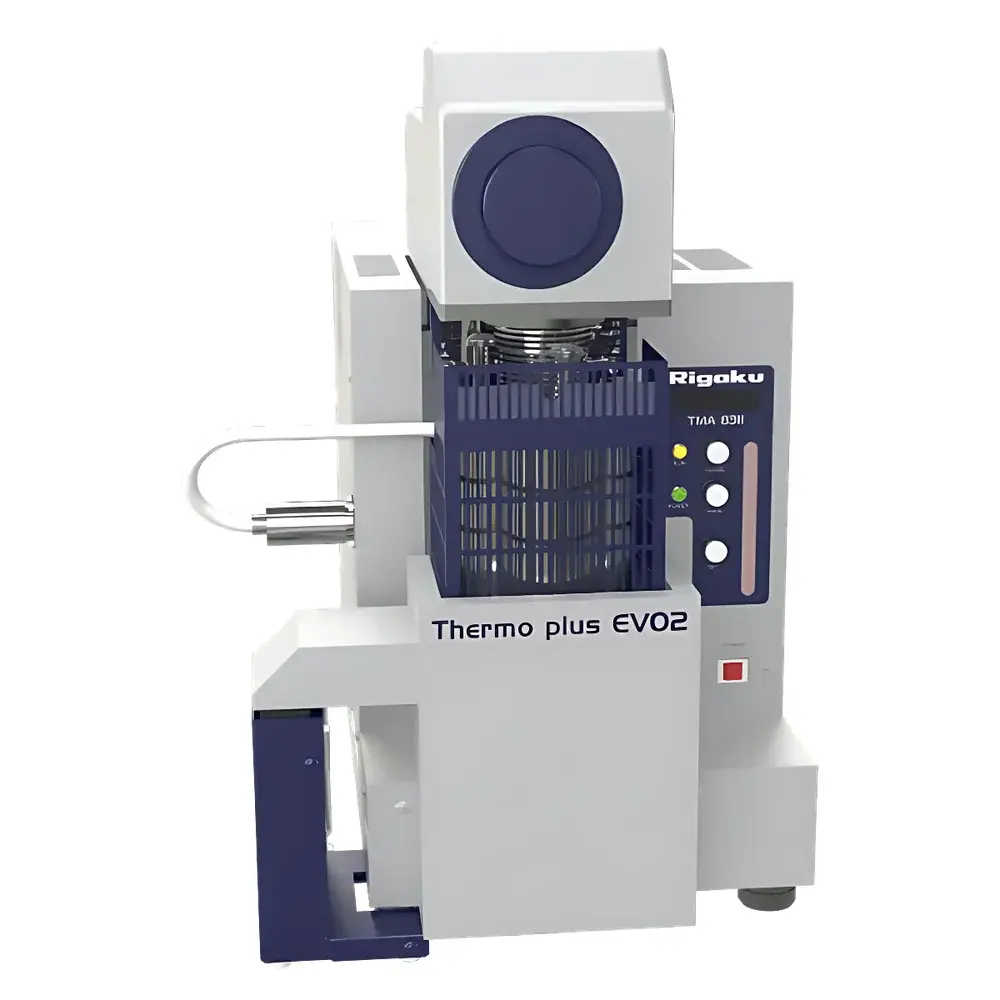
Rigaku TMA8311 Thermomechanical Analyzer
| Brand | Rigaku |
|---|---|
| Origin | Japan |
| Model | TMA8311 |
| Maximum Measurement Temperature | 1500 °C |
| Measurement Principle | Dual-rod Differential Dilatometry |
| Instrument Type | Thermomechanical Analyzer (TMA) |
Overview
The Rigaku TMA8311 Thermomechanical Analyzer is a high-precision, dual-rod differential dilatometer engineered for quantitative measurement of dimensional changes in solid and semi-crystalline materials as a function of temperature under controlled mechanical load. It operates on the principle of differential thermal expansion detection—using two identical, thermally symmetric probe rods (one contacting the sample, the other serving as a reference) to actively cancel out instrumental thermal drift. This architecture eliminates systematic errors arising from thermal expansion/contraction of the measurement mechanism itself, enabling reliable detection of minute dimensional changes—even in low-expansion ceramics, refractory metals, or sub-millimeter polymer specimens. Designed for laboratory environments requiring traceable, reproducible thermal expansion data, the TMA8311 supports continuous heating and cooling scans from ambient to 1500 °C with programmable ramp rates, dwell times, and dynamic load profiles.
Key Features
- Dual-rod differential dilatometry system with matched quartz or alumina probe assemblies, minimizing zero-drift and enhancing baseline stability over extended thermal cycles.
- High-temperature furnace with optimized thermal uniformity zone (±1 °C over 25 mm length) and inert atmosphere compatibility (N₂, Ar, He) up to 1500 °C.
- Programmable static and dynamic force application (0.01–1.0 N range), enabling both expansion coefficient (CTE) determination and softening point analysis under defined mechanical stress.
- Integrated high-resolution linear variable differential transformer (LVDT) displacement sensor with sub-nanometer resolution and <0.1 µm repeatability.
- Modular sample holder design accommodating rods, discs, fibers, and thin films; compatible with standard ISO 11359-2 and ASTM E831 geometries.
- Robust mechanical architecture with low-thermal-conductivity support structure and active thermal shielding to suppress convection-induced artifacts.
Sample Compatibility & Compliance
The TMA8311 accommodates a broad spectrum of solid-state materials—including oxide and non-oxide ceramics, metallic alloys, carbon composites, glass-ceramics, and high-performance polymers—with minimal sample preparation requirements. Rod-shaped specimens (diameter 2–6 mm, length 10–25 mm) are preferred, though disc and fiber configurations are supported via optional fixtures. All measurements comply with international standards governing thermal expansion characterization: ISO 11359-2 (Plastics — Thermomechanical Analysis), ASTM E831 (Linear Thermal Expansion of Solid Materials by Thermomechanical Analysis), and ASTM D696 (Coefficient of Linear Expansion of Plastics). The instrument’s thermal calibration traceability follows NIST-traceable reference materials (e.g., fused silica, α-alumina, Invar), and its mechanical calibration adheres to ISO 9001-certified procedures. For regulated environments, audit trail functionality and user access control can be configured to meet GLP and FDA 21 CFR Part 11 requirements when integrated with compliant LIMS or data management software.
Software & Data Management
Control and analysis are performed via Rigaku’s proprietary TMA Control Suite, a Windows-based application supporting real-time visualization, multi-segment temperature programming, and automated CTE calculation across user-defined intervals. Raw displacement vs. temperature data are exported in ASCII or CSV format for third-party statistical or modeling workflows. The software includes built-in validation tools for baseline correction, drift compensation, and outlier detection based on statistical deviation thresholds. All measurement parameters—including furnace setpoints, load profiles, sensor gain settings, and environmental conditions—are time-stamped and stored with each dataset. Optional modules enable advanced analysis such as viscoelastic transition mapping (α, β relaxations), creep compliance modeling, and derivative-based inflection point detection for phase transition identification.
Applications
- Determination of linear coefficient of thermal expansion (CTE) for aerospace-grade superalloys and ceramic matrix composites used in turbine components.
- Characterization of glass transition (Tg) and softening behavior in amorphous thermoplastics and specialty glasses under controlled stress conditions.
- Interfacial thermal strain analysis in multilayer electronic packaging structures (e.g., die attach, underfill, substrate interfaces).
- Thermal stability assessment of battery electrode materials and solid electrolytes during charge/discharge cycling simulations.
- Validation of thermal aging effects in nuclear-grade graphite and SiC/SiC composites exposed to high-temperature irradiation environments.
- Quality control of sintered technical ceramics where residual porosity and grain boundary evolution directly impact dimensional stability.
FAQ
What types of samples are suitable for measurement on the TMA8311?
Solid, rigid, or semi-rigid specimens with stable geometry at elevated temperatures—such as metals, ceramics, polymers, composites, and glasses—are appropriate. Powders, liquids, and highly viscous melts require alternative techniques (e.g., DSC or rheometry).
Is atmospheric control available during testing?
Yes—the furnace chamber supports purge gas introduction (N₂, Ar, He) and optional vacuum operation down to 10⁻² mbar, critical for oxidation-sensitive materials or high-temperature stability studies.
How is thermal calibration verified?
Calibration uses certified reference materials with known CTE values (e.g., NIST SRM 736 fused silica) measured across multiple temperature ranges; results are documented per ISO/IEC 17025 guidelines.
Can the TMA8311 perform dynamic mechanical measurements?
No—it is a static/dynamic-load TMA, not a DMA. It applies constant or stepwise mechanical loads but does not impose oscillatory stress; for viscoelastic modulus vs. temperature, a dedicated dynamic mechanical analyzer is recommended.
What is the typical measurement uncertainty for CTE below 1000 °C?
Under optimized conditions (stable baseline, calibrated probe, homogeneous sample), relative standard uncertainty for CTE is ≤ ±2% for materials with α ≥ 1×10⁻⁶ K⁻¹, per ISO 11359-2 repeatability criteria.



