
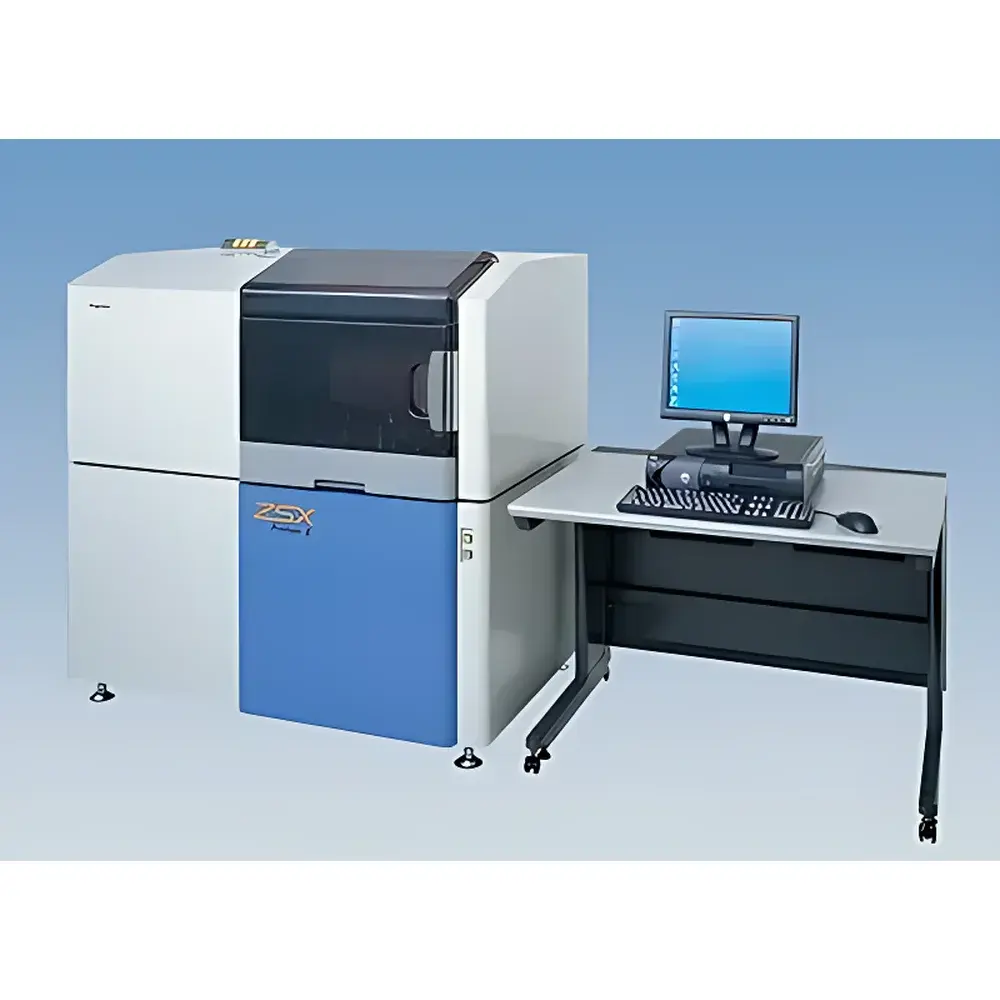
Rigaku ZSX Primus II Wavelength Dispersive X-Ray Fluorescence Spectrometer
| Brand | Rigaku |
|---|---|
| Origin | Japan |
| Model | ZSX Primus II |
| Excitation Source | End-window Rh-target X-ray tube (3 kW or 4 kW) |
| High-voltage Generator | High-frequency inverter type |
| Max. Output | 60 kV / 150 mA (4 kW) |
| Stability | ±0.005% (against ±10% AC line fluctuation) |
| Cooling | Integrated water-cooling system |
| Sample Changer Capacity | Up to 48 positions |
| Sample Dimensions | Ø51 mm × 40 mm (H) |
| Analyzed Area | Up to Ø35 mm |
| Sample Rotation | 30 rpm |
| Primary Beam Filters | Al, Ti, Cu, Zr (4-position auto-switch) |
| Collimators | 6 automatic apertures (Ø35, 30, 20, 10, 1, 0.5 mm) |
| Divergence Slits | 3 types (standard, high-resolution, ultra-light-element option) |
| Receiving Slits | SC and F-PC compatible |
| Goniometer | Independent θ–2θ drive |
| Angular Range | SC: 5°–118°, F-PC: 13°–148° |
| Max. Scan Speed | 1400°/min (2θ) |
| Continuous Scan Rate | 0.1–240°/min |
| Crystal Changer | 10-position auto-exchange |
| Standard Crystals | LiF(200), Ge, PET, RX25 |
| Optional Crystals | LiF(220), RX4, RX9, RX35–RX80, RX61F, TAP |
| Vacuum System | Dual-chamber rapid evacuation (dual-pump configuration) |
| Detectors | SC scintillation counter (1000 kcps linearity) for heavy elements |
| Pulse Height Analyzer (PHA) | Auto-adjustment (PAS, Rigaku patent) |
| F-PC Anode Wire Cleaning | Automatic thermal cleaning (ACC, Rigaku patent) |
| Optional Accessories | He purge module (with baffle), temperature-controlled sample stage (36.5 °C), CCD-based micro-imaging (100 µm resolution, 0.5 mm micro-area analysis & mapping), r-θ sample stage (Rigaku patent) |
| Software | NEW SQX (qualitative ID, background subtraction, smoothing, peak deconvolution, calibration curve method per JIS, matrix correction, standardless quantification, EZ-scan templates, auto-aperture selection, precision testing, email reporting, multi-standard management) |
| Compliance | Designed for GLP/GMP environments |
Overview
The Rigaku ZSX Primus II is a high-performance, top-illumination wavelength dispersive X-ray fluorescence (WDXRF) spectrometer engineered for precise elemental analysis across the full periodic table—from beryllium (Be, Z=4) to uranium (U, Z=92). Utilizing Bragg diffraction principles with precisely aligned analyzing crystals and mechanically synchronized goniometry, the instrument delivers exceptional spectral resolution and quantitative accuracy. Its dual-vacuum architecture—comprising independent sample and pre-evacuation chambers—ensures stable vacuum conditions critical for ultra-light element detection (e.g., B, C, N, O, F), while minimizing contamination risks during extended powder analysis. The system operates on a robust 4 kW Rh-target end-window X-ray tube with a 30 µm thin beryllium window, optimized for maximum photon flux in the low-energy region. Designed for routine laboratory deployment in industrial QC, R&D, and regulatory-compliant environments, the ZSX Primus II meets foundational requirements for traceability, repeatability, and long-term stability under ISO/IEC 17025 and ASTM E1361 frameworks.
Key Features
- Ultra-light element capability enabled by proprietary RX-series crystals (RX25, RX61, RX75) and APC (Automatic Pressure Control) vacuum regulation—ensuring consistent gas density and optimal F-PC detector response.
- Dual-pump vacuum system with dedicated sample and pre-pump chambers reduces particulate ingress during powder analysis and accelerates chamber evacuation cycles.
- CCD-assisted micro-analysis station with 100 µm positional resolution supports 0.5 mm micro-spot measurement and elemental mapping—validated under Rigaku’s patented optical alignment protocol.
- r-θ sample stage dynamically adjusts irradiation geometry to maintain uniform X-ray flux and crystal diffraction efficiency across heterogeneous or irregular samples.
- Automated maintenance subsystems—including PAS (Pulse Height Analyzer Self-Adjustment), ACC (Anode Wire Thermal Cleaning), and auto-aging diagnostics—reduce operator dependency and sustain analytical performance over thousands of hours.
- Energy-efficient operation via adaptive X-ray tube power modulation, PR-10 gas consumption optimization, and He purge scheduling—aligned with ISO 50001 energy management principles.
Sample Compatibility & Compliance
The ZSX Primus II accommodates solid blocks, pressed powders, fused beads, thin films, and homogeneous liquids without modification. Its top-illumination geometry eliminates cross-contamination between sample and optics—a key advantage over side-illumination systems in high-throughput metallurgical or cement labs. Optional helium purging enables reliable boron and carbon quantification at sub-ppm levels (down to 1×10⁻⁶ wt%), while the temperature-stabilized sample stage (36.5 °C) mitigates hygroscopic drift in volatile matrices. From a regulatory standpoint, the instrument’s firmware and NEW SQX software support role-based user authentication, full audit trails, electronic signatures, and data integrity controls compliant with FDA 21 CFR Part 11, EU Annex 11, and ICH-GCP guidelines. Routine verification protocols align with ASTM E1621 (WDXRF for metals), ISO 21043 (cement), and JIS Z 3211 (weld metal analysis).
Software & Data Management
NEW SQX is a modular, Windows-based application providing fully integrated acquisition, processing, and reporting workflows. Qualitative analysis employs automated peak identification with interference correction, background modeling, and iterative smoothing algorithms. Quantitative modules implement JIS-standard calibration curves, fundamental parameter (FP) matrix corrections, and standardless analysis validated against NIST SRMs. The software includes template-driven EZ-scan sequences, auto-aperture selection based on elemental mass, and real-time precision monitoring (RSD tracking per element). All raw spectra, processed results, instrument logs, and user actions are timestamped and stored in a relational database with configurable retention policies. Export options include CSV, PDF, XML, and LIMS-compatible ASTM E1382 format. Remote diagnostics and firmware updates are supported via encrypted TLS channels, with optional integration into enterprise SFTP or SharePoint repositories.
Applications
The ZSX Primus II serves as a primary analytical platform across multiple regulated sectors. In metallurgy, it performs grade identification and inclusion analysis for stainless steels, superalloys, and aluminum alloys per ASTM E406. In cement and ceramics, it quantifies SiO₂, Al₂O₃, Fe₂O₃, CaO, MgO, SO₃, and alkalis with <0.1% RSD at 1 wt% level. For electronics, it verifies solder composition (Pb, Sn, Ag, Cu), detects halogen contaminants (Cl, Br), and measures thin-film thicknesses using FP modeling. Environmental labs use it for soil and sediment screening (As, Cd, Cr, Pb, Hg) per EPA Method 6200, while petrochemical applications cover catalyst analysis (Ni, V, Fe, Na) and lubricant additive profiling. Geological laboratories rely on its wide dynamic range (0.0001–100 wt%) and light-element sensitivity for whole-rock geochemistry and rare-earth element partitioning studies.
FAQ
What is the minimum detection limit for boron using the ZSX Primus II?
Boron LOD is typically 0.2–0.5 ppm under optimized He-purge conditions with RX25 crystal and F-PC detection—dependent on matrix, counting time, and sample homogeneity.
Can the system analyze liquid samples without special preparation?
Yes—homogeneous liquids (e.g., oils, electrolytes) can be measured directly in quartz or PTFE cups; viscosity and volatility must remain within safe handling limits for the sample changer.
Is remote instrument monitoring supported out-of-the-box?
Yes—built-in Ethernet interface enables secure remote access for diagnostics, method transfer, and log review via Rigaku’s Remote Support Protocol (RSP), requiring no third-party VNC or RDP tools.
How does the r-θ stage improve measurement reproducibility?
By continuously rotating and radially adjusting the sample position, the r-θ stage ensures that the analyzed area remains centered under the primary beam and maintains constant take-off angle relative to the analyzing crystal—eliminating intensity variation caused by surface topography or grain orientation.
Does the software support compliance with ISO/IEC 17025 documentation requirements?
Yes—NEW SQX generates comprehensive analytical reports containing instrument parameters, calibration history, uncertainty estimates (per GUM), analyst ID, and digital signatures—all exportable in PDF/A-2 format for archival.
Related Products







