
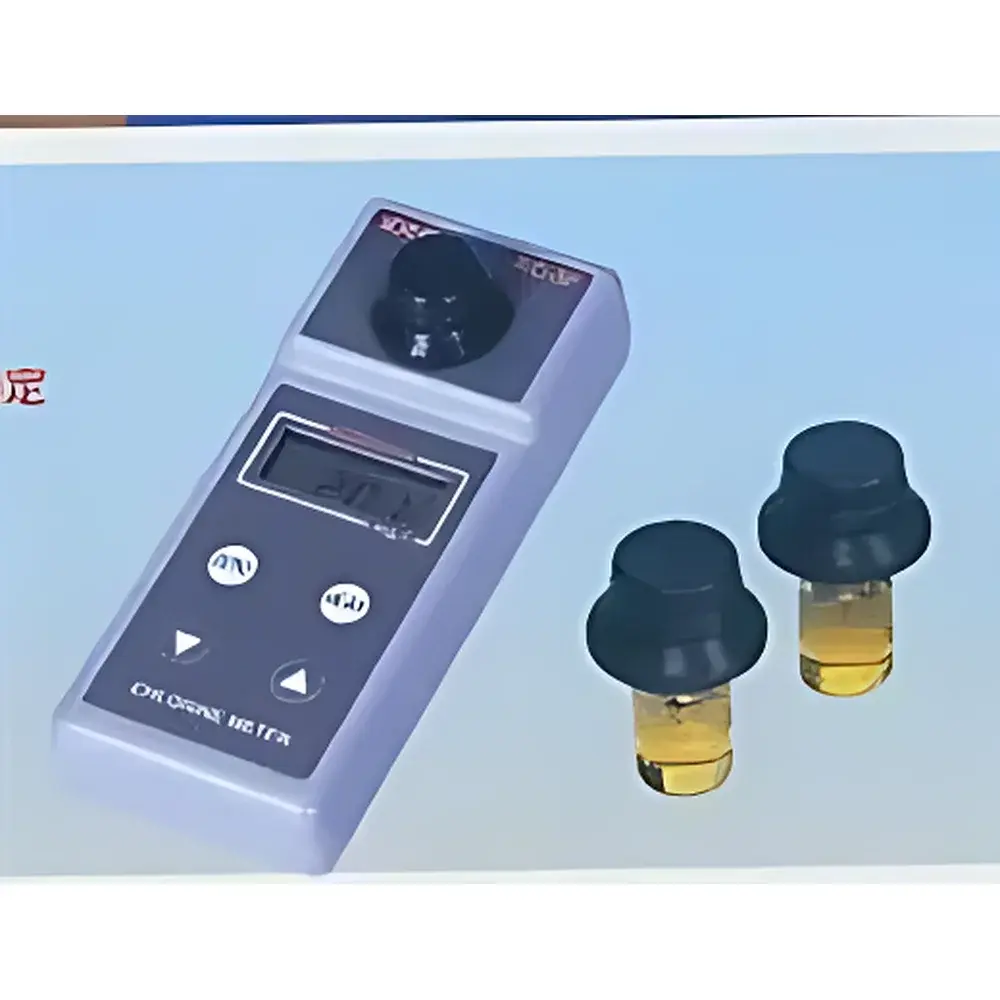
Rikari RC-3F High-Concentration Free Chlorine Analyzer
| Brand | Rikari |
|---|---|
| Origin | Japan |
| Model | RC-3F |
| Instrument Type | Portable |
| Measurement Principle | DPD Spectrophotometry |
| Measured Parameter | Free Chlorine (as Cl₂) |
| Range | 0–500 mg/L |
| Accuracy | ±2% of reading |
| Repeatability | ±2% RSD |
| Resolution | 1 mg/L |
| LOD | 1 mg/L |
| Power | 4 × AAA alkaline batteries (DC 6 V) |
| Operating Temperature | 5–35 °C |
| Dimensions | 75 × 180 × 38 mm (W × D × H) |
| Sample Volume | 5 mL |
| Reagent | HOCl-K-1 powder packet (single-use, pre-dosed) |
| Display | 3-digit LCD |
| Auto-off | 5 seconds after measurement |
| Hold function | Yes |
| Over-range alert | Flashing display above 550 mg/L |
Overview
The Rikari RC-3F High-Concentration Free Chlorine Analyzer is a dedicated portable photometer engineered for rapid, field-deployable quantification of free chlorine in highly concentrated disinfectant solutions—specifically sodium hypochlorite (NaOCl) dilutions and electrolytically generated hypochlorous acid (HOCl) water. Unlike conventional low-range residual chlorine meters designed for drinking water or swimming pool monitoring (typically 0–5 mg/L), the RC-3F operates on the standardized N,N-diethyl-p-phenylenediamine (DPD) spectrophotometric method optimized for high-concentration matrices where oxidation demand and matrix interference are elevated. It employs a stable LED light source centered at 515 nm and a calibrated silicon photodiode detector to measure absorbance changes induced by the DPD–free chlorine reaction, delivering traceable results compliant with ISO 7393-2 and APHA Standard Methods 4500-Cl G. Its optical architecture minimizes stray light and thermal drift, ensuring consistent performance across variable ambient conditions encountered in production floors, sanitation validation zones, and mobile QA/QC laboratories.
Key Features
- Optimized high-range detection: Linear response from 0 to 500 mg/L free chlorine (as Cl₂), eliminating need for manual dilution and associated error propagation.
- Two-button operation: Intuitive start-measure-hold workflow—no menu navigation or calibration sequence required prior to each test.
- Pre-formulated single-use reagent: HOCl-K-1 powder packets contain precisely dosed DPD and buffer components; no weighing, mixing, or stability concerns.
- Integrated sample handling: Includes two matched optical cuvettes with lids and a calibrated 5-mL transfer pipette—designed to minimize volume variability and cross-contamination.
- Low-power robust design: Operates on four standard AAA alkaline cells with >2,000 measurements per set; auto-power-off after 5 seconds conserves battery life without compromising usability.
- Environmental resilience: Validated for reliable operation between 5 °C and 35 °C, making it suitable for cold-chain sanitation verification and tropical processing environments alike.
Sample Compatibility & Compliance
The RC-3F is validated for use with clarified, non-turbid aqueous samples containing free chlorine as hypochlorous acid (HOCl) or hypochlorite ion (OCl⁻), including industrial-strength NaOCl solutions (e.g., 0.5–5% w/v), electrolyzed water (EW) generated via membrane or non-membrane electrochemical cells, and stabilized HOCl formulations. It is not intended for total chlorine or combined chlorine (chloramines) analysis. The instrument conforms to key regulatory expectations for disinfectant concentration verification in food safety and healthcare settings: its measurement protocol aligns with FDA Food Code Annex 4 (chlorine sanitizer concentration requirements), HACCP prerequisite programs, and ISO 22000 Clause 8.2.2 (monitoring of critical control points). While not a GLP-certified system, its fixed-wavelength optics, batch-traceable reagents, and built-in over-range warning support audit-ready documentation under GMP-aligned quality systems.
Software & Data Management
The RC-3F operates as a standalone hardware analyzer with no embedded software, Bluetooth, or data export capability—a deliberate design choice prioritizing operational simplicity, electromagnetic immunity, and compliance with cleanroom and explosion-proof zone restrictions. All measurement data remain on-device only during active display; no internal memory or timestamping is implemented. This architecture satisfies requirements where electronic record integrity is managed externally—e.g., when paired with paper-based logbooks signed per 21 CFR Part 11 Annex 11 principles, or when integrated into LIMS workflows via manual entry following SOP-defined transcription protocols. Reagent lot numbers (HOCl-K-1) are printed on each packet for full traceability to raw material certification and stability testing reports provided by Rikari.
Applications
- Food & beverage processing: Verification of sanitizing rinse concentrations for equipment contact surfaces (CIP final rinse), conveyor belts, and packaging lines—critical for dairy, meat, seafood, egg, and ready-to-eat vegetable facilities.
- Institutional hygiene management: Routine validation of chlorine levels in central kitchen, hospital ward, school cafeteria, and nursing home disinfection stations.
- Electrolytic disinfectant generation: Real-time output verification of on-site HOCl generators used in agricultural wash water, veterinary clinics, and pharmaceutical facility surface decontamination.
- Contract sanitation services: Field technicians use the RC-3F to document pre- and post-application chlorine concentrations during third-party validation audits.
- Regulatory readiness: Supports evidence generation for USDA-FSIS Directive 7120.1, EU Regulation (EC) No 852/2004 Annex II, and Japan’s Food Sanitation Law enforcement inspections.
FAQ
Does the RC-3F measure chlorine dioxide (ClO₂)?
No. Despite occasional misclassification in distribution channels, the RC-3F is analytically specific to free chlorine (HOCl/OCl⁻) via the DPD colorimetric reaction. It does not detect chlorine dioxide, which requires iodometric or amperometric methods per ASTM D1253 or ISO 10707.
Can I use generic DPD tablets instead of HOCl-K-1 packets?
No. The RC-3F’s optical calibration and reaction kinetics are validated exclusively with Rikari’s HOCl-K-1 formulation, which includes proprietary pH buffering and stabilizers optimized for high-concentration matrices. Substitution invalidates accuracy claims and voids metrological traceability.
Is temperature compensation automatic?
No. The instrument does not include a temperature sensor or algorithmic correction. Users must perform measurements within the specified 5–35 °C range and record ambient temperature manually if required for QA documentation.
What is the shelf life of HOCl-K-1 reagent packets?
Unopened HOCl-K-1 packets retain performance for 24 months when stored sealed at ≤25 °C and <60% RH. Each packet is individually foil-laminated to prevent moisture ingress and oxidative degradation.
How often should I verify instrument performance?
Rikari recommends daily verification using a freshly prepared 100 mg/L free chlorine standard (e.g., potassium permanganate–stabilized NaOCl reference solution) prior to routine use—consistent with ISO/IEC 17025 clause 7.7.1 for measurement traceability assurance.







