
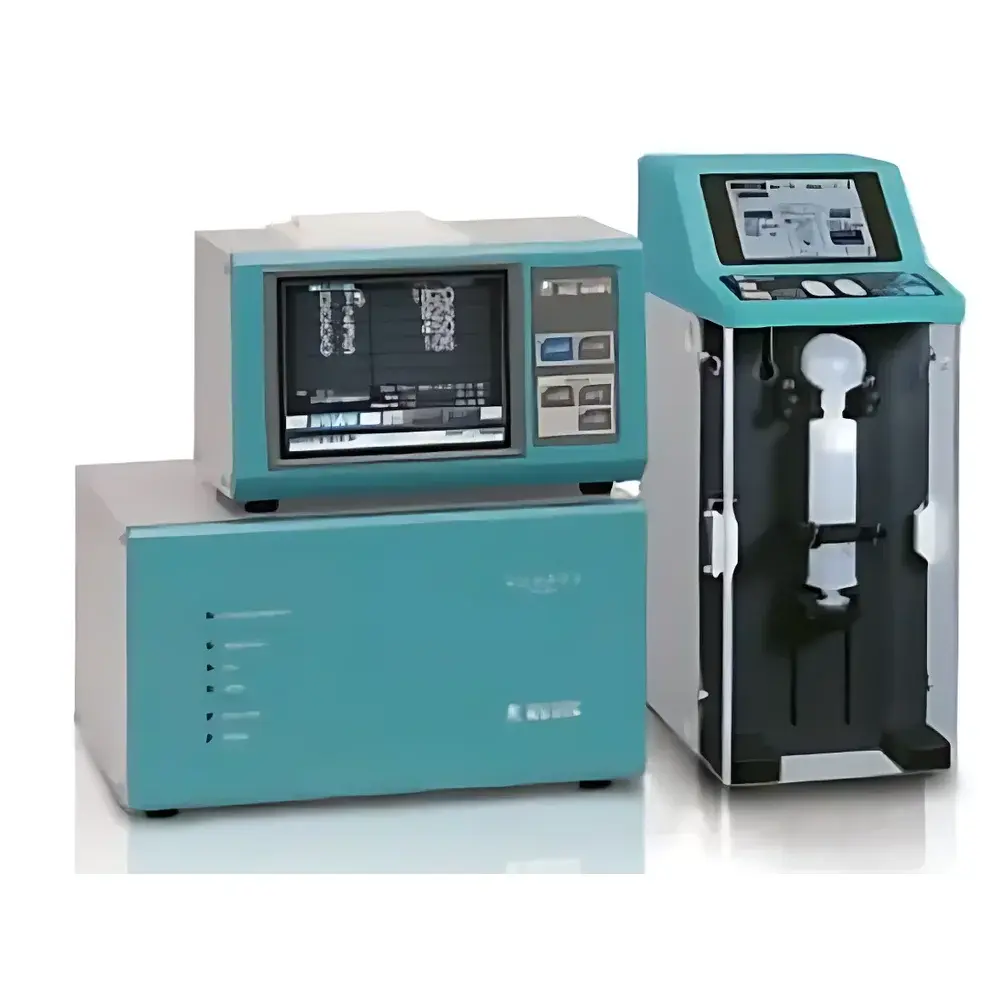
RION KE40B Liquid Particle Counter
| Brand | RION |
|---|---|
| Origin | Japan |
| Model | KE40B |
| Measurement Principle | Laser Light Scattering (830 nm Diode Laser, Class 1 per IEC 60825-1) |
| Detection Range | 0.15–0.5 µm (factory-configured 4-channel: 0.15 / 0.2 / 0.3 / 0.5 µm |
| Detection Efficiency | 50 ± 10% at 0.15 µm |
| Sample Flow Rate | 10 mL/min |
| Maximum Particle Concentration | 1,200 particles/mL (±5% accuracy for 0.15 µm particles) |
| Sample Pressure Limit | ≤300 kPa (gauge) |
| Wetted Materials | Quartz, PFA |
| Calibration Standard | PSL spheres (1.6 µm nominal) |
| Display Interface | Integrated resistive touch screen |
| Data Output | Built-in thermal printer + SD memory card storage |
| Communication | Direct interface with KE-40B1 controller (no external PC required) |
| Power Supply | DC 12 V (supplied by KE-40B1) |
| Operating Environment | 15–30 °C, ≤85% RH (non-condensing) |
| Dimensions (H×W×D) | 160 × 300 × 251 mm (excl. protrusions) |
| Weight | ~7.5 kg |
Overview
The RION KE40B Liquid Particle Counter is a precision-engineered optical particle counter designed for real-time, on-line or at-line monitoring of submicron particulate contamination in high-purity liquid systems. It operates on the principle of single-particle laser light scattering: a collimated 830 nm Class 1 laser diode (IEC 60825-1 compliant) illuminates individual particles suspended in the sample stream; scattered light is captured by a PIN photodiode detector and converted into pulse amplitude signals proportional to particle cross-sectional area. The instrument’s four factory-set detection thresholds—0.15, 0.2, 0.3, and 0.5 µm—are calibrated using traceable polystyrene latex (PSL) standards (1.6 µm reference), ensuring metrological consistency across installations. With a validated detection efficiency of 50 ± 10% at the 0.15 µm threshold and a maximum measurable concentration of 1,200 particles/mL (with <5% counting error at 0.15 µm), the KE40B meets stringent requirements for clean fluid qualification in semiconductor process chemicals, pharmaceutical water-for-injection (WFI), and biopharmaceutical final fill environments.
Key Features
- Class 1 laser safety compliance (IEC 60825-1) — no interlocks or operator training required for routine operation
- Chemically inert wetted path constructed entirely from quartz and perfluoroalkoxy (PFA), enabling compatibility with aggressive solvents, acids, and bases commonly used in microelectronics and API synthesis
- Integrated resistive touch-screen interface — eliminates dependency on external PCs and supports standalone operation with immediate access to real-time histograms, cumulative counts, and pass/fail status
- Modular channel architecture — base configuration supports 4 size thresholds; firmware-upgradable to 10 independent detection channels for granular distribution profiling
- On-board data management — thermal printer provides immediate hard-copy reports; SD card stores timestamped raw count data, system logs, and calibration records for audit readiness
- Leak detection circuitry — built-in continuity monitoring of internal fluidic seals; opens alarm contact upon breach to trigger PLC-integrated shutdown protocols
Sample Compatibility & Compliance
The KE40B accepts any liquid chemically compatible with quartz and PFA—including deionized water, ultrapure solvents (e.g., IPA, acetone), hydrogen peroxide solutions, and buffered saline formulations. It is not intended for use with suspensions containing abrasive solids, viscous oils (>5 cP), or gases. Its design aligns with critical regulatory expectations: the fixed 0.15 µm lower detection limit satisfies USP <788> and ISO 8573-4 requirements for particle monitoring in parenteral manufacturing; its traceable PSL calibration supports GLP/GMP documentation workflows; and its sealed optical path and non-volatile memory meet FDA 21 CFR Part 11 data integrity prerequisites when deployed with KE-40B1 controller logging.
Software & Data Management
The KE40B operates exclusively through the KE-40B1 host controller, which manages all hardware initialization, threshold configuration, and data aggregation. No third-party software installation is required. All measurement sessions are automatically stamped with date/time, operator ID (if configured), and system diagnostic flags. Raw count data (per channel, per second) is stored in CSV format on removable SD cards—structured for direct import into LIMS or statistical process control (SPC) platforms. Thermal printouts include batch ID, sampling duration, flow rate verification, and pass/fail determination against user-defined limits per ISO 14644-1 or internal SOPs. Audit trails—including calibration events and parameter changes—are retained for ≥12 months.
Applications
- Monitoring particle shedding in point-of-use filters for semiconductor CMP slurries and photoresist delivery lines
- Verification of filter integrity during WFI and purified water loop validation per EU GMP Annex 1
- Baseline contamination assessment of cleaning agents prior to wafer rinse steps
- In-process verification of nanofiltration membrane performance in monoclonal antibody purification skids
- Qualification of hydraulic fluids in aerospace test benches where sub-0.2 µm wear debris indicates early-stage component degradation
FAQ
What is the minimum detectable particle size, and how is detection efficiency verified?
The KE40B achieves a lower detection limit of 0.15 µm, with detection efficiency characterized at 50 ± 10% using NIST-traceable PSL standards. Efficiency validation is performed during factory calibration and may be repeated in-house using optional KS-42-123 verification kits.
Can the instrument operate continuously under pressure, and what is the maximum allowable backpressure?
Yes — the KE40B supports continuous pressurized flow up to 300 kPa (gauge). Inlet/outlet ports accept 2 mm OD × 4 mm OD tubing; Rc1/8 female threads enable integration with standard pneumatic manifolds and pressure regulators.
Is the touch-screen interface programmable for custom pass/fail logic?
No — the KE-40B1 controller executes fixed-count logic per channel. Custom rules (e.g., weighted scoring, trend-based alarms) require external SCADA or MES integration via analog/digital I/O outputs.
Does the unit require periodic recalibration, and what documentation is provided?
Annual recalibration against PSL standards is recommended. Each unit ships with a factory calibration certificate listing threshold voltages, background noise levels, and PSL response curves — fully compliant with ISO/IEC 17025 documentation requirements.
How is sample carryover mitigated between measurements?
An integrated gas purge circuit (Rc1/8 port) delivers dry nitrogen or compressed air to flush the quartz flow cell between runs, reducing residual particle retention to <0.1% as verified per ASTM F328.



