
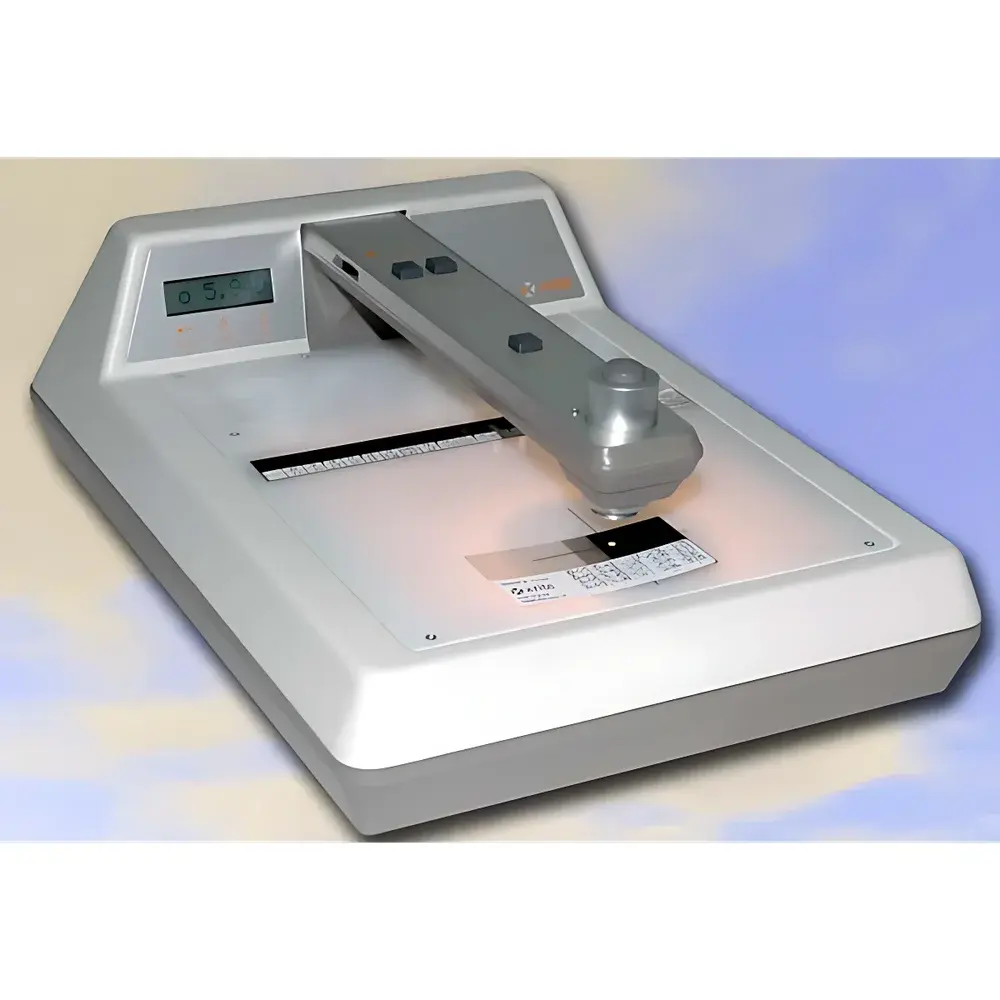
X-Rite 361T (V) High-Range Transmission Densitometer
| Brand | X-Rite |
|---|---|
| Origin | Japan |
| Model | 361T (V) |
| Optical Response | ISO Visual (Photopic) |
| Measurement Range | 0–6.0 D (OD) |
| Accuracy | ±0.01 D (0–5.0 D), ±2% (5.0–5.5 D), ±3% (5.5–6.0 D) |
| Zero Stability | ±0.02 D / 8 h |
| Aperture Sizes | Φ1 mm, Φ2 mm, Φ3 mm |
| Warm-up Time | 2 min (visible), 5 min (UV) |
| Power Supply | 90–130 V AC, ≤80 W |
| Operating Temperature | 10–35 °C, non-condensing |
| Dimensions | H152 × W330 × D435 mm |
| Weight | 8.63 kg |
Overview
The X-Rite 361T (V) is a precision transmission densitometer engineered for high-dynamic-range optical density (OD) measurement in industrial and quality control environments where accurate quantification of light attenuation through highly opaque or deeply colored media is critical. Based on the ISO Visual (photopic) spectral response function—standardized under JIS Z 8722 and aligned with CIE 1931 photopic luminosity function—the instrument delivers traceable, repeatable OD values from 0.00 to 6.00 D (decades of attenuation), corresponding to transmittance levels as low as 10⁻⁶ (0.0001%). Its design emphasizes stability, linearity, and compliance with metrological best practices for densitometric calibration across printing, semiconductor photomask fabrication, photographic film evaluation, and printed circuit board (PCB) manufacturing. Unlike general-purpose spectrophotometers, the 361T (V) employs a dedicated dual-beam optical architecture with stabilized tungsten-halogen and UV LED sources, enabling both visible and ultraviolet densitometry without spectral reconfiguration.
Key Features
- Extended OD range up to 6.00 D with two-decimal resolution—engineered for high-opacity substrates including diazo films, lithographic plates, and tinted safety glass.
- Dual-mode illumination: calibrated visible (ISO Visual) channel and selectable UV channel (365 nm peak) for evaluating UV-absorbing base materials and photoresist layers.
- Three interchangeable apertures (Φ1 mm, Φ2 mm, Φ3 mm) to accommodate localized measurements on fine-pitch patterns or macro-scale uniformity checks.
- High zero-point stability: ±0.02 D drift over 8 hours—critical for extended production-line monitoring and GLP-compliant batch verification.
- Multi-parameter output: simultaneous calculation of optical density, magnified density (×10 scaling), dot area percentage (for halftone evaluation), negative dot area, and UV-specific density.
- Rapid thermal stabilization: 2-minute warm-up for visible mode; 5-minute stabilization for UV mode—minimizing downtime during shift transitions.
Sample Compatibility & Compliance
The 361T (V) is optimized for planar, rigid, or semi-rigid transmissive samples up to 3 mm thickness, including polyester-based diazo films, silver-halide photographic negatives, color filter arrays, stained glass calibration standards, and UV-curable inkjet proofing substrates. It complies with ISO 5-3:2009 (Densitometry — Part 3: Calibration of transmission densitometers), JIS Z 8722:2012 (Methods for measuring optical density), and supports audit-ready operation under ISO/IEC 17025 and IATF 16949 frameworks. While not FDA 21 CFR Part 11–certified out-of-the-box, its analog output and deterministic firmware architecture allow integration into validated systems with appropriate electronic signature and audit-trail supplementation.
Software & Data Management
The 361T (V) operates as a standalone benchtop instrument with front-panel LCD interface and direct numeric readout. It does not include embedded data logging or USB connectivity; however, analog voltage output (0–1 V per OD unit) enables seamless integration with PLCs, SCADA systems, or custom LabVIEW/Python acquisition platforms. For traceability, users are advised to pair the device with NIST-traceable neutral-density reference standards (e.g., X-Rite NIST-verified calibration tiles, SRM 2065 series) and document calibration intervals per internal SOPs. Full calibration certificates—including spectral responsivity curves and linearity verification reports—are available upon request from authorized X-Rite service centers in Japan and APAC regions.
Applications
- Quality assurance of diazo photomasks used in PCB and flat-panel display manufacturing—verifying UV blocking performance and edge acuity.
- Optical density profiling of automotive window tints and architectural laminated glass—ensuring regulatory compliance with JIS A 5759 and ECE R43.
- Process validation of gravure and flexographic printing—measuring solid ink density and dot gain on press proofs.
- Evaluation of radiographic film processing consistency in non-destructive testing (NDT) labs adhering to ASTM E999 and ISO 11699-1.
- Calibration transfer between master densitometers and field units in multi-site manufacturing networks.
FAQ
What does “ISO Visual” mean in the context of this densitometer?
It refers to spectral sensitivity weighted according to the CIE 1931 photopic luminosity function (V(λ)), standardized in ISO 5-3 and JIS Z 8722—ensuring human-eye-relevant density values for visual inspection applications.
Can the 361T (V) measure reflective samples?
No—it is strictly a transmission densitometer and requires sample illumination from behind; reflective or diffuse reflectance measurements require a separate instrument such as the X-Rite eXact or SpectroEye.
Is UV calibration traceable to NIST?
UV source output is factory-characterized against reference filters; full NIST-traceable UV density calibration requires external certification using SRM 2065 or equivalent transfer standards.
How often should the unit be recalibrated?
X-Rite recommends annual calibration for routine QC use; more frequent verification (e.g., daily zero check with certified blank) is required in regulated environments per ISO/IEC 17025 Clause 6.5.
Does the 361T (V) support RS-232 or Ethernet communication?
No—it provides only analog voltage output (0–1 V = 0–6 D); digital interfacing requires third-party signal conditioning hardware or DAQ integration.



