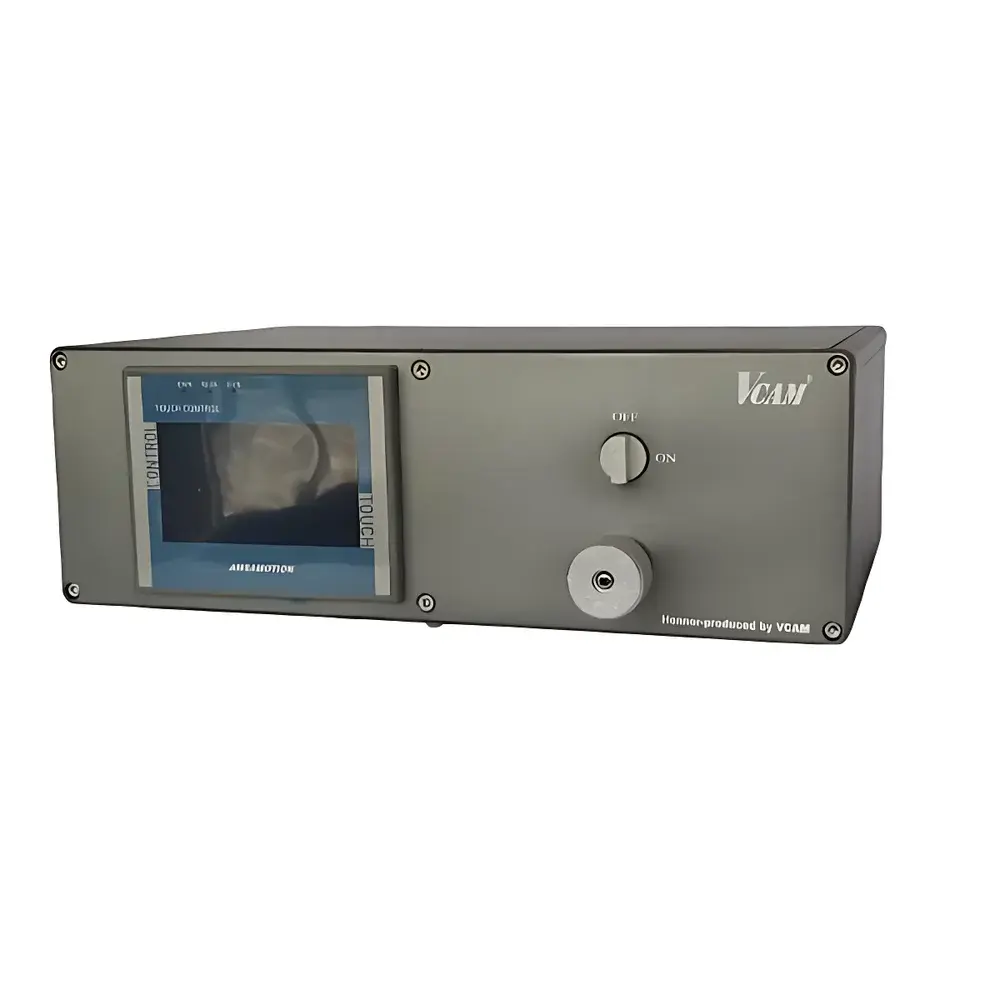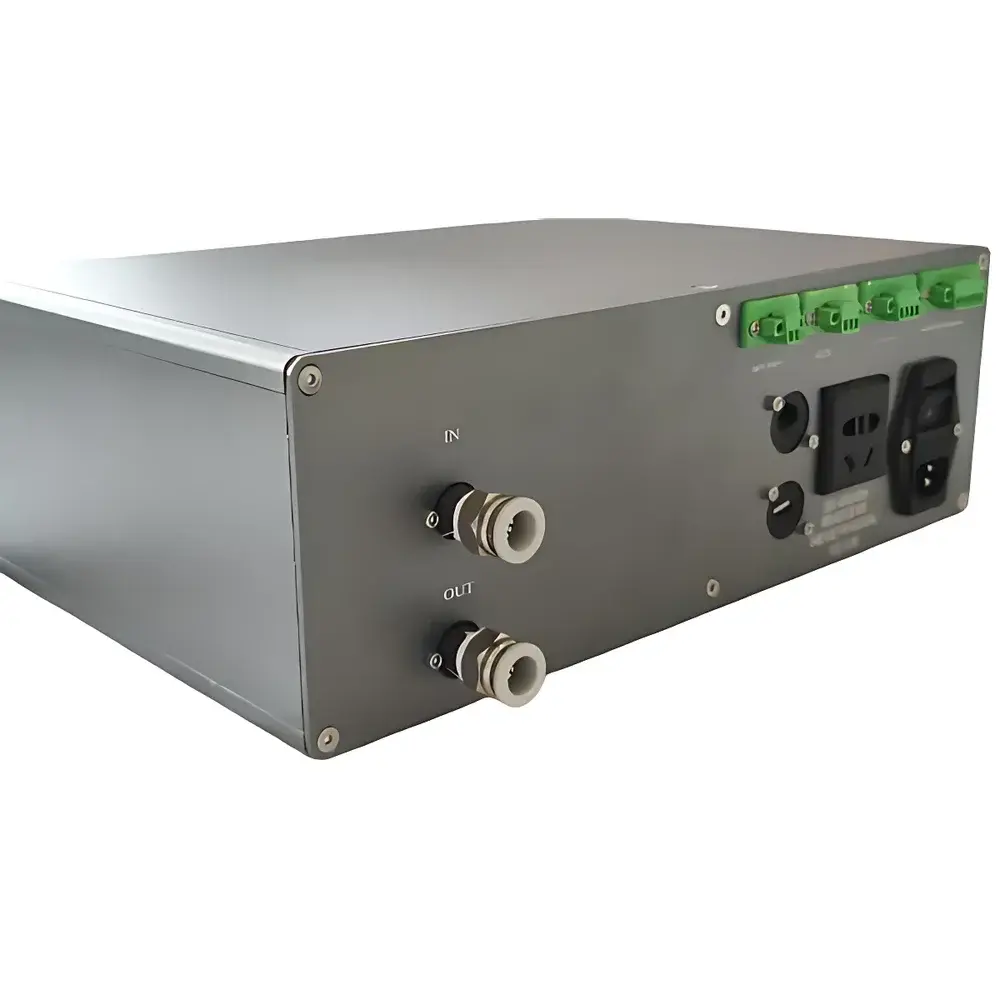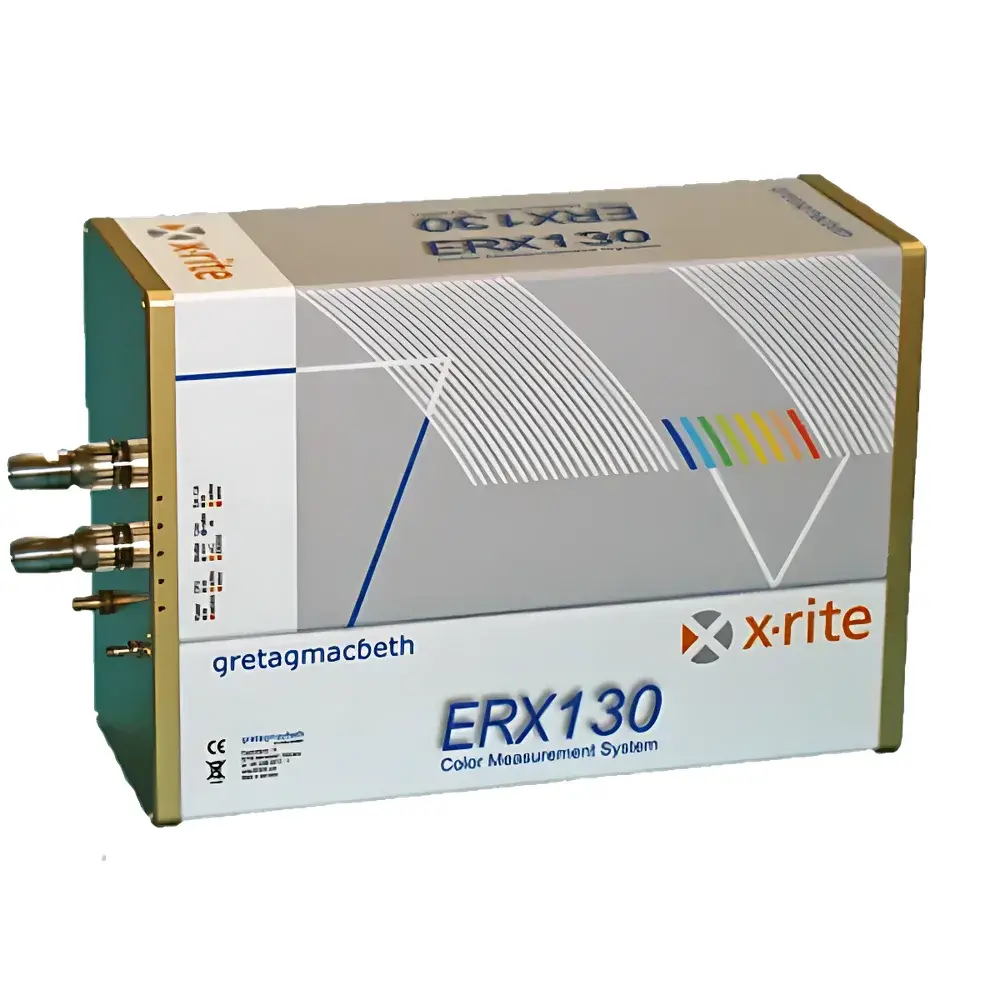
X-Rite ERX130 Non-Contact Spectrophotometer
| Brand | X-Rite |
|---|---|
| Origin | USA |
| Manufacturer Type | Authorized Distributor |
| Origin Category | Imported |
| Model | ERX130 |
| Pricing | Upon Request |
| Short-Term Repeatability (White Tile) | ΔL*, Δa*, Δb* < 0.03 |
| Illumination Geometry | 45°/0° (Coaxial Illumination) |
| Measurement Time | Flash-based |
| Working Distance | 300 mm |
| Spectral Range | 330–730 nm |
| Spectral Interval | 1 nm |
| Measurement Spot Size | 90 mm |
| Calibration Interval | External calibration recommended every 4 weeks |
| Optical Design | True Dual-Beam Architecture |
| Wavelength Calibration | Automatic onboard reference |
Overview
The X-Rite ERX130 Non-Contact Spectrophotometer is an industrial-grade, real-time color measurement system engineered for integration into continuous manufacturing lines. Operating on the principle of diffuse reflectance spectroscopy with a 45°/0° coaxial illumination geometry, the ERX130 captures full spectral data across the visible range (330–730 nm at 1 nm resolution) without physical contact—eliminating surface damage, contamination risk, or mechanical wear associated with probe-based systems. Its flash-based measurement cycle delivers rapid, consistent readings synchronized to line speed, enabling closed-loop process monitoring in high-throughput environments such as paint mixing, plastic extrusion, textile dyeing, food processing, and pharmaceutical coating operations. Designed for rugged industrial deployment, the ERX130 meets IP65-rated ingress protection standards and operates reliably under ambient temperature fluctuations, dust exposure, and variable lighting conditions typical of factory floors.
Key Features
- True dual-beam optical architecture ensures high short-term repeatability (ΔL*, Δa*, Δb* < 0.03 on white tile), minimizing drift during extended unattended operation.
- Automatic onboard wavelength calibration using integrated reference standards maintains long-term spectral fidelity without manual intervention.
- Large 90 mm (3.5″) measurement aperture provides robust spatial averaging over textured, patterned, glossy, or heterogeneous surfaces—including woven fabrics, embossed films, granular powders, and viscous pastes.
- Fixed 300 mm working distance enables safe, stable positioning above conveyors, rollers, or batch mixers—compatible with standard mounting brackets and robotic integration kits.
- Flash-based pulsed LED illumination eliminates thermal loading on heat-sensitive substrates (e.g., thin polymer films or coated tablets) and supports synchronization with encoder-triggered sampling.
- Low-maintenance design requires only external recalibration every four weeks—maximizing uptime and reducing dependency on metrology lab support.
Sample Compatibility & Compliance
The ERX130 accommodates diverse material classes without sample preparation: opaque solids (plastics, ceramics), semi-transparent films, textured textiles, matte or high-gloss coatings, foodstuffs (cereal flakes, confectionery, dairy products), pharmaceutical tablets and ointments, and bulk particulates (pigments, sand, powdered cosmetics). Its 45°/0° geometry complies with ASTM E308, ISO 11664-4, and CIE Publication No. 15 for colorimetric evaluation under standardized illuminants (D65, A, F2). The instrument supports user-defined tolerances aligned with industry-specific specifications (e.g., AATCC Evaluation Procedure 1, ISO 105-J03 for textiles; ASTM D2244 for paints). Data integrity protocols are compatible with GLP/GMP environments when paired with validated ESWin QC software—supporting audit trails, electronic signatures, and 21 CFR Part 11–compliant reporting.
Software & Data Management
Integrated via Ethernet or RS-485, the ERX130 interfaces natively with X-Rite’s ESWin QC software—a modular platform for real-time dashboard visualization, SPC charting (X̄-R, Cpk), deviation alerts, and automatic pass/fail flagging against master standards. ESWin QC stores raw spectral curves (ASCII .spc format), CIELAB coordinates, and metadata (timestamp, operator ID, lot number) in encrypted local databases or SQL servers. Batch export functions generate CSV, PDF, or XML reports traceable to ISO/IEC 17025 documentation requirements. Remote firmware updates and configuration management are supported through secure HTTPS endpoints, ensuring alignment with evolving internal quality procedures and regulatory expectations.
Applications
- Real-time color consistency monitoring during inline paint dispensing and automotive clear-coat application.
- Batch-to-batch verification of pigment dispersion uniformity in inkjet ink and screen printing paste production.
- Non-destructive evaluation of tablet coating thickness and hue homogeneity in pharmaceutical solid-dose manufacturing.
- Automated sorting of recycled plastic flakes by spectral signature in material recovery facilities.
- Continuous validation of food product color stability during thermal processing or shelf-life testing.
- Feedback control of dye dosing systems in continuous textile dyeing lines to minimize water and chemical consumption.
FAQ
What spectral resolution does the ERX130 provide, and how is it achieved?
The ERX130 acquires spectra at 1 nm intervals from 330 nm to 730 nm using a high-stability diffraction grating and thermally stabilized CMOS linear array detector.
Can the ERX130 measure transparent or translucent materials?
It is optimized for reflectance measurements on opaque or semi-opaque surfaces; transmission mode is not supported. For translucent films, backside illumination with a white diffuser is required to obtain meaningful reflectance data.
Is the ERX130 suitable for use in hazardous areas (e.g., Class I Div 1)?
No—the ERX130 is rated for general industrial use (IP65) but lacks intrinsic safety certification for explosive atmospheres.
How is traceability maintained for calibration records?
ESWin QC logs all calibration events—including date, operator, reference standard ID, and post-calibration verification results—with immutable timestamps and optional digital signature enforcement.
Does the ERX130 support custom color difference formulas beyond CIEDE2000?
Yes—ESWin QC allows definition of user-specific ∆E equations, weighting factors, and multi-point tolerance zones aligned with proprietary brand standards.