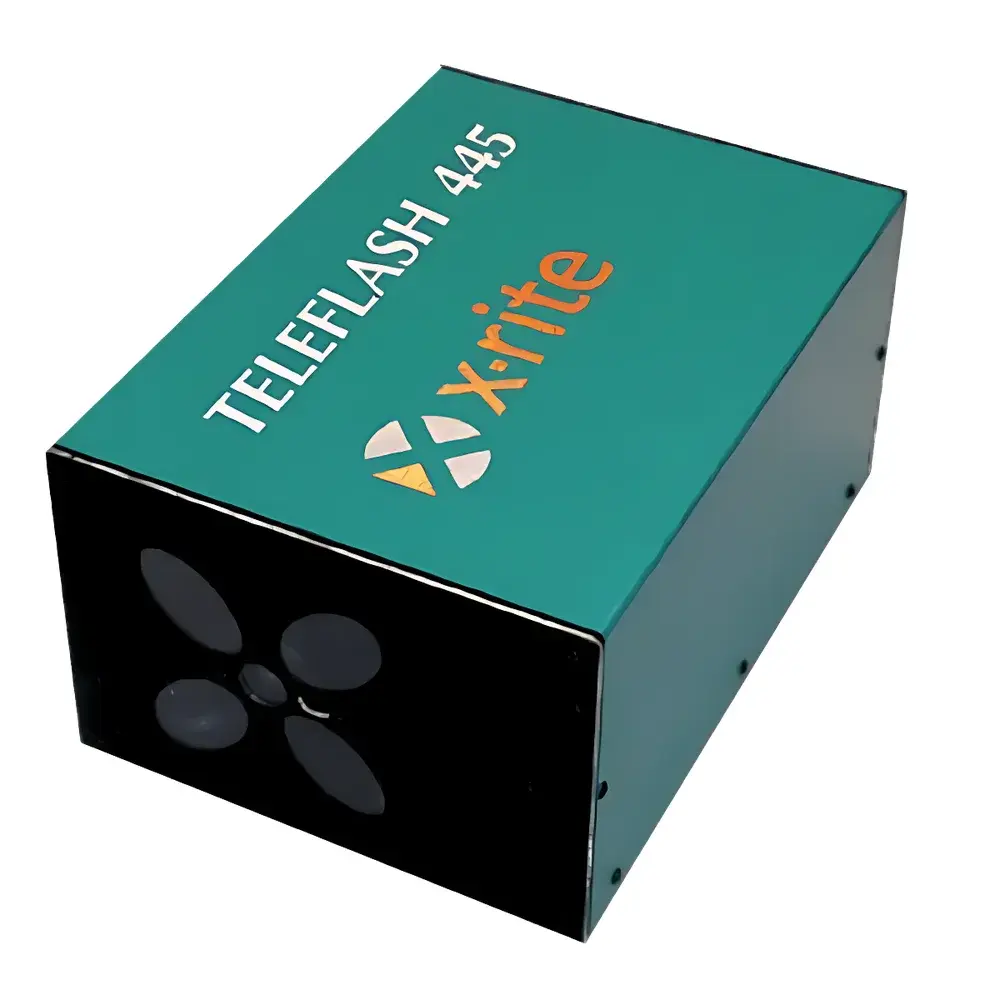
X-Rite TeleFlash 445 In-Line Color Measurement System
| Brand | X-Rite |
|---|---|
| Origin | USA |
| Manufacturer Type | Authorized Distributor |
| Origin Category | Imported |
| Model | TeleFlash 445 |
| Pricing | Available Upon Request |
| Short-Term Repeatability (White) | < 0.03 ΔE(CMC) |
| Geometry | 45°/0° |
| Measurement Method | Flash Spectrophotometry |
| Working Distance | 55 mm |
| Spectral Range | 400–700 nm |
| Spectral Interval | 20 nm |
| Measurement Area | 30 mm Ø |
| Thermal Compensation | Ambient-Temperature Referenced Data Recalculation for Hot Substrates |
Overview
The X-Rite TeleFlash 445 In-Line Color Measurement System is an industrial-grade, non-contact spectrophotometric sensor engineered for real-time color verification in continuous web-based manufacturing environments—particularly coil coating, extrusion, printing, and laminating lines. Operating on the standardized 45°/0° illumination/viewing geometry per ISO 5-4 and ASTM E308, the TeleFlash 445 captures full spectral reflectance data (400–700 nm at 20 nm intervals) using a pulsed xenon flash source, eliminating thermal drift and enabling stable operation under variable ambient lighting. Its 30 mm measurement aperture accommodates macro-scale surface heterogeneity common in textured, patterned, or glossy substrates—including vinyl, textiles, food-colored films, glass coatings, and powdered polymer layers—without requiring physical contact or sample removal. Designed for integration into PLC-controlled production systems, it delivers traceable, repeatable colorimetric output (CIE L*a*b*, ΔE(CMC), ΔE00) synchronized with line speed, supporting closed-loop process feedback and statistical process control (SPC).
Key Features
- Non-contact, flash-based 45°/0° spectrophotometry compliant with ISO/CIE standard geometries for consistent inter-instrument agreement
- 30 mm circular measurement area optimized for web-coated surfaces, minimizing edge effects and averaging micro-variations across textured or structured materials
- Short-term repeatability of < 0.03 ΔE(CMC) on white standards—validated per ISO 13655 and ASTM D2244—ensuring high confidence in pass/fail decisions
- Fixed working distance of 55 mm with integrated focus compensation, enabling robust performance across varying substrate flatness and vibration conditions
- Thermal compensation algorithm that recalculates spectral data to ambient-reference conditions when measuring hot substrates (e.g., post-curing coils), mitigating thermochromic artifacts
- IP65-rated enclosure with optional ATEX/IECEx-certified variants for use in dusty, humid, or explosion-hazardous zones (Zone 2 / Class I, Div 2)
- Integrated visual (multi-color LED ring) and audible alarms triggered by user-defined ΔE thresholds—configurable per job or material setpoint
Sample Compatibility & Compliance
The TeleFlash 445 demonstrates broad substrate compatibility without calibration transfer loss: it reliably measures diffuse-reflective, semi-specular, and moderately glossy surfaces—including embossed vinyl, woven textiles, matte-finish food packaging films, ceramic-coated glass, and granular pigment dispersions. Its optical design inherently suppresses specular component exclusion errors associated with high-gloss materials under 45°/0° geometry. All measurements adhere to ISO 13655:2017 (spectral measurement practices), ISO 12647-2 (graphic technology), and ASTM D3134 (plastics color standards). The system supports audit-ready data logging aligned with GLP/GMP documentation requirements, including timestamped spectral scans, operator ID, and environmental metadata.
Software & Data Management
The TeleFlash 445 interfaces via Ethernet/IP or Modbus TCP to factory MES/SCADA platforms and X-Rite’s proprietary Color iQC software suite. Color iQC provides real-time SPC dashboards, trend analysis, historical deviation mapping, and automated report generation compliant with FDA 21 CFR Part 11 (electronic records/signatures) when deployed with validated server configuration. Raw spectral data (ASCII .spc format) is exportable for third-party modeling (e.g., PCA, PLS regression) or integration into digital twin workflows. Firmware updates and parameter reconfiguration are performed remotely via secure HTTPS, minimizing downtime during scheduled maintenance windows.
Applications
- Real-time color monitoring in metal coil coating lines—detecting batch-to-batch chromatic shifts before curing
- Quality gate validation in flexible packaging lamination—verifying ink density and overprint consistency across film webs
- Process stabilization in textile dyeing—correlating online reflectance with lab-standard spectrophotometer baselines
- Food-safe film production—ensuring regulatory-compliant hue uniformity in colored barrier layers (e.g., E-number pigments)
- Automotive interior trim extrusion—tracking color stability across multi-zone die temperatures and cooling rates
FAQ
What industry standards does the TeleFlash 445 comply with for color measurement geometry and data reporting?
It conforms to ISO 5-4 (45°/0° geometry), ISO 13655 (spectral measurement), ISO 12647-2 (process control tolerances), and ASTM E308 (color computation). Data outputs meet ISO 15739 (noise characterization) and ASTM D2244 (ΔE calculation) requirements.
Can the TeleFlash 445 measure moving substrates at high line speeds?
Yes—it synchronizes measurement pulses with encoder signals up to 1,200 m/min line speed; exposure time is fixed at 10 ms, ensuring motion blur suppression across typical web tensions.
Is thermal drift compensated during measurement of hot substrates?
Yes—the system applies real-time spectral recalibration using embedded temperature sensors and pre-characterized thermal response curves, referencing all output to 23°C ambient per ISO 13655 Annex B.
How is measurement traceability maintained across multiple TeleFlash units in a multi-line facility?
Each unit undergoes factory calibration against NIST-traceable ceramic standards; inter-unit agreement is verified annually using X-Rite’s Cross-Instrument Agreement (CIA) protocol per ISO 13655 Section 9.3.
Does the system support integration with existing PLC or DCS architectures?
Yes—native support for EtherNet/IP, Modbus TCP, and OPC UA enables direct connection to Rockwell Automation, Siemens SIMATIC, and Honeywell Experion DCS systems without gateway hardware.
Related Products