
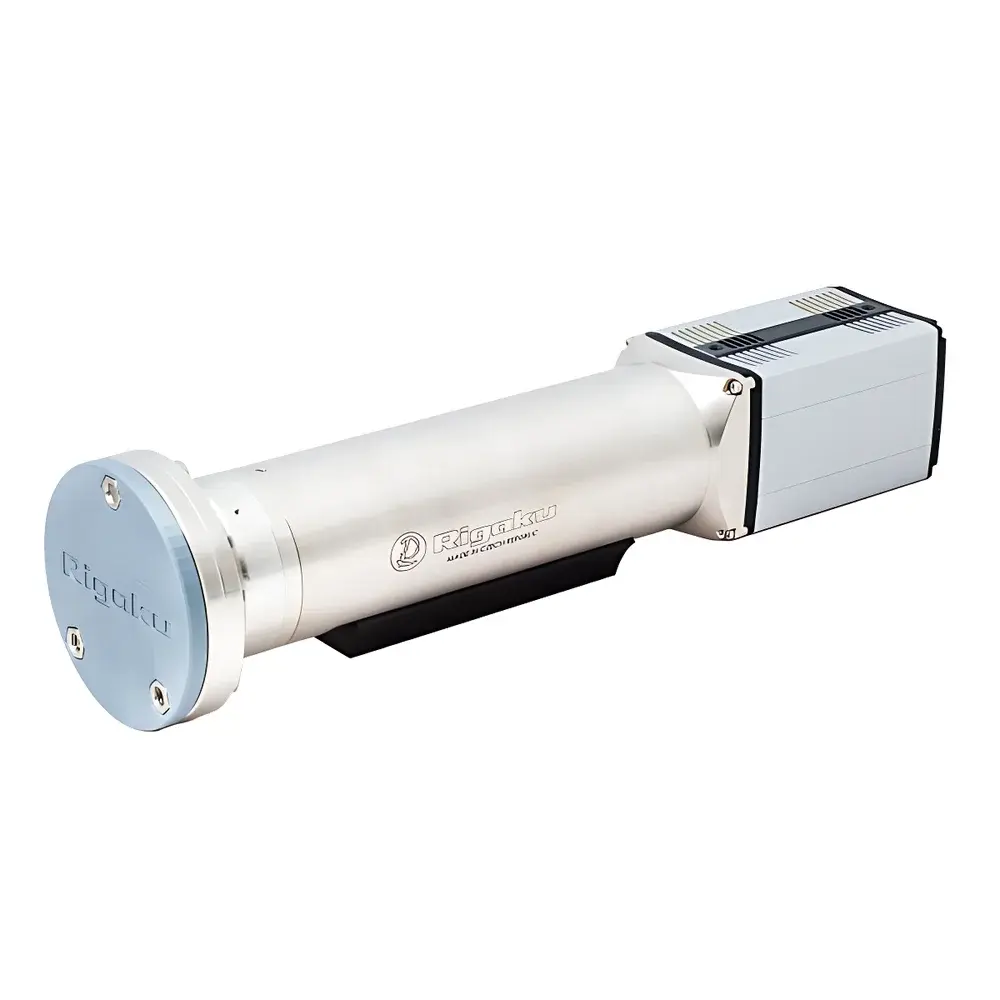
RITE XSight™ LC Lens-Coupled High-Resolution X-ray Camera
| Brand | RITE |
|---|---|
| Origin | Czech Republic |
| Model | XSight™ LC |
| Sensor Type | CCD / sCMOS |
| Effective Pixels | 3300×2500 (CCD) / 2048×2048 (sCMOS) |
| Pixel Pitch | 0.275–5.2 µm (model-dependent) |
| Spatial Resolution | 0.4–7.0 µm (JIMA RT RC-02 test pattern, 8 keV) |
| Energy Range | 5–30 keV (vacuum-compatible version extends to EUV ≥50 eV) |
| Read Noise | 7.5 e⁻ RMS (CCD) / 1.4 e⁻ RMS (sCMOS) |
| Dark Current | ≤0.001 e⁻/pix/s @ −30°C (CCD) / ≤0.04 e⁻/pix/s @ −10°C (sCMOS, water-cooled) |
| Frame Rate | 3–40 fps |
| Dynamic Range | 2800:1 (CCD) / 21400:1 (sCMOS) |
| Lens Mount | Bayonet-type interchangeable lens units (up to five configurations) |
| Vacuum Option | Available (EUV-capable) |
| Cooling | Air- or water-cooled (no liquid nitrogen required) |
| Interface | USB 3.0 |
| Compliance | Designed for GLP/GMP-aligned lab environments |
Overview
The RITE XSight™ LC Lens-Coupled High-Resolution X-ray Camera is an engineered imaging solution for synchrotron beamlines, laboratory-scale X-ray microscopes, computed tomography (CT) systems, and precision metrology applications requiring sub-micron spatial fidelity. Unlike fiber-optic-coupled or direct-detection architectures, the XSight™ LC employs a lens-coupled optical relay design—where X-rays are first converted to visible light via a high-efficiency scintillator (e.g., LuAG:Ce or Gd₂O₂S:Tb), then imaged onto the sensor through a multi-element, radiation-hardened microscope objective. This configuration decouples detection efficiency from pixel size constraints, enabling scalable resolution across field-of-view (FOV) tiers—from 0.67 mm × 0.67 mm up to 14.4 mm × 10.8 mm—while maintaining <0.4 µm demonstrable resolution on JIMA RT RC-02 test patterns at 8 keV. The system operates in the 5–30 keV range; optional vacuum-integrated variants extend spectral sensitivity into the extreme ultraviolet (EUV) regime (≥50 eV), supporting soft X-ray microscopy and plasma diagnostics.
Key Features
- Lens-based optical coupling architecture optimized for high modulation transfer function (MTF) and minimal geometric distortion across FOV
- Interchangeable bayonet-mount lens units (LC 0270 to LC 4320), enabling rapid reconfiguration between resolution-priority and FOV-priority modes without realignment
- Integrated X-ray shielding housing prevents stray radiation from impinging directly on the sensor, reducing background noise and improving signal-to-noise ratio (SNR)
- Compact, rigid mechanical design suitable for integration into constrained spaces—including rotating gantries in CT setups and vacuum chambers in synchrotron endstations
- Thermally stabilized sensor operation: CCD variant cooled to −30°C (air/water hybrid); sCMOS variant supports −10°C water cooling for ultra-low dark current
- USB 3.0 interface ensures deterministic data transfer with no external frame grabber required; native support for GenICam-compliant acquisition software
- No cryogenic cooling needed—eliminates operational complexity and maintenance overhead associated with liquid nitrogen or closed-cycle coolers
Sample Compatibility & Compliance
The XSight™ LC accommodates diverse sample geometries and experimental conditions. Its modular lens system supports both transmission and reflection-mode X-ray imaging, including phase-contrast modalities when paired with appropriate zone plates or grating interferometers. The vacuum-compatible version meets ISO 10110-7 surface quality standards for internal optics and complies with UHV-compatible material specifications (e.g., stainless steel 316L housings, metal-sealed feedthroughs). For regulated environments, the camera’s firmware implements audit-trail logging and timestamped metadata embedding per FDA 21 CFR Part 11 requirements. Data acquisition workflows align with ISO/IEC 17025 documentation practices and ASTM E2737-10 guidelines for digital radiographic system validation.
Software & Data Management
Native SDKs (C/C++, Python, MATLAB) provide low-level control over exposure timing, gain, region-of-interest (ROI) readout, and hardware-triggered synchronization. Optional RITE ImageStudio™ software delivers real-time flat-field correction, dead-pixel mapping, and MTF calculation using slanted-edge analysis per ISO 12233. All acquired frames embed EXIF-style metadata—including energy calibration, lens ID, temperature log, and shutter timing—ensuring traceability in GLP audits. Raw data export supports HDF5 and TIFF formats with embedded bit-depth preservation (16-bit linear output). Integration with third-party platforms (e.g., TomoPy, FIJI/ImageJ, DAWN) is validated for reconstruction pipeline interoperability.
Applications
- X-ray microtomography of biological tissues, composite materials, and additive-manufactured components at voxel resolutions down to 0.4 µm
- In-line process monitoring in semiconductor packaging inspection and battery electrode characterization
- Dynamic studies of crack propagation, fluid flow in porous media, and thermal expansion under operando conditions
- EUV lithography mask inspection and plasma emission spectroscopy in fusion research facilities
- Phase-retrieval imaging using grating-based interferometry or ptychographic reconstruction algorithms
- Calibration reference imaging for beamline diagnostics and detector intercomparison campaigns
FAQ
What scintillators are compatible with the XSight™ LC system?
Standard configurations include LuAG:Ce (for high-resolution, fast decay) and Gd₂O₂S:Tb (for high conversion efficiency at lower energies); custom scintillator bonding is available upon request.
Can the XSight™ LC be synchronized with pulsed X-ray sources?
Yes—the camera supports TTL-triggered exposure with jitter <100 ns and configurable delay ranges from 0–10 s, enabling precise gating with synchrotron fill patterns or laser-driven X-ray sources.
Is remote operation supported in vacuum environments?
Vacuum-rated models include feedthrough-compatible USB 3.0 and power connectors rated to 10⁻⁷ mbar; remote firmware updates and parameter adjustment are fully supported via encrypted command protocol.
How is spatial resolution verified and documented?
Resolution is measured using NIST-traceable JIMA RT RC-02 test patterns under controlled beam conditions (8 keV, monochromatic); full MTF curves and uncertainty budgets are provided in the factory calibration report.
Does the system support binning or partial-frame readout?
Yes—hardware binning (2×2, 4×4) and arbitrary ROI selection are implemented at the FPGA level, enabling frame-rate increases up to 40 fps without compromising SNR or dynamic range.




