
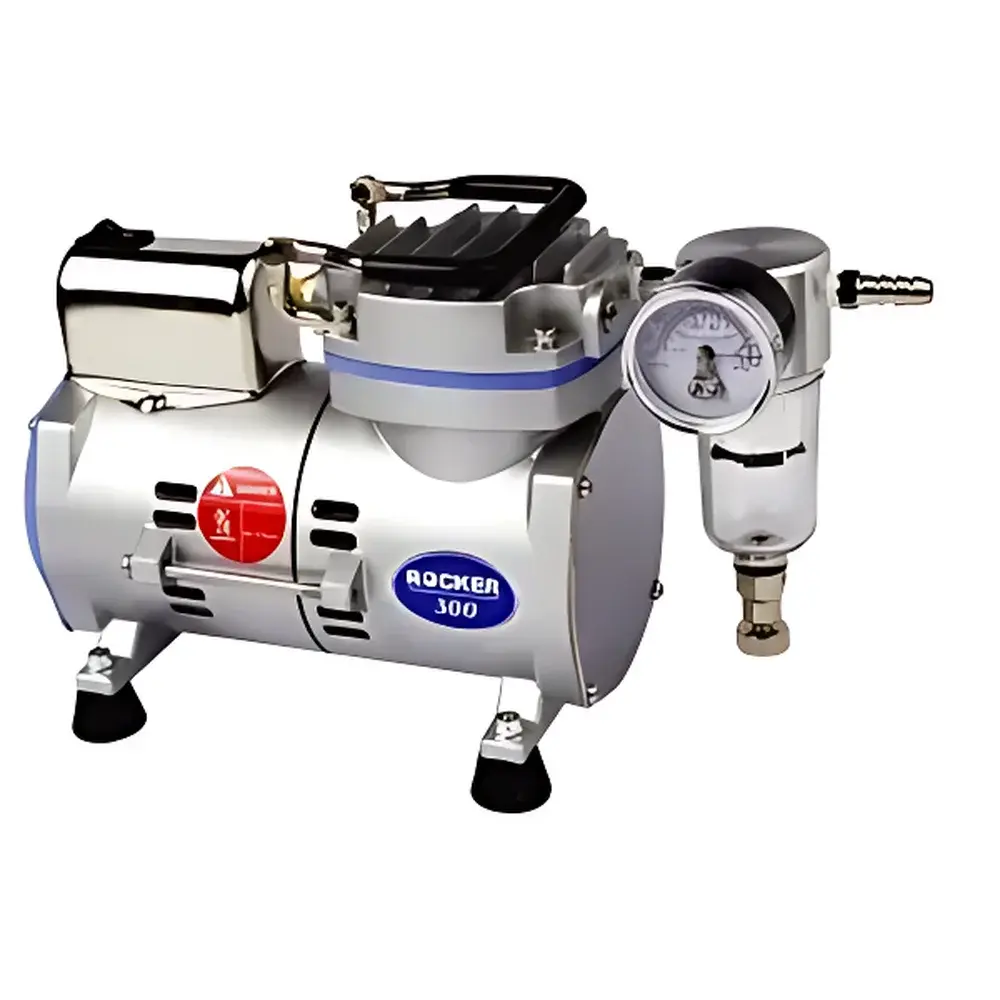
ROCKER C300 Oil-Free Diaphragm Vacuum Pump
| Brand | ROCKER |
|---|---|
| Origin | Taiwan |
| Model | C300 |
| Pump Type | Oil-Free Diaphragm Pump |
| Vacuum Level | -89.3 kPa (120 mbar) |
| Flow Rate | 18 L/min |
| Noise Level | 50 dB(A) |
| Motor Speed | 1450 rpm |
| Power | 60 W |
| Voltage | 220–240 V, 50 Hz |
| Weight | 4.1 kg |
| Dimensions (L×W×H) | 27.2 × 12.1 × 16.5 cm |
| Inlet Hose ID | 8 mm |
| Certifications | CE, CSA |
| Protection Features | Thermal Overload Cut-off, Prote™ Anti-Splash Valve, Integrated Inlet Filter |
Overview
The ROCKER C300 Oil-Free Diaphragm Vacuum Pump is an engineered solution for laboratories requiring reliable, contamination-free vacuum generation in routine filtration, sampling, and analytical preparation workflows. Unlike oil-lubricated rotary vane pumps, the C300 employs a precision-machined reciprocating piston mechanism coupled with elastomeric diaphragm sealing—eliminating the need for lubricating oil and preventing hydrocarbon vapor backstreaming or oil mist carryover into sensitive samples or downstream instrumentation. Its dry operation ensures compliance with stringent cleanroom and GLP environments where sample integrity and instrument longevity are critical. Designed for continuous-duty laboratory use, the C300 delivers stable vacuum performance up to –89.3 kPa (120 mbar absolute) at a free-air flow rate of 18 L/min, making it suitable for standard Büchner funnel filtration, membrane filtration for microbiological analysis, and low-flow air or water sampling applications.
Key Features
- Oil-free piston-diaphragm architecture: Eliminates oil contamination risk and eliminates routine oil replenishment, filter replacement, or oil change maintenance cycles.
- Thermal protection system: Integrated temperature-sensitive cut-off switch automatically de-energizes the motor when internal winding temperature exceeds safe operational thresholds; auto-resets upon cooling.
- Prote™ anti-splash valve: Patented internal check-valve assembly prevents accidental ingress of liquid into the pump chamber during vacuum interruption or overfill events—protecting the piston seal and cylinder bore from corrosion or mechanical damage.
- Integrated inlet particulate/moisture filter: Removable sintered polyethylene filter element traps dust, aerosols, and condensate upstream of the compression chamber, extending service life of the diaphragm and piston components.
- Low-noise, low-vibration operation: Direct-drive motor coupling (no belts or gears) combined with vibration-damping feet and acoustic enclosure design achieves ≤50 dB(A) sound pressure level at 1 m distance—compatible with shared lab spaces and noise-sensitive instrumentation rooms.
- Global safety certification: Fully compliant with EN 61000-6-3 (EMC), EN 61000-6-1 (Immunity), and certified to both EU CE Directive 2014/30/EU (EMC) and 2014/35/EU (LVD), as well as North American CSA C22.2 No. 61010-1 requirements.
Sample Compatibility & Compliance
The C300 is validated for use with aqueous, mildly acidic, and saline solutions commonly encountered in environmental, pharmaceutical, and food microbiology testing—including ASTM D512 (chloride), ISO 9308-1 (E. coli enumeration), and USP <61> microbial limits testing. Its oil-free construction meets FDA 21 CFR Part 11 data integrity prerequisites when paired with compliant digital controllers or logging systems. The pump’s sealed housing and IP20-rated enclosure satisfy general-purpose indoor laboratory deployment per IEC 60529. It is not rated for organic solvent vapors, explosive atmospheres (ATEX), or high-humidity continuous condensation scenarios without external cold trap or coalescing pre-filter integration.
Software & Data Management
As a standalone analog vacuum source, the C300 operates without embedded firmware or digital interfaces. However, its stable electrical signature (60 W, 220–240 V, 50 Hz) and consistent thermal profile enable seamless integration into automated vacuum manifolds equipped with external pressure transducers (e.g., 4–20 mA or 0–10 V output sensors) and programmable logic controllers (PLCs). When used within validated QC/QA systems, runtime logs, thermal event timestamps, and power-on hours may be captured via facility-level energy monitoring platforms compliant with ISO/IEC 17025 clause 5.9.2 (monitoring of equipment performance). Optional analog-to-digital signal adapters support connection to LIMS-compatible SCADA environments requiring audit-trail-capable vacuum status reporting.
Applications
- Vacuum-assisted membrane filtration for total coliform and heterotrophic plate count (HPC) assays in drinking water and wastewater compliance testing (e.g., EPA Method 1603, ISO 9308-2).
- Gravimetric suspended solids (TSS) determination per APHA Standard Methods 2540D using glass fiber filters and vacuum ovens.
- Air sampling for viable particulate monitoring in cleanrooms (ISO 14644-1 Class 5–8) and HVAC validation studies.
- Sample concentration and solvent removal in preparatory HPLC or GC workflows where hydrocarbon-free vacuum is mandatory.
- Supporting vacuum desiccators, freeze dryers (primary drying stage), and vacuum-assisted pipette tip loading in molecular biology labs.
FAQ
Is the C300 suitable for vacuum oven or lyophilizer primary drying applications?
Yes—provided the process load remains below 10% of the pump’s maximum vapor handling capacity and condensable vapors are intercepted by an inline cold trap or desiccant cartridge to prevent diaphragm saturation.
Does the C300 require periodic calibration or metrological verification?
No formal calibration is mandated per ISO/IEC 17025, as it is a non-measuring utility device; however, routine verification of ultimate vacuum (using a calibrated digital manometer) and flow stability (via timed volumetric displacement test) is recommended every 6 months in GMP-regulated environments.
Can the C300 operate continuously for 24/7 duty cycles?
It is rated for intermittent duty (duty cycle ≤ 70%) under ambient temperatures ≤35°C; extended unattended operation requires thermal monitoring and airflow clearance ≥10 cm on all sides.
What maintenance intervals are recommended for the inlet filter and Prote™ valve?
Inspect the inlet filter weekly in high-particulate environments; replace when visibly clogged or after 500 operating hours. The Prote™ valve requires no scheduled maintenance but should be visually inspected quarterly for seal integrity and debris accumulation.
Is a 110 V / 60 Hz version available for North American labs?
Yes—the C300-110 model (P/N 167300-11) is factory-configured for 110–120 V, 60 Hz operation and carries identical performance specifications and certifications.



