
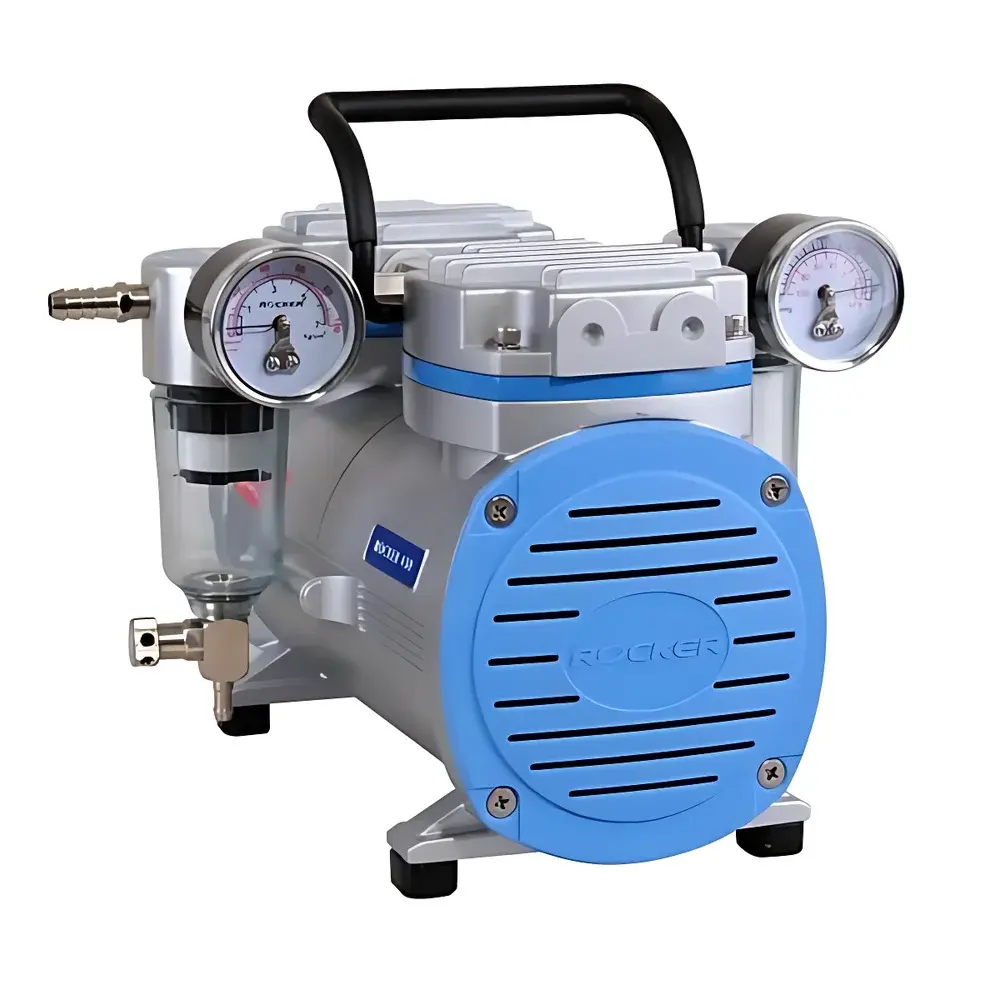
ROCKER Rocker430 Dual-Mode Positive/Negative Pressure Oil-Free Vacuum Pump
| Brand | ROCKER |
|---|---|
| Origin | Taiwan |
| Model | Rocker430 |
| Pump Type | Oil-Free Piston Pump |
| Air Displacement Rate | 28 L/min |
| Ultimate Vacuum | 173 mbar (−630 mmHg) |
| Dimensions (W×D×H) | 247 × 235 × 204 mm |
| Weight | 5.5 kg |
| Motor Power | 125 W |
| Input Voltage | AC 220 V, 50 Hz (also available in AC 110 V, 60 Hz) |
| Max Pressure Output | 80 psi |
| Noise Level | 52 dB(A) |
| Inlet Hose ID | 8 mm (5/16″) |
| Built-in Vacuum Regulator | Yes |
| Prote™ Float Ball Liquid Protection | Yes |
| Inlet Filter | Yes |
| Thermal Overload Protection | Yes |
| Safety Certifications | CE, RoHS, IP30 |
Overview
The ROCKER Rocker430 is an engineered dual-mode oil-free piston pump designed for precise, reliable, and contamination-free operation in analytical, microbiological, and environmental laboratory workflows. Unlike oil-lubricated vacuum systems, the Rocker430 employs a dry-running, single-stage reciprocating piston mechanism that eliminates hydrocarbon vapor carryover, oil mist generation, and routine lubrication requirements—making it ideal for applications demanding clean vacuum or positive pressure delivery. Its dual-mode capability enables seamless switching between vacuum aspiration (e.g., filtration, solvent removal) and low-pressure positive displacement (e.g., air sampling, controlled fluid transfer), all within a compact, benchtop footprint. The pump operates at a nominal speed of 1450 RPM and delivers consistent performance across its full operational range, with thermal stability ensured by an integrated bi-metallic thermal cutoff switch.
Key Features
- Oil-free piston technology: Eliminates oil contamination risk and reduces lifecycle maintenance—no oil changes, no oil degradation, no downstream filter saturation from lubricant vapors.
- Prote™ float-ball liquid protection system: A proprietary inline float-valve assembly automatically seals the intake path upon detection of liquid ingress, preventing water or aqueous solution from entering the cylinder chamber and causing mechanical failure.
- Integrated inlet particulate/moisture filter: Removable sintered polyethylene filter traps dust, aerosols, and condensate upstream of the piston head—extending service life and preserving volumetric efficiency.
- Thermal overload protection: Embedded motor thermistor triggers automatic shutdown when internal temperature exceeds safe thresholds; restarts autonomously after passive cooling.
- Adjustable vacuum regulation: Onboard precision vacuum control valve allows fine-tuning of suction pressure without external regulators—critical for sensitive filtration or membrane integrity testing.
- Compliance-ready design: Certified to CE (2014/30/EU EMC & 2014/35/EU LVD), RoHS Directive 2011/65/EU, and rated IP30 for protection against solid objects ≥2.5 mm—suitable for ISO/IEC 17025-accredited laboratories.
Sample Compatibility & Compliance
The Rocker430 is compatible with standard laboratory filtration manifolds (e.g., Millipore® Sterivex®, Whatman® vacuum funnels), air sampling cassettes (NIOSH/OSHA-compliant), and aqueous sample preparation systems. Its oil-free architecture ensures compatibility with solvents including ethanol, acetone, and dilute acids—provided vapor concentrations remain below material compatibility limits of Viton® and PTFE components. For regulated environments, the pump supports GLP/GMP documentation protocols through traceable calibration records and service logs. While not intrinsically rated for explosive atmospheres, its non-sparking motor design and absence of flammable lubricants meet general safety requirements for Class I, Division 2 areas per NEC Article 500 when used with appropriate ventilation.
Software & Data Management
The Rocker430 operates as a standalone electromechanical device with no embedded firmware or digital interface. As such, it does not require software drivers, cloud connectivity, or cybersecurity validation. This analog architecture enhances long-term reliability, simplifies qualification (IQ/OQ), and avoids obsolescence risks associated with proprietary communication stacks. Users may integrate the pump into validated workflows using external pressure transducers (e.g., Validyne DP15) and data loggers compliant with FDA 21 CFR Part 11 for audit-trail-capable vacuum monitoring. Service history—including date-stamped filter replacements and Prote™ cartridge inspections—can be recorded manually in lab notebooks or electronic quality management systems (eQMS).
Applications
- Microbiological analysis: Membrane filtration for coliform, E. coli, and heterotrophic plate count (HPC) assays per EPA Method 1603 and ISO 9308-1.
- Suspended solids determination: Gravimetric analysis of total suspended solids (TSS) in wastewater per APHA Standard Method 2540D.
- Vacuum-assisted sample concentration: Gentle solvent evaporation prior to GC-MS or LC-MS analysis without thermal degradation or cross-contamination.
- Ambient air monitoring: Low-flow collection of particulates (PM10/PM2.5) and VOCs onto sorbent tubes per US EPA TO-17 and ISO 16000-6.
- Cell culture support: Sterile media filtration and flask evacuation during aseptic processing under biosafety cabinet conditions.
FAQ
Is the Rocker430 suitable for continuous 24/7 operation?
It is rated for intermittent duty cycles up to 8 hours per day under ambient temperatures ≤35°C. Extended unattended use requires periodic inspection of the Prote™ float assembly and inlet filter.
Can this pump handle corrosive gases?
No. It is not chemically resistant to chlorine, hydrogen sulfide, or strong oxidizers. Use only with ambient air or inert, non-reactive process gases.
What maintenance intervals are recommended?
Inspect inlet filter monthly; replace every 3–6 months depending on particulate load. Replace Prote™ float cartridge annually or after any confirmed liquid exposure.
Does the pump include a warranty?
Yes—ROCKER provides a 24-month limited warranty covering parts and labor for defects in materials and workmanship under normal laboratory use.
Is calibration required before first use?
No factory calibration is needed. However, users should verify ultimate vacuum (≤173 mbar) and flow rate (28 L/min at open flow) using NIST-traceable instrumentation during installation qualification (IQ).



