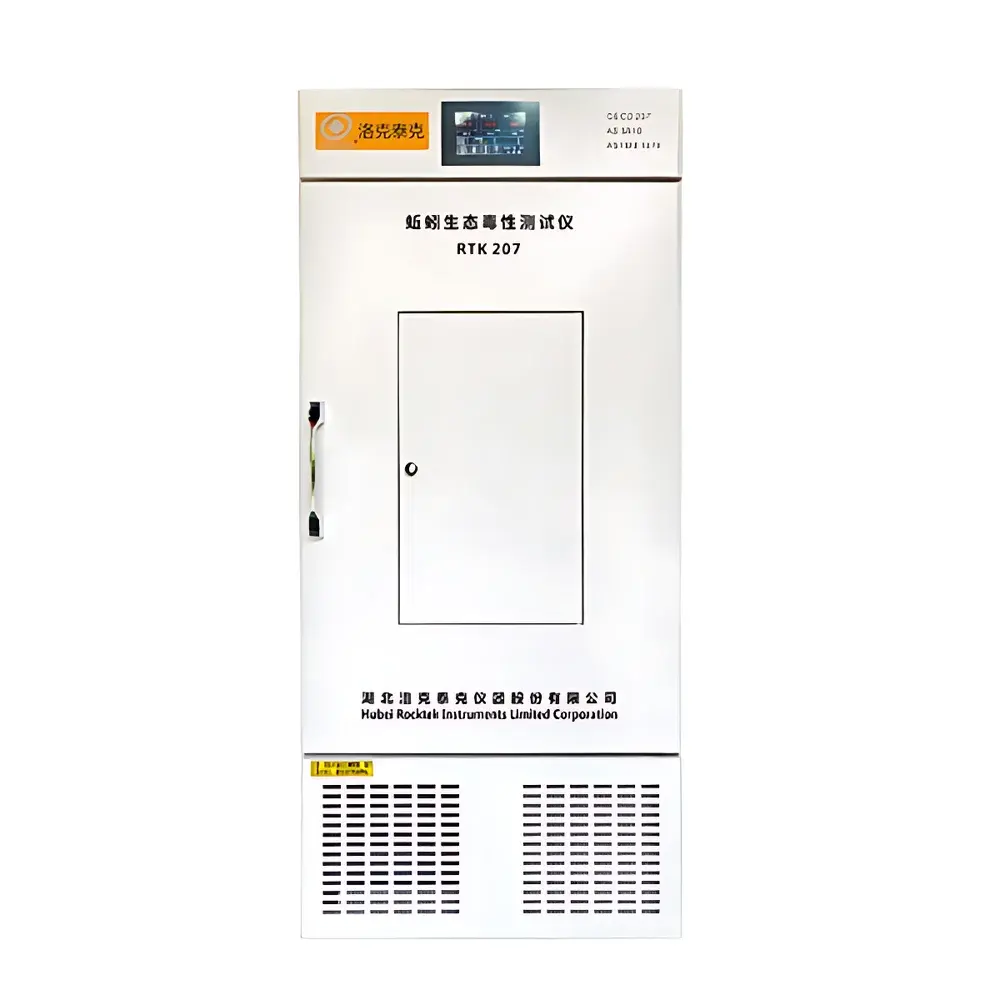
Rocktek RTK-207 OECD 207 Earthworm Acute Toxicity Test System
| Brand | Rocktek |
|---|---|
| Origin | Hubei, China |
| Manufacturer Type | Authorized Distributor |
| Country of Origin | China |
| Model | RTK-207 |
| Pricing | Upon Request |
| Temperature Range | 20–40 °C (Uniformity ≤ ±1 °C) |
| Illuminance | ≥10,000 lux |
| Humidity Range | 50–95% RH (Stability ≤ ±3% RH) |
| Chamber Volume | ≥150 L |
| Power Supply | 220 V, 50 Hz, Max. 750 W |
| Dimensions (W×D×H) | 600 × 650 × 1410 mm |
| Weight | 120 kg |
| Refrigeration | Hermetic Compressor with Modular Design, Delayed Start & Dual Pressure Protection |
| Interior | Stainless Steel with Adjustable Shelves |
| Air Circulation | Forced Convection via Stainless Steel Duct System |
| Control Interface | Touchscreen Display with Data Export Capability |
Overview
The Rocktek RTK-207 Earthworm Acute Toxicity Test System is a purpose-engineered environmental toxicity chamber designed to conduct standardized terrestrial ecotoxicity assays in strict compliance with OECD Guideline 207 (Earthworm, Eisenia fetida, Acute Toxicity Tests), AS 5810 (Australian Standard for Soil Toxicity Testing), and ASTM E1676 (Standard Guide for Conducting Laboratory Soil Toxicity or Bioaccumulation Tests with the Lumbricid Eisenia fetida). The system provides a precisely controlled microenvironment—regulating temperature, relative humidity, photoperiod, and air circulation—to support reproducible 14-day exposure studies evaluating mortality, behavioral endpoints (e.g., avoidance, coiling, surface emergence), and sublethal physiological responses in adult earthworms (Eisenia fetida or Eisenia andrei) exposed to test substances in artificial soil matrices. Its architecture supports GLP-aligned experimental execution, including documented environmental parameter logging, traceable calibration records, and audit-ready operational logs.
Key Features
- Hermetically sealed refrigeration unit with modular compressor assembly, engineered for long-term thermal stability and low maintenance intervals; incorporates delayed startup logic and dual high/low pressure safety cutoffs.
- Stainless steel interior chamber with corrosion-resistant, adjustable shelving optimized for uniform spatial distribution of test vessels (e.g., 1-L glass jars or polypropylene containers per OECD 207 protocol).
- High-efficiency forced-air circulation system utilizing a stainless steel duct network and low-turbulence blower—ensuring temperature homogeneity ≤ ±1 °C across the entire working volume (≥150 L).
- Full-spectrum LED lighting array delivering ≥10,000 lux at specimen level, programmable for photoperiod control (e.g., 16 h light / 8 h dark cycles) with spectral output matching natural daylight requirements for earthworm photobiology.
- Integrated touchscreen HMI with real-time display of chamber conditions (temperature, RH, illuminance), event-triggered data logging, and USB-based export of time-stamped CSV files compliant with FDA 21 CFR Part 11 audit trail requirements.
- Double-glazed observation window with anti-fog coating enables non-invasive visual monitoring without compromising environmental integrity or introducing thermal leakage.
Sample Compatibility & Compliance
The RTK-207 accommodates standard OECD 207 test vessels (e.g., 1-L wide-mouth glass jars) containing artificial soil mixtures (sand, kaolin clay, sphagnum peat, and calcium carbonate) spiked with test compounds—including microplastics, biodegradable polymer fragments, pesticide formulations, heavy metal salts, or industrial effluent solids. It supports concurrent testing of up to 24 replicate units under identical environmental conditions. All operational parameters meet the minimum performance thresholds specified in OECD 207 Annex 2 (e.g., temperature stability, humidity control, light intensity). The system is validated for use in laboratories operating under ISO/IEC 17025, GLP, and EPA OPPTS 850.1035-compliant quality management systems.
Software & Data Management
The embedded firmware records all environmental setpoints and actual values at user-defined intervals (default: 10-minute sampling). Data are timestamped, stored internally for ≥30 days, and exportable via USB mass storage mode to external PCs for integration into LIMS or statistical analysis platforms (e.g., R, SAS, JMP). Calibration certificates for integrated sensors (Pt100 temperature probes, capacitive RH sensors, lux meters) are traceable to NIST standards. Audit log entries include operator ID, parameter changes, door opening events, and alarm triggers—supporting full traceability required under GLP and GMP frameworks.
Applications
- Regulatory submission testing for biodegradable plastics (e.g., PBAT, PLA, PHA) under EN 13432, ISO 17556, and ASTM D5338 soil burial protocols.
- Ecotoxicological screening of nanomaterials, biosolids, compost amendments, and contaminated site remediation agents.
- Academic research on soil invertebrate stress physiology, oxidative biomarker expression, and sublethal neurobehavioral endpoints.
- Method validation and inter-laboratory comparison studies coordinated by national reference labs (e.g., CNAS-accredited facilities in China, UK NEL, German Umweltbundesamt partners).
FAQ
Does the RTK-207 comply with OECD 207 validation criteria for temperature uniformity and lighting?
Yes—the chamber maintains ≤ ±1 °C spatial uniformity across the full volume and delivers ≥10,000 lux at specimen height using calibrated, spectrally balanced LEDs.
Can the system be integrated into an existing LIMS or ELN infrastructure?
Raw CSV exports support direct ingestion into common laboratory informatics platforms; optional Modbus TCP interface is available upon request for real-time SCADA integration.
What maintenance is required for long-term operation?
Annual verification of sensor calibration (temperature, RH, lux) and refrigerant charge integrity is recommended; compressor oil and filter replacement intervals exceed 15,000 operating hours.
Is technical support and method consultation available for first-time users?
Rocktek provides remote application engineering support, OECD 207 protocol SOP templates, and on-site commissioning services through its Wuhan-based Application Lab and partner network in Europe and North America.