
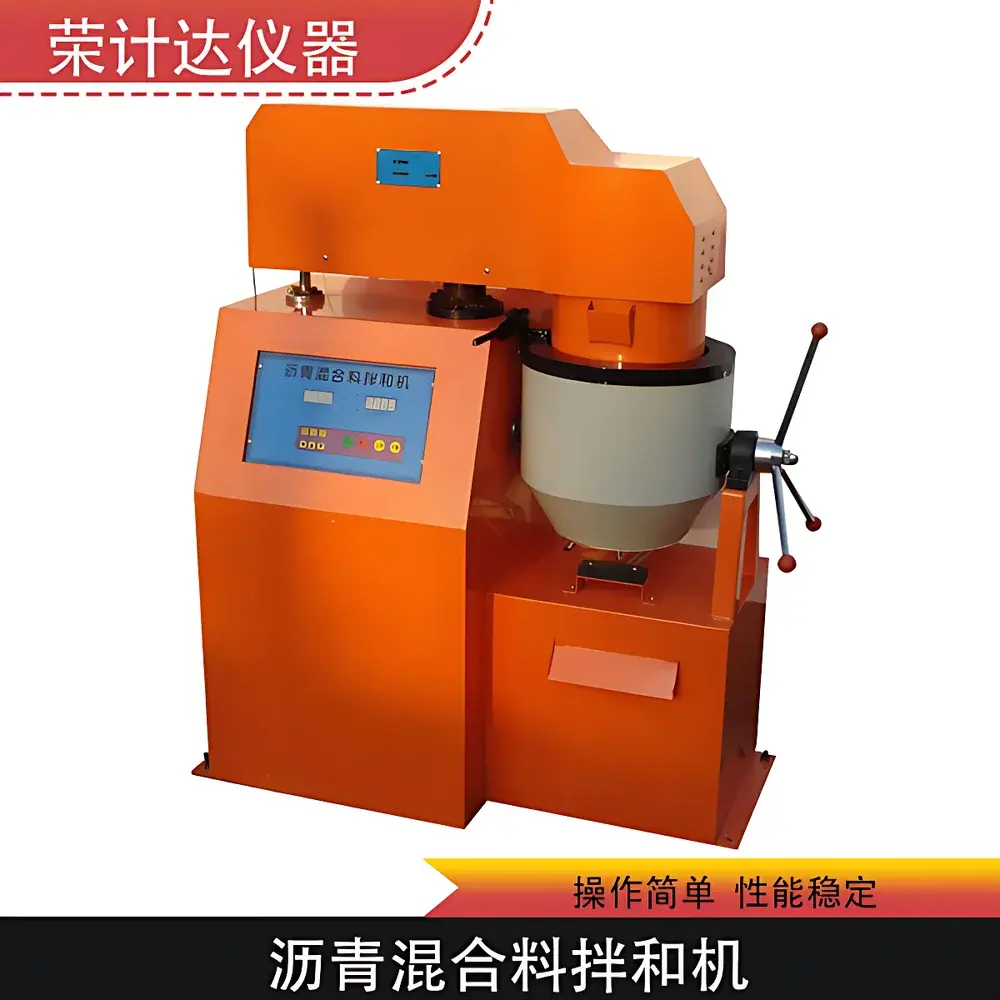
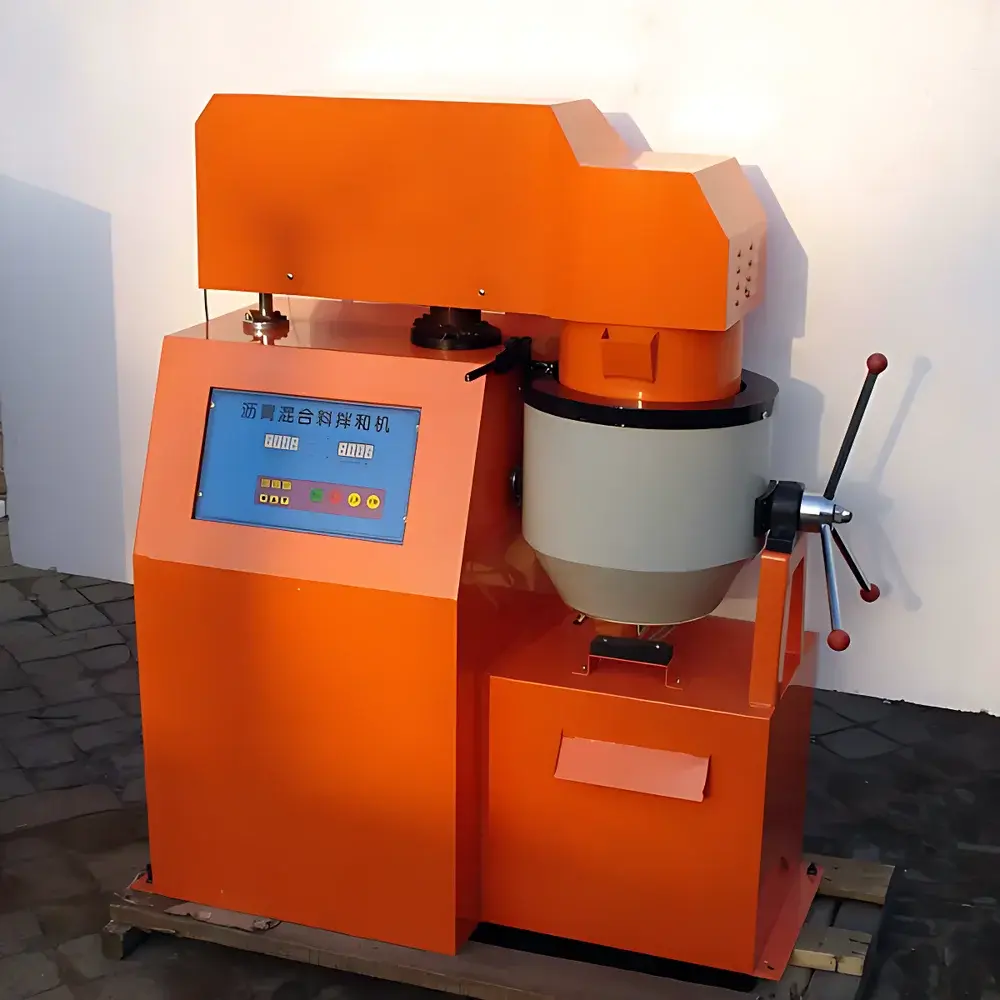
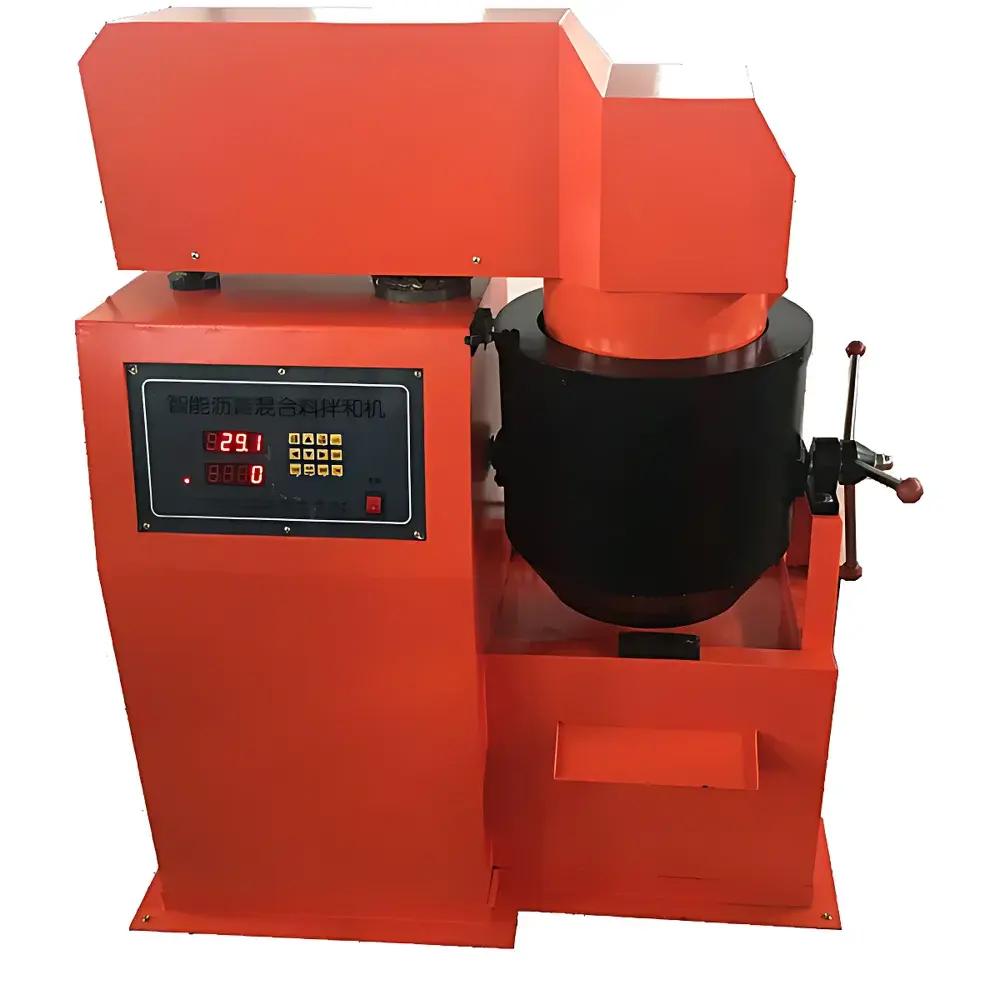
Rongjida BH-10/20 Asphalt Mixture Mixer
| Brand | Rongjida |
|---|---|
| Origin | Shanghai, China |
| Manufacturer Type | Direct Manufacturer |
| Model | BH-10/20 |
| Mixing Capacity | 10 L or 20 L (selectable) |
| Heating Pan Temperature Range | Ambient to 250 °C (adjustable in 1 °C increments) |
| Temperature Control Accuracy | ±3 °C (empty pan) |
| Mixing Time Range | 1–999 s (programmable) |
| Agitator Speed | Orbital rotation 48 rpm, Planetary rotation 76 rpm |
| Dimensions (BH-10 / BH-20) | 1100 × 560 × 1270 mm / 1220 × 620 × 1320 mm |
| Weight (BH-10 / BH-20) | 190 kg / 236 kg |
| Power Supply | 220 V AC, 50 Hz |
| Rated Power | 3 kW |
| Operating Ambient Temperature | 5–40 °C |
| Relative Humidity | ≤85% RH |
Overview
The Rongjida BH-10/20 Asphalt Mixture Mixer is a precision-engineered laboratory instrument designed for the reproducible preparation of asphalt-aggregate and cement-aggregate mixtures in accordance with standardized test protocols. It operates on a dual-rotation planetary mixing principle—combining orbital motion (48 rpm) and independent planetary rotation (76 rpm) of the agitator assembly—to ensure uniform dispersion of bituminous binder across mineral aggregates without segregation or localized overheating. The unit integrates a thermally insulated double-walled heating pan filled with high-stability heat-transfer oil, enabling precise temperature control from ambient up to 250 °C. Its design strictly complies with JTJ 052–2000, the Chinese national standard for testing methods of bitumen and asphalt mixtures, and supports methodologically consistent sample preparation required for Marshall stability tests, rutting resistance evaluation, and indirect tensile strength (IDT) analysis per ASTM D6927, AASHTO T 245, and EN 12697 series specifications.
Key Features
- Dual-capacity configuration: Selectable 10 L or 20 L mixing volume to accommodate both small-batch research trials and full-scale production-quality specimen preparation.
- High-fidelity thermal management: PID-controlled heating system with ±3 °C accuracy (measured in empty pan), verified via calibrated PT100 sensor embedded in the pan wall; heating rate optimized to minimize thermal lag during ramp-up.
- Automated vertical actuation: Electromechanical lift mechanism with dual mechanical limit switches ensures repeatable positioning of the agitator head—fully ascending for loading/unloading, descending to precise immersion depth prior to mixing initiation.
- One-touch operational sequence: Integrated microprocessor controller coordinates heating, lifting, mixing duration, and post-mixing pause intervals; all parameters stored in non-volatile memory for recall across sessions.
- Rugged structural architecture: Powder-coated steel frame with reinforced upright columns and linear guide rails; vibration-damped base plate minimizes transmission to adjacent instrumentation.
- Electrical safety compliance: Dual-pole isolation switch, overtemperature cut-off relay, and grounded oil-heating circuit meeting IEC 61000-6-3 EMC emission limits and GB 4793.1–2007 safety requirements for laboratory equipment.
Sample Compatibility & Compliance
The BH-10/20 accommodates a broad range of aggregate gradations—from fine sand to coarse crushed stone (max. particle size ≤25 mm)—and is compatible with penetration-grade, viscosity-grade, and polymer-modified bitumens (e.g., PG 64-22, SBS-modified 70/100). It supports preparation of cylindrical specimens (101.6 mm × 63.5 mm) for Marshall compaction and slab specimens for Hamburg wheel-tracking tests. All operational procedures align with the traceability and documentation expectations of ISO/IEC 17025-accredited laboratories. While not inherently 21 CFR Part 11 compliant, audit trails (time-stamped parameter logs, operator ID fields, and calibration history entries) can be exported in CSV format for integration into validated LIMS environments supporting GLP/GMP workflows.
Software & Data Management
The mixer utilizes an embedded 8-bit microcontroller with real-time clock and EEPROM-based parameter storage. No external PC software is required for basic operation; however, optional RS-232 serial interface (standard on BH-20 variant) enables remote command execution (e.g., START, STOP, SET_TEMP, SET_TIME) and acquisition of live temperature readings and cycle status flags. Logged data—including start time, target temperature, actual pan temperature at 5-s intervals, mixing duration, and completion timestamp—is retained for the last 100 cycles and exportable via terminal emulation. Firmware updates are performed using vendor-provided utility tools and require physical access to the rear-panel programming port.
Applications
- Preparation of asphalt mixture specimens for Marshall stability and flow value determination (ASTM D6927, JTG E20–2011).
- Homogenization of warm-mix asphalt (WMA) formulations containing organic or chemical additives prior to compaction and performance testing.
- Controlled blending of reclaimed asphalt pavement (RAP) and recycled asphalt shingles (RAS) with virgin binder and aggregate under simulated field heating conditions.
- Protocol development for modified binder dispersion validation, including nanomaterials (e.g., nano-clay, graphene oxide) requiring extended shear exposure.
- Quality assurance testing in asphalt plant laboratories where batch-to-batch consistency must be verified against reference standards.
FAQ
What safety certifications does the BH-10/20 hold?
The unit conforms to GB 4793.1–2007 (equivalent to IEC 61010-1) for electrical safety in laboratory equipment and meets CE-marking essential requirements for electromagnetic compatibility (EN 61326-1) and low-voltage directive (2014/35/EU) when supplied with EU-spec power cord and labeling.
Can the heating pan be replaced independently?
Yes—the double-walled oil-filled pan is a modular subassembly secured by eight M6 stainless-steel bolts; replacement requires draining the thermal oil, disconnecting the heater and sensor leads, and reinstalling with new gasket material (supplied with spare parts kit).
Is it possible to integrate the mixer into an automated testing line?
The RS-232 interface (available on BH-20) supports Modbus RTU protocol for handshake-controlled triggering from external PLCs or central lab controllers; discrete I/O terminals (start, stop, ready, fault) are also provided on the rear terminal block.
How often does the thermal oil require replacement?
Under normal use (≤4 hours/day, max 220 °C continuous), the synthetic heat-transfer oil should be inspected annually via flash point and acid number testing; typical service life exceeds 3 years before replacement is indicated.
Does the instrument support multi-step mixing protocols (e.g., dry mix → binder addition → wet mix)?
Yes—the programmable timer allows sequential activation of lift-down/mix cycles; users may configure two-stage procedures (e.g., 30 s dry agitation, pause, mineral filler addition, then 60 s final mix) using manual intervention between steps or via external automation logic.




