
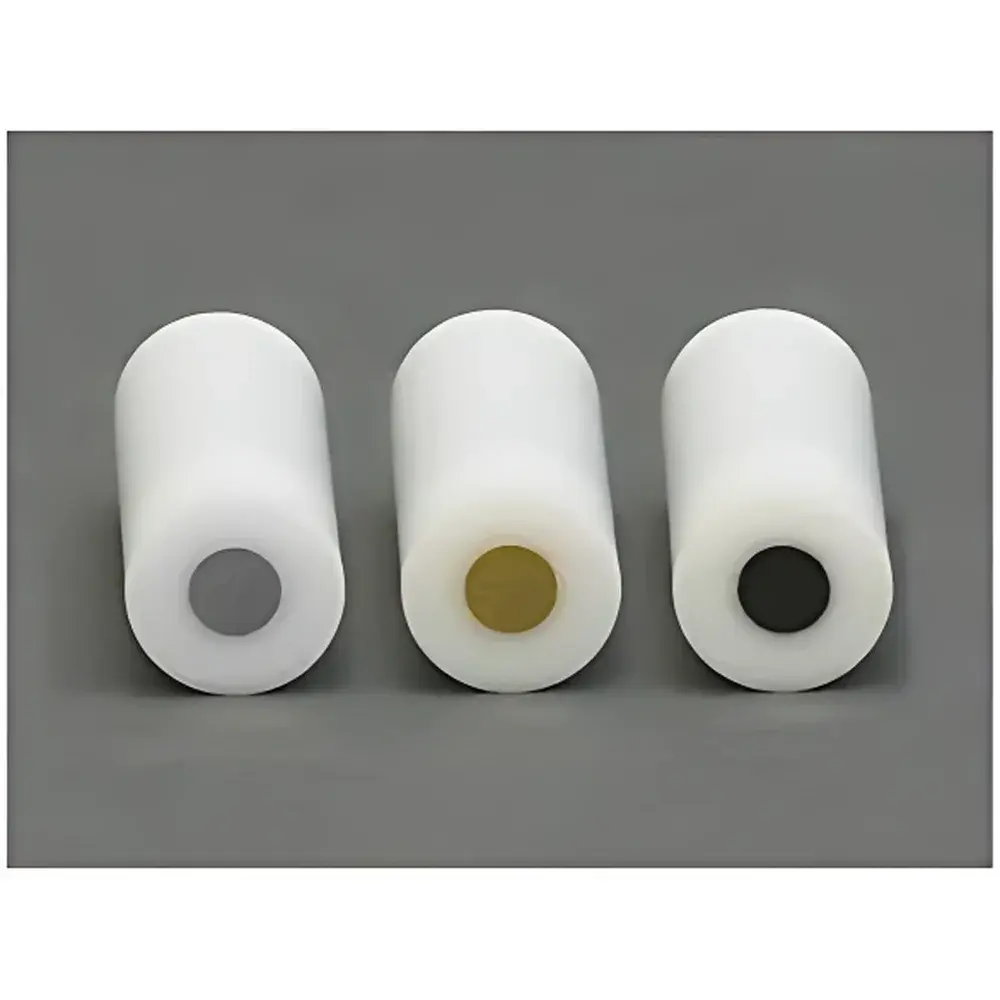
Rotating Disk Electrode (RDE) / Rotating Glassy Carbon Disk Electrode (RGCE) – dc-energies DCGC Series
| Brand | dc-energies |
|---|---|
| Diameter | 5 mm (active disk) |
| Overall Outer Diameter | 15 mm |
| Material | High-purity glassy carbon disk, PTFE-insulated shaft, stainless steel or brass housing (configurable) |
| Origin | Hubei, China |
| Instrument Type | Electrochemical Working Electrode Accessory |
Overview
The dc-energies DCGC Series Rotating Disk Electrode (RDE) is a precision-engineered electrochemical working electrode designed for controlled hydrodynamic voltammetry and kinetic studies in fundamental and applied electrochemistry. Based on the Levich equation and Koutecký–Levich analysis, this electrode enables quantitative determination of diffusion-controlled current, electron transfer kinetics, and mass transport parameters under well-defined laminar flow conditions. The DCGC features a 5 mm nominal active glassy carbon (GC) disk embedded within a chemically inert, electrically insulated body—typically constructed from PTFE-shielded stainless steel or brass—with an outer diameter of 15 mm and standardized external threading (M6 or 1/4″-28 UNC, depending on configuration) for seamless integration with commercially available potentiostat-coupled rotator systems (e.g., Pine Research, ALS, Metrohm Autolab). Its geometry ensures minimal edge effects and high rotational symmetry, critical for reproducible current response across rotation speeds ranging from 100 to 10,000 rpm.
Key Features
- Precision-machined 5 mm diameter glassy carbon disk with low background current, wide electrochemical window (−1.0 V to +1.2 V vs. Ag/AgCl in aqueous media), and excellent chemical stability in acidic, alkaline, and organic electrolytes.
- Robust mechanical design: fully insulated shaft with PTFE sleeve prevents parasitic current leakage; threaded outer body ensures secure, vibration-resistant mounting in standard RDE holders.
- Consistent disk-to-shaft alignment and polished surface finish (Ra < 0.05 µm) guarantee uniform mass transport and minimize radial convection artifacts.
- Interchangeable configurations available: single-disk GC, GC/Pt dual-ring-disk (RRDE-ready), or custom substrate options (e.g., Pt, Au, Ni) upon request.
- Compliant with ISO 13485–aligned manufacturing controls; each unit undergoes electrical continuity verification and dimensional inspection prior to dispatch.
Sample Compatibility & Compliance
The DCGC electrode is compatible with standard three-electrode electrochemical cells (e.g., 10–50 mL volume), including jacketed and gas-tight configurations. It supports aqueous (e.g., 0.1 M H2SO4, 0.1 M KOH), non-aqueous (e.g., acetonitrile/LiClO4, DMF/TBAP), and ionic liquid electrolyte systems. Surface pretreatment protocols—including mechanical polishing (0.05 µm alumina slurry), electrochemical activation (cyclic voltammetry in H2SO4), and UV-ozone cleaning—are recommended prior to use to ensure reproducible baseline behavior. The electrode meets functional requirements referenced in ASTM E2751-21 (Standard Guide for Electrochemical Kinetic Measurements Using Rotating Electrodes) and supports GLP-compliant data acquisition when paired with validated potentiostats and audit-trail-enabled software.
Software & Data Management
While the DCGC is a passive transducer and requires no embedded firmware, its performance is fully leveraged through industry-standard electrochemical workstations (e.g., BioLogic SP-300, Gamry Interface 5000E, PalmSens EmStat GO). When used with compliant software platforms supporting 21 CFR Part 11 modules (e.g., NOVA, EC-Lab, Framework), experimental parameters—including rotation speed, scan rate, potential limits, and timestamped current response—are recorded with electronic signatures, user access logs, and immutable audit trails. Export formats include ASCII (.txt), .csv, and binary (.mpr), facilitating downstream analysis via MATLAB, Python (PyChrono, ECpy), or OriginLab for Levich plot generation and kinetic parameter extraction.
Applications
- Oxygen reduction reaction (ORR) and hydrogen evolution reaction (HER) mechanism studies in fuel cell catalyst development.
- Electrocatalytic CO2 reduction kinetics and selectivity mapping under controlled mass transport.
- Corrosion science: evaluation of passivation behavior and pitting susceptibility in chloride-containing media.
- Sensor development: calibration of amperometric biosensors and redox polymer-based detection interfaces.
- Electroanalytical method validation per USP and EP 2.2.44 for pharmaceutical redox impurity quantification.
FAQ
What is the recommended cleaning protocol before first use?
Mechanically polish the disk with 0.05 µm alumina slurry on microcloth, rinse thoroughly with ultrapure water and ethanol, then perform 20 cyclic voltammetric scans (−0.2 to +1.2 V vs. Ag/AgCl, 50 mV/s) in 0.5 M H2SO4 to stabilize the surface oxide layer.
Is the DCGC compatible with rotating ring-disk electrode (RRDE) setups?
Yes—the DCGC base design allows retrofitting into RRDE assemblies when ordered with dual-collection geometry and appropriate insulator spacing (standard gap: 0.25 mm). Custom RRDE versions are available under separate part numbers.
Can the electrode be used in high-temperature electrochemical cells?
The standard PTFE insulation limits continuous operation to ≤80 °C; for elevated temperature applications (up to 200 °C), high-temperature variants with polyimide or ceramic insulation are offered upon engineering review.
Does dc-energies provide calibration certificates or traceable metrology documentation?
Dimensional verification reports (including disk diameter, concentricity, and thread pitch) are supplied with each batch. Electrochemical performance validation data (e.g., Levich slope consistency at 1600 rpm in 5 mM K3[Fe(CN)6]) can be provided upon request for IQ/OQ qualification.





