
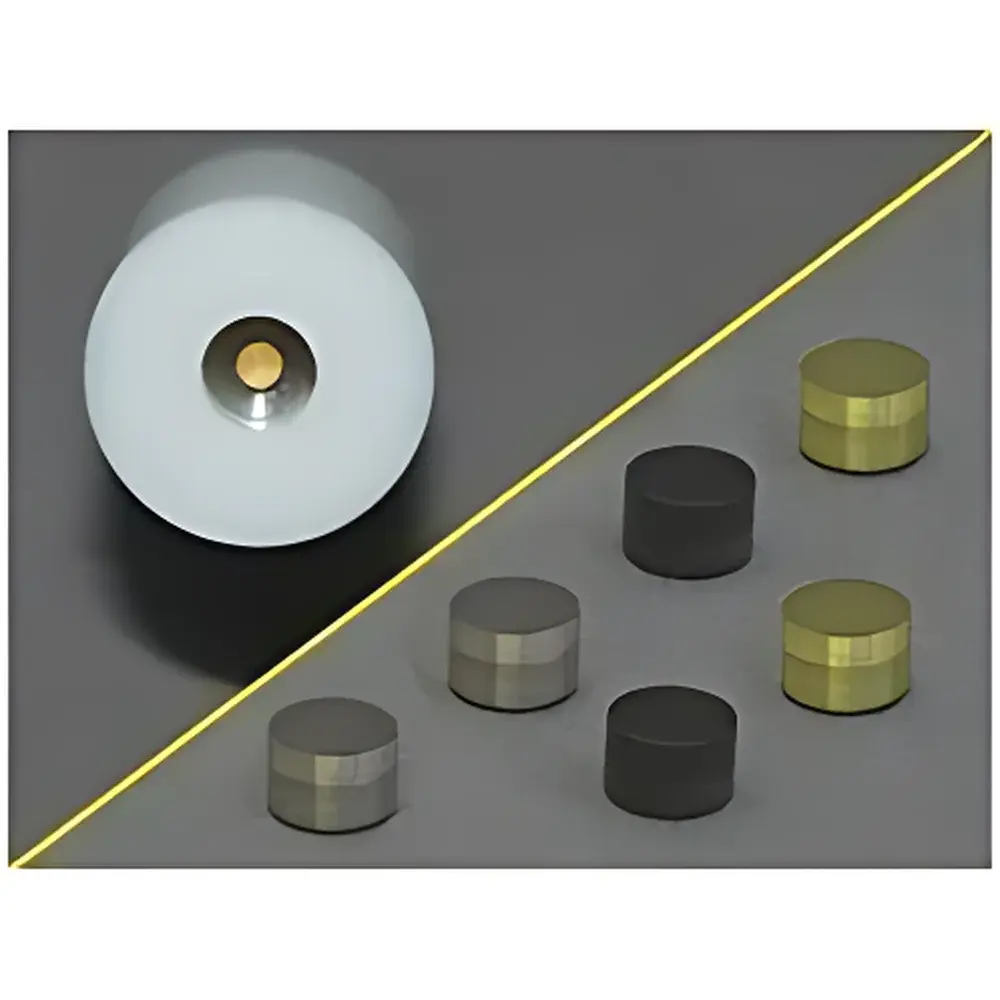
Rotating Ring-Disk Electrode (RRDE) with Interchangeable Disk – dc-energies
| Brand | dc-energies |
|---|---|
| Material Options | Glassy Carbon (GC), Gold (Au), Platinum (Pt) |
| Disk Diameter | 5.0 mm |
| Overall Electrode Outer Diameter | 15 mm |
| Operating Temperature Range | 10–25 °C |
Overview
The dc-energies RRDE-Interchangeable Disk is a precision-engineered rotating ring-disk electrode system designed for advanced electrochemical kinetic and mechanistic studies under controlled hydrodynamic conditions. Based on the classical Levich and Koutecký–Levich formalisms, this RRDE operates on the principle of forced convection: rotation of the disk generates a well-defined, laminar flow profile that transports electroactive species to the electrode surface at a predictable mass-transfer rate. The concentric ring electrode enables simultaneous detection or collection of reaction intermediates generated at the disk—making it indispensable for probing multi-step electron-transfer processes, catalytic oxygen reduction (ORR), hydrogen evolution (HER), CO₂ reduction (CO₂RR), and corrosion-related redox cycling. Unlike fixed-disk configurations, this system integrates a modular U-Cup holder mechanism, allowing users to physically insert and secure discrete disk inserts (GC, Au, Pt) without adhesive bonding or permanent assembly—thereby preserving electrode integrity across experiments and enabling rapid material screening.
Key Features
- Modular U-Cup disk retention system: Enables tool-free, repeatable insertion and removal of disk electrodes—eliminating epoxy-based mounting and reducing cross-contamination risk between material sets.
- High-precision machined shaft with external threading: Ensures low-contact-resistance electrical connection and mechanical stability during high-speed rotation (compatible with standard RDE rotators up to 10,000 rpm).
- Uniformly dense, low-defect glassy carbon (GC) disk blanks: Certified for minimal surface heterogeneity and consistent electron-transfer kinetics; optional Au and Pt disks supplied with certified purity (≥99.99%) and electrochemically active surface area validation.
- Geometrically defined hydrodynamic geometry: 5.0 mm disk diameter embedded within a 15 mm outer housing ensures compliance with Levich equation assumptions for diffusion-controlled current calculations.
- Thermally stable construction: Rated for continuous operation between 10 °C and 25 °C—optimized for ambient lab environments where thermal drift must be minimized during long-duration chronoamperometric or cyclic voltammetric sweeps.
Sample Compatibility & Compliance
This RRDE configuration supports aqueous and non-aqueous electrolytes including 0.1 M HClO₄, 0.1 M KOH, acetonitrile/LiClO₄, and DMSO/TBAP systems. All disk materials meet ASTM E2784–19 standards for electrochemical sensor substrate characterization. The U-Cup interface design conforms to ISO 13485-aligned mechanical interchangeability requirements for laboratory electrochemical accessories. When used in conjunction with GLP-compliant potentiostats (e.g., BioLogic SP-300, Pine Research WaveNow), full audit trails—including rotation speed logs, timestamped potential steps, and electrode identification metadata—can be maintained per FDA 21 CFR Part 11 guidelines.
Software & Data Management
No proprietary firmware or closed software is embedded in the hardware; compatibility is ensured across industry-standard platforms including EC-Lab (BioLogic), AfterMath (Pine Research), and NOVA (Metrohm Autolab). The mechanical modularity allows seamless integration into automated electrochemical workstations equipped with robotic sample changers and environmental chambers. Raw current–potential–rotation datasets export natively to .txt, .mpt, and .csv formats—enabling direct import into Python (SciPy, PyEIS), MATLAB, or Origin for Koutecký–Levich linearization, Tafel analysis, and ring-to-disk collection efficiency (N) calibration.
Applications
- Oxygen reduction reaction (ORR) pathway discrimination via ring collection of H₂O₂ (N = Iring/Idisk) in fuel cell catalyst evaluation.
- Electrocatalyst stability assessment through accelerated degradation protocols (ADT) with periodic disk material exchange to isolate support vs. metal contributions.
- Redox mediation studies in flow batteries using dual-material disk–ring combinations (e.g., GC disk + Pt ring).
- In situ monitoring of passivation layer formation on stainless steel or Ni-based alloys in chloride-containing media.
- Quantitative determination of diffusion coefficients (D) and electron-transfer rate constants (k⁰) using rotating disk voltammetry (RDV) in homogeneous electron-transfer kinetics.
FAQ
Can this RRDE be used with commercial bipotentiostats?
Yes—fully compatible with all major bipotentiostats supporting independent control of disk and ring potentials (e.g., Pine Research AFMSIECE, Metrohm Autolab PGSTAT302N, Gamry Interface 5000P).
Is the U-Cup holder supplied with each electrode?
Yes—the U-Cup retaining mechanism is integrated into the electrode body and requires no additional accessories for disk insertion.
What is the recommended cleaning protocol between disk material changes?
Mechanically polish GC/Au/Pt disks with 0.05 µm alumina slurry on microcloth, rinse sequentially with ultrapure water, ethanol, and acetone, then dry under nitrogen; verify cleanliness via cyclic voltammetry in blank supporting electrolyte.
Does dc-energies provide calibration data for collection efficiency (N)?
Each RRDE undergoes geometric verification; users are advised to determine N experimentally using the [Fe(CN)₆]³⁻/⁴⁻ redox couple at pH 7.0 buffer per ASTM G102–89 guidelines.
Are custom disk diameters or ring gap dimensions available?
Standard configuration follows widely adopted 5.0 mm disk / 15 mm outer diameter geometry; custom geometries are available under OEM agreement with minimum order quantities.






