
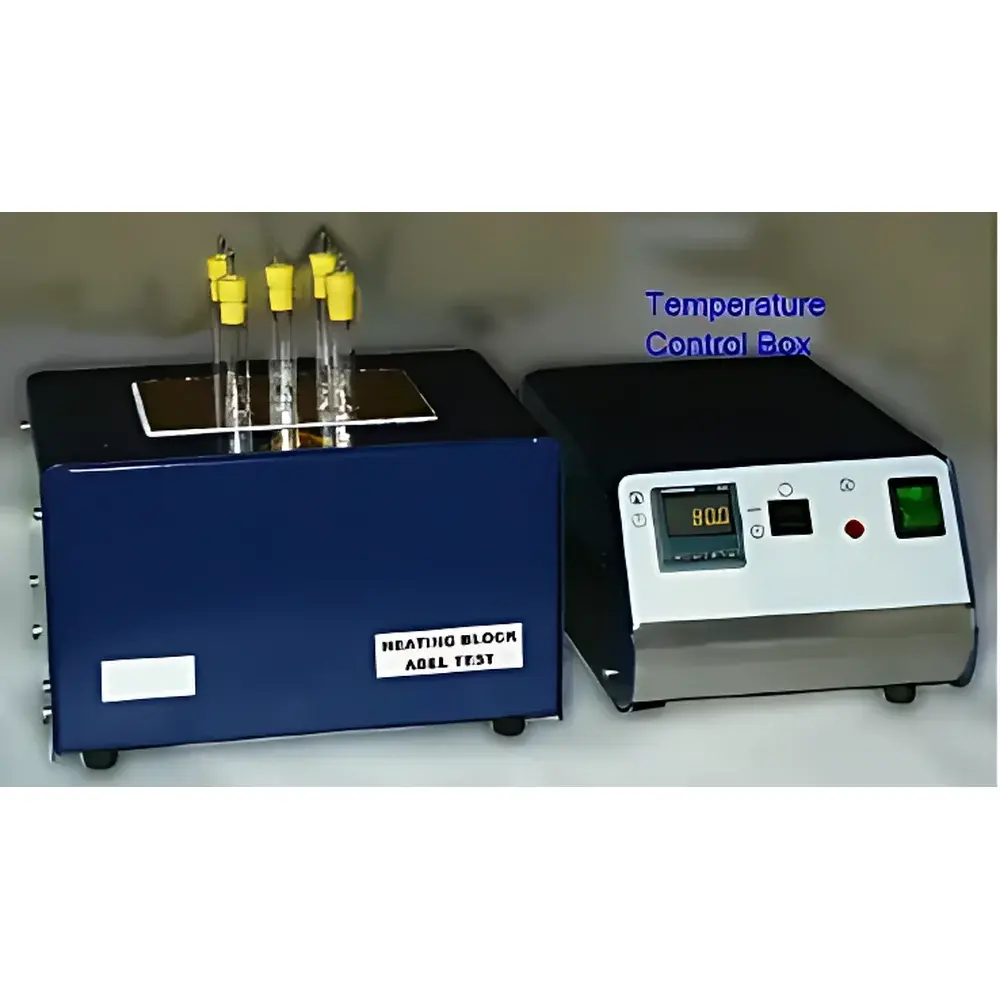
R&P AB140 Abel Stability Analyzer
| Brand | R&P |
|---|---|
| Origin | Germany |
| Manufacturer Type | Authorized Distributor |
| Origin Category | Imported |
| Model | AB140 |
| Price Range | USD 27,000 – 68,000 |
| Heating Block Material | Aluminum |
| Sample Capacity | 5 positions |
| Sample Tube Dimensions | Ø17.5 ± 0.1 mm × 70 mm depth (tube body) |
| Temperature Sensor | PT100 probe |
| Temperature Control | PID controller with independent control cabinet |
| Max Setpoint | 140 °C |
| Temperature Accuracy | ±0.1 °C |
| Power Supply | 230 V / 50 Hz, 300 VA |
| Safety Features | Over-temperature cut-off protection |
| Accessories Included | 5 calibrated cylindrical sample tubes (with three annular bands), perforated rubber stoppers, platinum-tipped glass rods, KI-starch test paper support fixture |
Overview
The R&P AB140 Abel Stability Analyzer is a precision-engineered instrument designed specifically for the quantitative assessment of thermal chemical stability in energetic materials—particularly nitroglycerin, nitrocellulose, and nitrate ester-based compounds—according to the internationally recognized Abel test method (BS 6397:2008, DIN 51700, STANAG 4147, and NATO AOP-4). This standardized procedure evaluates the time required for a defined mass of sample, heated under controlled conditions in a sealed tube, to generate sufficient nitrogen oxides (NOx) to discolor potassium iodide–starch indicator paper at the dry–wet interface. The resulting “Abel time” serves as a critical quality control parameter in propellant and explosive manufacturing, munitions surveillance, and raw material acceptance testing. The AB140 implements this gravimetric–colorimetric endpoint detection with metrological rigor, leveraging a thermally homogeneous aluminum heating block, high-fidelity PT100 sensing, and closed-loop PID temperature regulation to ensure repeatability across laboratories and compliance with GLP and defense procurement requirements.
Key Features
- Five-position aluminum heating block with uniform thermal distribution and ±0.1 °C temperature stability over extended dwell periods
- Individually calibrated sample tubes (Ø17.5 ± 0.2 mm × 135 ± 2 mm) manufactured to strict dimensional tolerances per DIN 51700 Annex A
- Dedicated platinum-tipped glass rods and perforated rubber stoppers optimized for consistent headspace geometry and gas diffusion kinetics
- Independent PID temperature controller housed in a shielded cabinet, minimizing electromagnetic interference with adjacent instrumentation
- Dual digital display showing real-time measured temperature and user-defined setpoint, with visual alarm indication upon deviation exceeding ±0.3 °C
- Integrated over-temperature safety cutoff (145 °C mechanical limit) compliant with IEC 61010-1 for Class II laboratory equipment
- Modular accessory kit including KI-starch paper holder, timing stopwatch mount, and traceable calibration certificate for initial verification
Sample Compatibility & Compliance
The AB140 supports routine analysis of Class 1.1–1.3 explosives and propellant formulations containing nitrocellulose (NC), nitroglycerin (NG), diethylene glycol dinitrate (DEGN), and ethyl centralite (EC), provided samples are handled in accordance with UN Transport Regulations (UN 0232, UN 0233) and national ordnance safety directives. All wetted components—including tubes, stoppers, and rods—are chemically inert toward nitrate esters under test conditions. The system conforms to ISO/IEC 17025:2017 requirements for test method validation, and its operational protocol satisfies the documentation and audit-trail expectations of MIL-STD-1981B, NATO AQAP-2110, and EU Directive 2014/28/EU on explosives for civil uses. Traceability of temperature calibration is maintained via NIST-traceable PT100 sensor certification.
Software & Data Management
While the AB140 operates as a stand-alone analog-digital hybrid instrument (no embedded firmware or touchscreen), it is fully compatible with external laboratory data management systems. Temperature profiles and manual timer logs can be exported via RS-232 or USB-to-serial interface (optional adapter) for integration into LIMS platforms supporting ASTM E2500-21 electronic record workflows. Users may configure automated pass/fail criteria based on minimum acceptable Abel time thresholds (e.g., ≥180 s for NC-based propellants per MIL-DTL-22077E). Audit trails—including operator ID, date/time stamp, setpoint, actual temperature history, and result entry—are retained in CSV format for FDA 21 CFR Part 11–compliant environments when paired with validated third-party software.
Applications
- Batch release testing of double-base and triple-base propellants in defense manufacturing facilities
- Stability surveillance of aged munitions stockpiles per DoD 4140.01-R and NATO AMSP-10
- Raw material qualification of nitrocellulose supplied by cellulose nitrate producers (e.g., AkzoNobel, Nitrochemie Wimmis)
- Research-level kinetic studies of NOx evolution rates under isothermal conditions (120–140 °C)
- Interlaboratory comparison exercises coordinated by ECSS-Q-ST-70-02C or ISO/IEC 17043
- Validation of stabilizer efficacy (e.g., diphenylamine, 2-nitrodiphenylamine) in nitrate ester formulations
FAQ
What standards does the AB140 comply with for military applications?
The AB140 fulfills the physical configuration and procedural requirements of STANAG 4147 Ed. 5, AOP-4 Ed. 7, and MIL-STD-1981B Annex C for Abel test execution.
Can the instrument be used for non-nitrate-ester compounds?
No—the AB140 is purpose-built for NOx-evolving energetic materials; it is not validated for peroxides, azides, or metal hydrides, which require alternative test methods (e.g., Bergmann-Junk, Vacuum Stability Test).
Is calibration verification required before each test series?
Per ISO/IEC 17025 Clause 6.4.10, temperature uniformity across all five wells must be verified at least daily using a secondary NIST-traceable thermometer prior to sample loading.
How is operator safety ensured during high-temperature operation?
The unit incorporates dual redundant thermal protection: electronic PID limiter (140 °C) and independent bimetallic cut-off (145 °C), plus insulated housing meeting IEC 61010-1 touch-temperature limits for Class II equipment.
Are spare parts and consumables available globally?
Yes—R&P maintains certified spare tube sets, PT100 sensors, and KI-starch paper through its authorized distributor network in North America, EMEA, and APAC regions, with documented shelf-life and lot traceability.





