
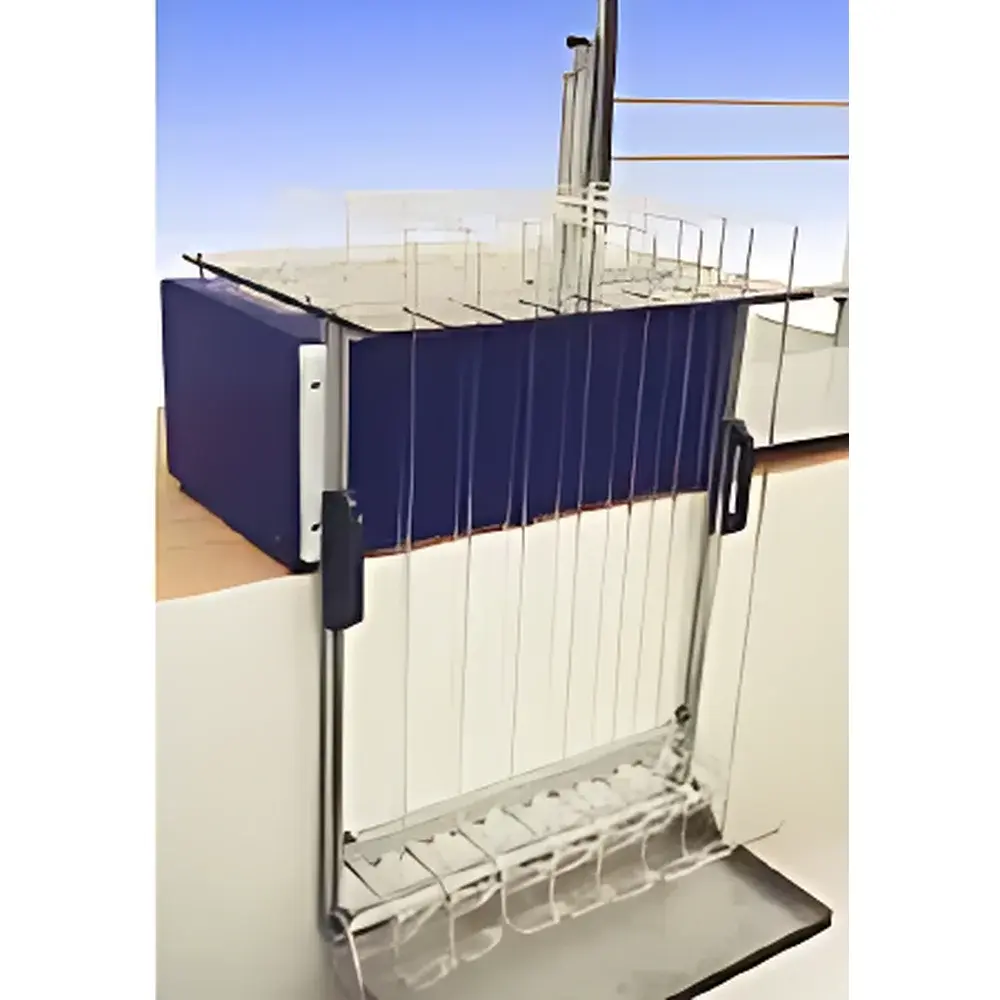
R&P Thermogravimetric Stability Analyzer for Energetic Materials
| Brand | R&P |
|---|---|
| Origin | Germany |
| Model | Thermogravimetric Stability Analyzer |
| Heating Range | Ambient to 135 °C |
| Temperature Control Accuracy | ±0.1 °C |
| Sample Capacity | 15 positions |
| Sample Tube Dimensions | Ø15 mm × 155 mm |
| Heating Block | Aluminum, Electrically Heated |
| Temperature Sensor | PT100 probe |
| Safety Cutoff | 150 °C thermal limiter |
| Controller | Dedicated PID temperature controller with digital display of setpoint and actual temperature |
| Power Supply | 230 V / 50 Hz, 1800 VA |
| Vacuum Measurement Method | Mercury manometer (capillary + mercury reservoir) per MIL-STD-286C |
| Compliance | Designed for ASTM E2070, ISO 11119-2, and NATO AEP-97 test protocols |
Overview
The R&P Thermogravimetric Stability Analyzer for Energetic Materials is a precision-engineered instrument designed for the quantitative assessment of thermal stability in propellants, explosives, pyrotechnic compositions, and energetic binders—including nitrocellulose, nitramines, double-base and single-base propellants, and related nitro-compounds. It operates on the principle of vacuum stability testing (VST), as standardized in MIL-STD-286C and aligned with ASTM E2070 and ISO 11119-2. In this method, a precisely weighed sample is sealed within a calibrated cylindrical glass tube under high vacuum, then heated at a constant temperature in a thermostatically controlled aluminum heating block. Gaseous decomposition products evolve over time and exert pressure on a mercury column in a U-tube manometer; the resulting displacement is measured and converted to gas volume at standard temperature and pressure (STP). This evolved gas volume—typically reported in mL/48 h or mL/24 h—is the primary metric for evaluating chemical stability, aging behavior, and compatibility between formulation components.
Key Features
- Aluminum heating block with uniform thermal distribution and rapid thermal response, enabling precise temperature ramping and isothermal hold stability.
- 15 independent sample positions (Ø15.75 mm × 125 mm depth), each accommodating a standardized glass test tube (Ø15 mm × 155 mm) with integrated mercury-sealed capillary assembly.
- High-accuracy PT100 platinum resistance thermometer embedded directly in the heating block for real-time feedback and closed-loop PID control.
- Dedicated temperature controller with dual digital LED display—simultaneously showing setpoint and actual block temperature—with resolution of 0.1 °C and long-term stability better than ±0.1 °C over 48-hour tests.
- Programmable temperature range from ambient up to 135 °C, with factory-calibrated safety cutoff at 150 °C to prevent thermal runaway during extended operation.
- Integrated mercury manometer system comprising fused-silica capillary tubing and calibrated mercury reservoir, traceable to national metrology standards for pressure-to-volume conversion.
- Modular mechanical support frame constructed from chemically inert anodized aluminum, ensuring rigid alignment of glassware and mercury columns across all 15 stations.
Sample Compatibility & Compliance
The analyzer accommodates solid energetic materials in granular, flake, or pellet form—provided they fit within the specified tube geometry and do not react with mercury or borosilicate glass under test conditions. It supports routine qualification per military and aerospace specifications including MIL-STD-286C (Vacuum Stability Test), NATO AEP-97 (Test Methods for Propellants), and national standards such as DIN 55523-2 and GOST 12.2.070. All hardware components—including heating block, sensor housing, and mercury containment fixtures—meet CE marking requirements for electrical safety and electromagnetic compatibility (EMC Directive 2014/30/EU). The system design facilitates GLP-compliant documentation when paired with validated laboratory notebooks and audit-trail-enabled data loggers.
Software & Data Management
While the base configuration operates as a standalone analog-manometer instrument, optional digital data acquisition modules are available for integration with PC-based logging software compliant with FDA 21 CFR Part 11. These modules record temperature profiles, elapsed test time, and mercury column displacement at user-defined intervals (e.g., every 15 minutes), automatically converting raw pressure readings into STP-corrected gas volumes using NIST-traceable algorithms. Export formats include CSV and PDF reports with embedded metadata (operator ID, calibration certificate numbers, environmental conditions), supporting full traceability in regulated environments.
Applications
- Qualification testing of new propellant formulations prior to lot acceptance in defense manufacturing.
- Batch-to-batch stability monitoring of nitrocellulose-based smokeless powders during shelf-life studies.
- Compatibility screening between oxidizers (e.g., ammonium perchlorate) and polymer binders (e.g., HTPB, GAP) in composite solid rocket fuels.
- Accelerated aging studies under elevated isothermal conditions (e.g., 90 °C, 100 °C, 120 °C) to predict long-term storage behavior.
- Root-cause analysis of instability incidents in fielded munitions through comparative VST profiling against baseline reference lots.
FAQ
What standards does this instrument support?
It is engineered for direct implementation of MIL-STD-286C, ASTM E2070, ISO 11119-2, and NATO AEP-97 Annex D procedures.
Is mercury handling training required?
Yes—users must comply with local occupational health regulations (e.g., OSHA 29 CFR 1910.1200, EU Directive 2003/18/EC) regarding mercury exposure control, spill response, and waste disposal.
Can the system be upgraded for automated data capture?
Yes—R&P offers optional digital transducer kits with USB/RS-485 interfaces and validated software compliant with 21 CFR Part 11 for electronic records and signatures.
What maintenance is recommended for long-term accuracy?
Annual recalibration of the PT100 sensor and mercury manometer zero-point verification are advised; R&P provides certified calibration services traceable to PTB (Physikalisch-Technische Bundesanstalt).
Are replacement tubes and mercury assemblies available?
Yes—original-specification glassware, mercury reservoirs, and capillary sets are stocked and supplied with individual calibration certificates.



