
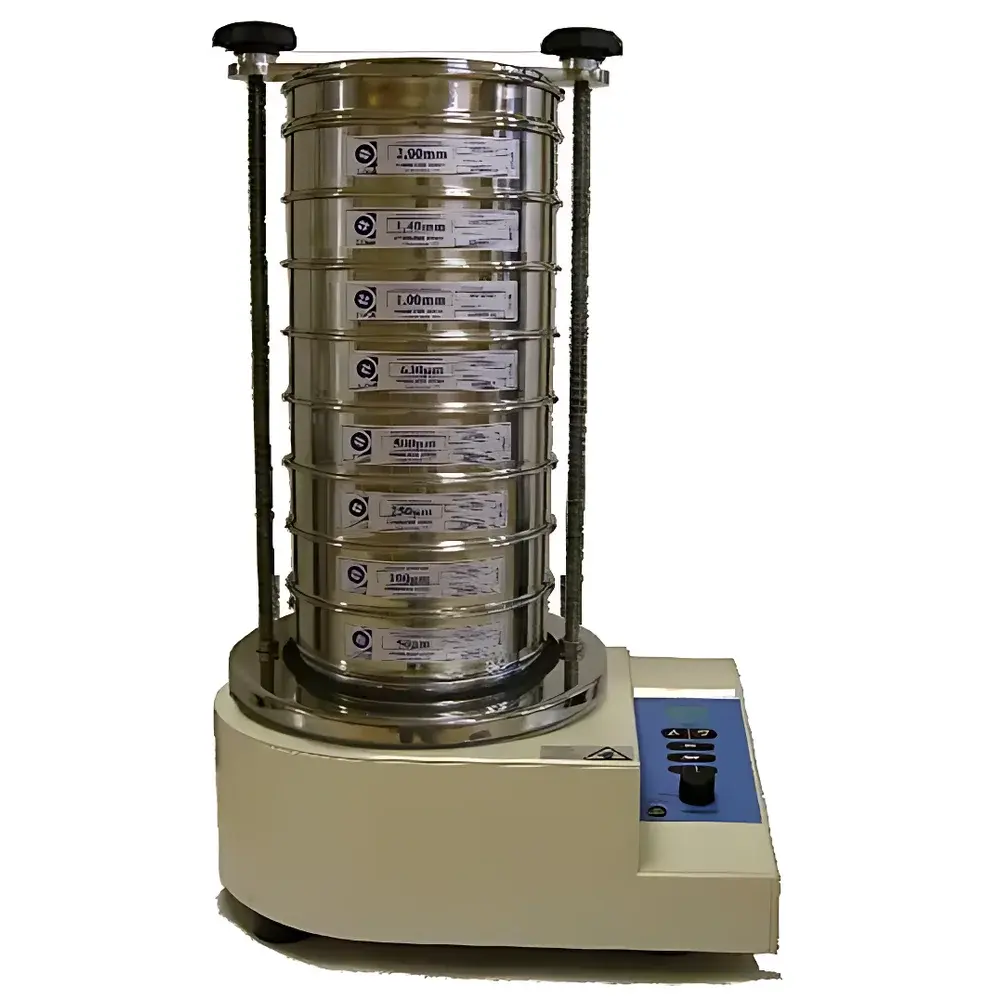
RP20 Electromagnetic Digital Sieve Shaker
| Origin | Spain |
|---|---|
| Manufacturer Type | Authorized Distributor |
| Origin Category | Imported |
| Model | RP20 |
| Price | Upon Request |
Overview
The RP20 Electromagnetic Digital Sieve Shaker is a precision-engineered laboratory instrument designed for standardized dry and wet sieve analysis of granular and powdered materials. It operates on the principle of electromagnetic resonance—generating controlled, reproducible three-dimensional motion (simultaneous circular and vertical oscillation) to ensure uniform particle stratification and efficient separation across stacked sieve decks. Unlike mechanical shakers driven by eccentric motors or cam systems, the RP20’s electromagnetic actuation eliminates mechanical wear, reduces energy consumption, and delivers exceptional motion consistency over extended operational cycles. Its design complies with internationally recognized sieve analysis standards including ISO 2591-1, ASTM E11, and USP <786>, making it suitable for regulated environments in pharmaceutical development, chemical quality control, mineral processing, and academic research laboratories.
Key Features
- Electromagnetic resonance drive system delivering stable, low-maintenance 3D motion (circular + vertical) with programmable intermittent vibration profiles
- Digital microprocessor control with real-time display of amplitude (max. 2.50 mm), duration, and cycle count
- Universal sieve platform accommodating standard 200 mm and 203 mm diameter sieves; optional adapters available for 100 mm and 150 mm sieves
- Modular stack configuration: up to eight 50 mm-height sieves or fifteen 25 mm-height sieves per run
- PRESS clamping system—patented mechanical locking mechanism ensuring rigid, gap-free sieve alignment and eliminating lateral slippage during operation
- Dual-mode operation: compatible with both dry sieving and wet sieving (via optional liquid-tight accessories and drain kit)
- Integrated vibration-dampening base and CE-certified electromagnetic shielding—ensuring operator safety, minimal acoustic noise (<65 dB(A)), and no structural resonance transmission to lab benches or adjacent equipment
- Robust cast-aluminum housing with stainless-steel lid and quick-release fasteners; net weight: 40 kg (excluding sieves)
- Input power: 220 V AC, 50 Hz; no external compressed air or cooling required
Sample Compatibility & Compliance
The RP20 is optimized for free-flowing, non-cohesive particulates with bulk density ≥0.8 g/cm³. Sample mass range spans 50 g to 3500 g, supporting both trace-level method validation and high-throughput batch screening. Its motion profile ensures effective de-agglomeration without particle fracture—critical for fragile APIs, catalysts, and ceramic precursors. The instrument meets CE marking requirements under the EU Machinery Directive 2006/42/EC and Electromagnetic Compatibility Directive 2014/30/EU. When used with validated sieve sets and documented SOPs, it supports GLP-compliant data generation and is routinely employed in GMP environments where audit-ready performance qualification (PQ) and periodic verification are mandated.
Software & Data Management
While the RP20 operates as a standalone unit with intuitive front-panel controls, it supports optional RS-232 or USB-to-serial interface for integration into LIMS or ELN platforms. All operational parameters—including total run time, number of cycles, amplitude setting, and start/stop timestamps—are logged internally and exportable in CSV format. Optional software modules provide automated report generation compliant with FDA 21 CFR Part 11 requirements, including electronic signatures, audit trails, and user-access level management. Calibration records and maintenance logs can be associated with each test session to satisfy regulatory traceability demands.
Applications
- Pharmaceutical: Excipient particle size distribution (PSD) profiling per ICH Q5A and USP <429>; blend uniformity assessment; granule sizing prior to tableting
- Chemicals: Catalyst support grading; pigment dispersion analysis; polymer powder classification
- Food & Agriculture: Flour fineness testing; spice particle consistency; feed pellet size verification
- Geotechnical & Mining: Sand gradation analysis (ASTM D6913); crushed aggregate sizing; tailings characterization
- Materials Science: Metal powder qualification for additive manufacturing (ASTM F3049); battery electrode material screening
FAQ
What sieve diameters does the RP20 support natively?
The RP20 is configured for 200 mm and 203 mm standard test sieves. Adapters for 100 mm and 150 mm sieves are available as optional accessories.
Can the RP20 perform wet sieving?
Yes—when equipped with the optional wet-sieving kit (including sealed lid, drain port, and splash guard), the RP20 supports standardized wet sieving per ISO 11277 and ASTM C136/C702 protocols.
Is the RP20 compliant with FDA 21 CFR Part 11 for electronic records?
The base unit does not include Part 11 functionality, but the optional software package provides full compliance—including audit trail, electronic signatures, and role-based access control.
What is the maximum allowable sample density?
The instrument is engineered for materials with bulk density ≥0.8 g/cm³. Lower-density samples (e.g., aerogels, fumed silica) may require modified protocols or alternative techniques such as laser diffraction.
Does the RP20 require routine calibration?
Amplitude and timing accuracy are factory-verified and stable over time due to solid-state electromagnetic actuation. Annual verification using NIST-traceable reference weights and displacement sensors is recommended for regulated applications.



