
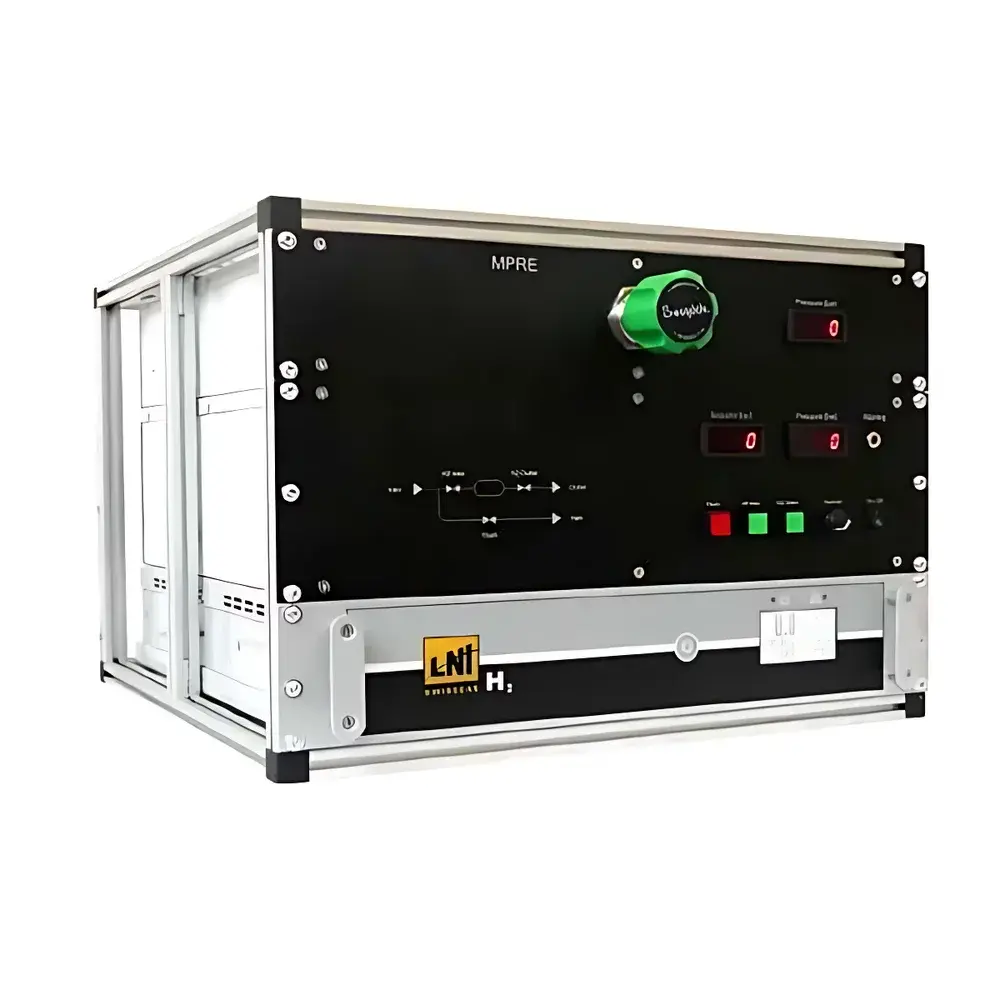
RuboLab RuboHyCo Portable High-Pressure Hydrogen Source
| Brand | RuboLab |
|---|---|
| Origin | Germany |
| Model | RuboHyCo |
| Hydrogen Generation Principle | Metal Hydride-Based Thermal Desorption |
| Output Flow Rate | 800 mL/min (per compression station) |
| Output Pressure | 20 MPa (2,900 psi) or 70 MPa (10,000 psi) |
| Hydrogen Purity | 99.9999% |
| Power Consumption | Not specified (device is thermally actuated |
Overview
The RuboLab RuboHyCo Portable High-Pressure Hydrogen Source is a solid-state, metal hydride-based hydrogen delivery system engineered for laboratory and field-deployable applications requiring ultra-high-purity, high-pressure hydrogen without mechanical compression or electrolysis. Unlike conventional gas cylinders or PEM electrolyzers, the RuboHyCo operates on reversible metal hydride (MH) thermodynamics: hydrogen is reversibly absorbed into a proprietary alloy matrix at near-ambient pressure and temperature, forming a stable metal hydride phase. Upon controlled thermal activation (typically via integrated resistive heating), the equilibrium shifts to desorb hydrogen at precisely regulated pressures—up to 70 MPa—while simultaneously rejecting oxygen, moisture, nitrogen, and hydrocarbon impurities through selective chemisorption. This intrinsic purification mechanism eliminates the need for downstream catalytic purifiers or palladium membranes, delivering 99.9999% (6N) hydrogen directly from the source. The absence of moving parts, valves, or high-speed compressors ensures silent operation, zero maintenance, and exceptional long-term reliability—critical for unattended operation in analytical labs, fuel cell testing rigs, and hydrogen sensor calibration environments.
Key Features
- Zero-mechanical-compression architecture: No pumps, pistons, or rotating components—eliminates vibration, wear, and failure modes associated with traditional high-pressure gas systems.
- Instant deployment: Plug-and-play operation with no system conditioning, purge cycles, or pressure ramping delays; achieves full 20 MPa output within ≤6 minutes from standby state.
- Passive safety by design: Stored hydrogen remains chemically bound below 10 bar at ambient temperature; pressure rises only upon intentional thermal activation—no risk of catastrophic rupture or uncontrolled venting.
- Modular scalability: Base RuboHyCo 110 unit (90 L storage capacity) delivers up to 800 mL/min at 20 MPa; paired with RuboHyCo 120 expansion module (180 L total), flow increases to 1600 mL/min while maintaining identical pressure and purity specifications.
- Multi-pressure configuration: Standard 20 MPa (2,900 psi) version compatible with most high-pressure analytical instrumentation; optional 70 MPa (10,000 psi) variant supports next-generation hydrogen storage research and advanced fuel cell stack validation protocols.
- Electrical independence: Core hydrogen release requires only low-power thermal control (no continuous electrical load); optional integrated controllers support 24 V DC or 100–240 V AC input for automated sequencing and monitoring.
Sample Compatibility & Compliance
The RuboHyCo is compatible with all standard CGA-350 and DIN 477-1 threaded high-pressure hydrogen interfaces. Its output meets ASTM D7165–22 (Standard Practice for High-Purity Hydrogen for Fuel Cell Applications) and ISO 8573-1:2010 Class 1 compressed gas quality requirements for particulates, water, and oil content. The 99.9999% purity level satisfies USP and EP 2.5.27 specifications for hydrogen used in pharmaceutical residual solvent analysis (e.g., GC carrier gas). All pressure vessels comply with PED 2014/68/EU and ASME BPVC Section VIII Div. 1 certification standards. Integrated pressure relief devices and redundant thermal cutoffs ensure full alignment with IEC 60079-0 (explosive atmospheres) and NFPA 55 (hydrogen technologies) safety frameworks. No GLP/GMP audit trail is required for standalone use; however, optional digital controller modules support FDA 21 CFR Part 11-compliant electronic records when integrated into regulated QC workflows.
Software & Data Management
The RuboHyCo operates autonomously but supports optional RuboControl™ v3.2 firmware for remote monitoring and parameter logging via USB-C or Ethernet (TCP/IP). Real-time telemetry includes bed temperature (±0.5 °C), outlet pressure (±0.1 MPa), cumulative H₂ mass delivered (calculated from stoichiometric MH desorption models), and thermal cycle count. Data export formats include CSV and SQLite for integration with LIMS platforms (e.g., LabWare, Thermo Fisher SampleManager). Firmware updates are signed and verified; audit logs record all configuration changes, user access events, and alarm triggers—including overtemperature alerts and pressure deviation thresholds. No cloud dependency: all data remains on-device unless explicitly exported.
Applications
- GC carrier gas supply for trace-level volatile organic compound (VOC) analysis, especially in environmental and forensic laboratories where helium scarcity necessitates high-purity hydrogen alternatives.
- Fuel cell performance testing under realistic operating pressures (20–70 MPa), including membrane electrode assembly (MEA) durability studies and catalyst poisoning experiments.
- In-situ hydrogenation reactor feed for flow chemistry systems requiring precise, pulse-free H₂ delivery without backpressure fluctuations.
- Calibration of hydrogen leak detectors, combustible gas sensors, and explosion-proof analyzers—leveraging certified 6N purity and traceable pressure stability.
- On-site hydrogen supply for portable FTIR, Raman, and XRD instruments deployed in field geology or aerospace material testing where cylinder logistics are prohibitive.
FAQ
Does the RuboHyCo require external power to generate hydrogen?
No—the core hydrogen release mechanism is thermally driven and does not rely on electricity. However, the optional controller module requires low-voltage DC or AC power for temperature regulation, data logging, and safety interlocks.
How often must the metal hydride bed be replaced?
Under normal laboratory usage (≤5 thermal cycles per day), the alloy bed maintains >95% capacity retention after 10,000 absorption/desorption cycles—equivalent to ≥5 years of continuous operation. Replacement is only necessary upon measurable purity degradation or pressure drop exceeding 5% of nominal output.
Can the RuboHyCo be integrated with existing hydrogen distribution manifolds?
Yes—standardized 1/4″ NPT and 3/8″ VCR fittings enable direct connection to stainless steel gas panels. Optional pressure-reducing regulators (0.1–20 MPa range) and particulate filters (0.01 µm) are available as certified accessories.
Is training or special certification required for operation?
No formal certification is mandated. Basic operation involves connecting power (if using controller), initiating thermal ramp via front-panel interface or software command, and verifying outlet pressure and flow. Safety documentation complies with GHS and CLP regulations; lab-specific SOPs are provided upon installation.
What is the maximum allowable ambient temperature for continuous operation?
The system is rated for ambient temperatures between 10 °C and 40 °C. Operation above 40 °C reduces thermal efficiency and may trigger automatic derating; below 10 °C requires extended preheat time to achieve target pressure within specification.



