
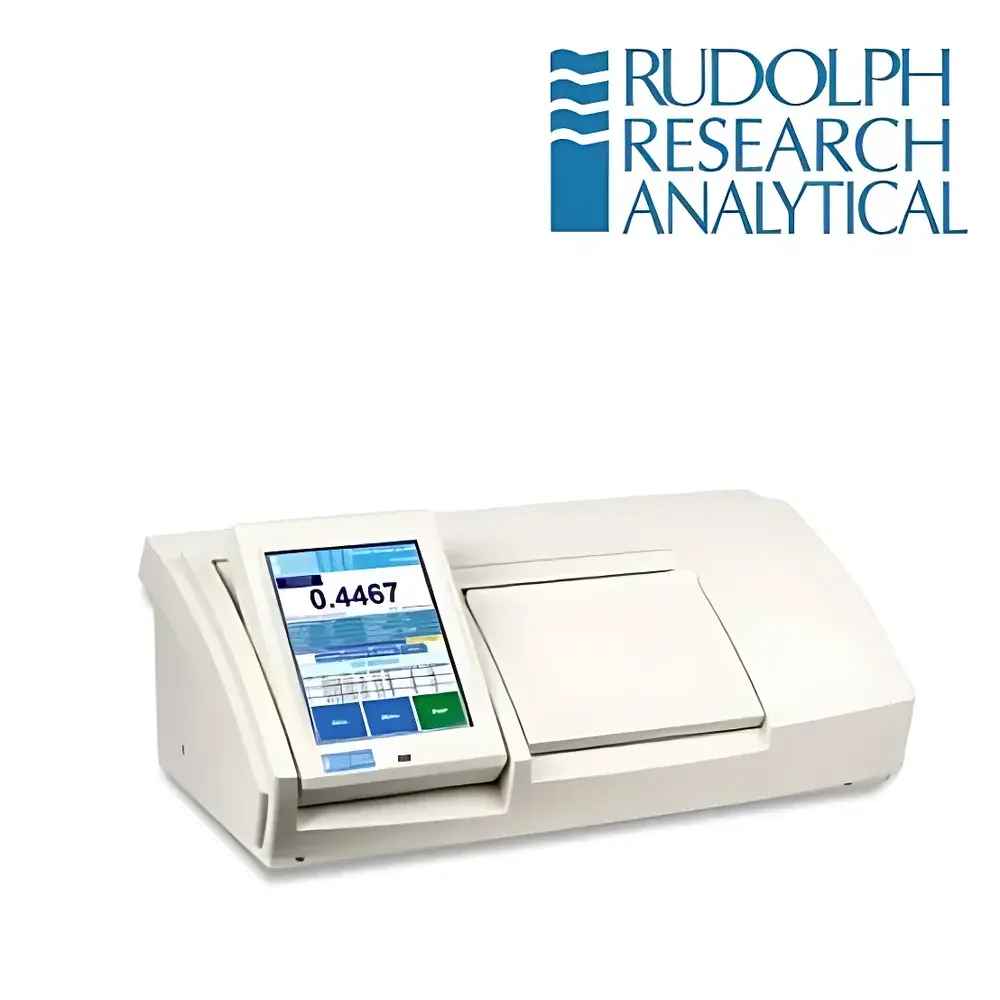
Rudolph Autopol IV Automatic Polarimeter
| Brand | Rudolph |
|---|---|
| Origin | USA |
| Model | Autopol IV |
| Product Type | Automatic Polarimeter |
| Temperature Control | Yes (10–40 °C) |
| Digital Display | Yes |
| Light Source | Tungsten-Halogen Lamp |
| Measurement Range | ±89.99° Arc, 0–99.9% concentration |
| Measurement Resolution | 0.0001° Arc, 0.0001% concentration |
| Accuracy | ±0.002° Arc |
| Wavelength Options | 365, 405, 436, 546, 589, 633 nm (custom wavelengths available) |
| Sample Cell Compatibility | 10–200 mm pathlength, 0.02–15 mL volume |
| Calibration Standards | Certified quartz control plates (−80° to +80° Arc) |
Overview
The Rudolph Autopol IV is a microprocessor-controlled automatic polarimeter engineered for high-precision optical rotation measurement in regulated laboratory and industrial quality control environments. It operates on the fundamental principle of plane-polarized light interaction with optically active chiral compounds—measuring the angular deviation (optical rotation) induced as polarized light passes through a sample solution. The instrument calculates specific rotation (αD20) and concentration directly from raw angular data using user-defined or system-standard cell pathlengths, eliminating manual computation and reducing operator-induced error. Designed for compliance-critical workflows, the Autopol IV supports temperature-compensated measurements via an integrated platinum resistance thermometer (PRT) embedded in the sample cell holder, enabling real-time thermal monitoring and automatic correction to standard reference temperatures (e.g., 20 °C or 25 °C). Its optical architecture employs a high-stability tungsten-halogen lamp coupled with interference bandpass filters to deliver stable, narrow-band spectral output across six factory-installed wavelengths—including the sodium D-line (589 nm), mercury e-line (546 nm), and UV-capable lines (365 nm, 405 nm)—with optional custom wavelength integration for method-specific validation.
Key Features
- True automatic operation with embedded microprocessor controlling all measurement, calculation, and reporting functions
- Simultaneous real-time display and output of optical rotation (° Arc), specific rotation (°·mL·g−1·dm−1), concentration (% w/v), and Brix/sugar scale equivalents
- Programmable sample test protocols—up to 30 user-defined methods with assignable shortcut keys, including preconfigured cell length, wavelength, temperature coefficient, acceptance limits, and auto-reporting settings
- Automated wavelength selection via software menu—no manual filter wheel manipulation or lamp replacement required
- High-intensity tungsten-halogen light source (>2000 h lifetime) with spectral stability and transmission capability down to 0.01% absorbance
- Calibration-grade calcite polarizers—thermally and hygroscopically stable, ensuring long-term angular reproducibility without drift
- Integrated PRT-based temperature sensing with direct sample-cell contact; supports ASTM E291 and USP temperature correction protocols
- Configurable analog output (0–10 V or 4–20 mA) with >0.1% full-scale resolution for integration into PLC-based process monitoring systems
Sample Compatibility & Compliance
The Autopol IV accommodates standard and custom sample cells ranging from 10 mm to 200 mm pathlength and 0.02 mL to 15 mL volume, supporting both low-volume microcells and high-throughput flow cells. Certified quartz calibration standards (−80° to +80° Arc) are supplied for daily verification per ISO 13022 and pharmacopeial requirements (USP , EP 2.2.7, JP 2.05). Temperature control (10–40 °C) is achieved via Peltier-regulated cell blocks compatible with GLP/GMP documentation needs. All measurement data—including timestamps, operator ID, cell ID, temperature logs, and calibration history—can be archived with audit-trail integrity when connected to compliant LIMS or ELN platforms. The instrument meets electromagnetic compatibility (EMC) requirements per IEC 61326-1 and safety standards per IEC 61010-1.
Software & Data Management
Data acquisition and reporting are managed through a built-in menu-driven interface with large-backlit LCD display. Measurement statistics—including mean, standard deviation, min/max values, and confidence intervals—are computed over up to 999 consecutive readings. Print outputs (via parallel or RS-232) support customizable templates compliant with 21 CFR Part 11 when paired with validated third-party software—enabling electronic signatures, user access controls, and immutable audit trails. Dual RS-232 ports allow simultaneous connection to a host PC (for remote control via ASCII command protocol) and a dedicated printer or data logger. Time/date stamping is enabled by an internal real-time clock, with timestamped reports suitable for regulatory submissions.
Applications
The Autopol IV serves critical analytical roles across pharmaceutical manufacturing (API identity testing, enantiomeric purity assessment per ICH Q5B), food and beverage QA/QC (sucrose, fructose, and invert sugar quantification per AOAC 951.02), fine chemical synthesis (chiral intermediate verification), and academic research in asymmetric catalysis and natural product isolation. Its multi-wavelength capability enables wavelength-dependent optical rotation studies required for structural elucidation of complex carbohydrates and glycoconjugates. In production environments, the programmable alarm outputs (TTL-level) and analog interface support integration into automated batch release systems with real-time pass/fail decision logic.
FAQ
Does the Autopol IV comply with pharmacopeial standards for polarimetry?
Yes—it meets USP , EP 2.2.7, and JP 2.05 requirements for resolution, accuracy, temperature control, and calibration traceability.
Can measurement data be exported to LIMS or ERP systems?
Yes—via RS-232 ASCII protocol or analog output; validated interfaces are available for major LIMS vendors under 21 CFR Part 11 configurations.
What is the calibration frequency recommendation?
Daily verification with certified quartz standards is recommended; full calibration every 6 months by an ISO/IEC 17025-accredited service provider.
Is temperature correction applied automatically during measurement?
Yes—the system applies user-input temperature coefficients in real time and reports corrected values referenced to 20 °C or 25 °C.
Can the instrument measure samples with very low transmittance?
Yes—its high-output halogen source and optimized signal-to-noise ratio enable reliable measurement down to 0.01% transmittance.




