
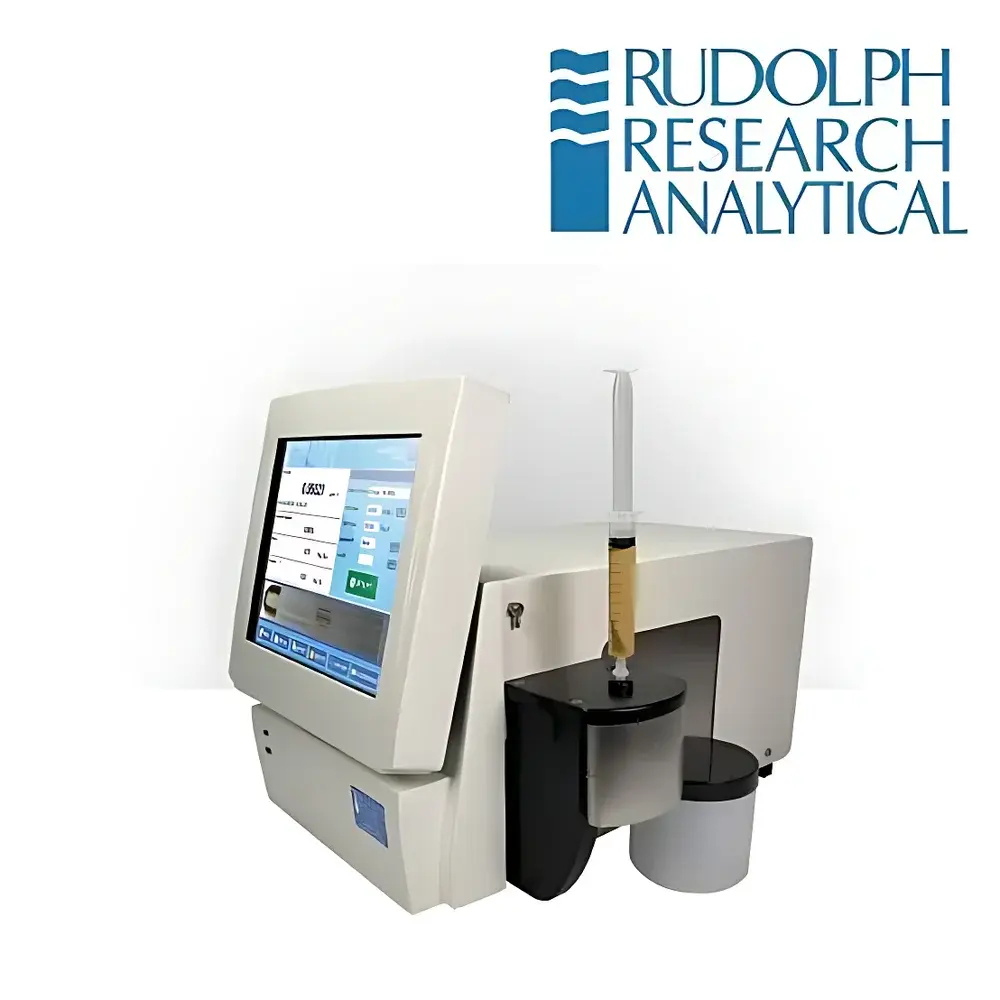
Rudolph DDM2911 Autofill Digital Oscillating U-Tube Density Meter
| Brand | Rudolph |
|---|---|
| Origin | USA |
| Model | DDM2911 Autofill |
| Instrument Type | Oscillating U-Tube Density Meter |
| Form Factor | Benchtop Laboratory Instrument |
| Sample Type | Liquids |
| Density Range | 0–3 g/cm³ |
| Density Resolution | 0.000001 g/cm³ |
| Density Accuracy | ±0.000010 g/cm³ |
| Density Repeatability | ±0.000002 g/cm³ |
| Temperature Control Range | 0–100 °C |
| Temperature Accuracy | ±0.01 °C |
| Temperature Repeatability | ±0.001 °C |
| Display Precision | 0.000001 g/cm³ / 0.001 °C |
| Minimum Sample Volume | 1 mL |
| Integrated Viscosity Correction | Yes |
| Regulatory Compliance | 21 CFR Part 11, GLP/GMP-ready |
| Data Storage | 32 GB internal memory |
| Interface Ports | 5× USB, 2× RS232, 2× Ethernet, 1× HDMI |
| Touchscreen | 10.4″ color LCD |
| Video View™ Technology | 10× digital zoom for real-time U-tube bubble visualization |
Overview
The Rudolph DDM2911 Autofill is a high-precision benchtop oscillating U-tube density meter engineered for traceable, reproducible liquid density measurement in regulated and research-intensive laboratory environments. Based on the fundamental principle of oscillating tube metrology—where the resonant frequency of a precisely manufactured U-shaped glass tube filled with sample correlates directly to its mass density—the DDM2911 delivers exceptional resolution (0.000001 g/cm³) and accuracy (±0.000010 g/cm³) across a broad operational range (0–3 g/cm³) and temperature span (0–100 °C). Its fully automated sample handling system eliminates manual pipetting errors and ensures consistent fill volume (as low as 1 mL), while integrated real-time viscosity correction compensates for damping effects without requiring separate viscometry instrumentation. Designed and manufactured in the United States by Rudolph Research Analytical—a leader in optical and physical property instrumentation since 1940—the DDM2911 meets the stringent demands of pharmaceutical QC, chemical R&D, food & beverage formulation, and petrochemical analysis.
Key Features
- Autofill sampling system with programmable aspiration, rinse, and purge cycles—reducing operator variability and cross-contamination risk
- Proprietary Video View™ technology (U.S. Patent No. 7,437,909): 10× digital zoom capability enables real-time visual verification of bubble presence, position, and stability within the oscillating U-tube—critical for method validation and troubleshooting
- Onboard reference cell for continuous drift monitoring and automatic thermal compensation
- Embedded viscosity correction algorithm compliant with ISO 12058 and ASTM D4052 standards, enabling accurate density reporting for non-Newtonian or high-viscosity liquids without external calibration
- 10.4″ high-resolution color touchscreen interface with intuitive icon-driven navigation and multilingual OS support
- Comprehensive I/O architecture: five USB ports (for keyboard, printer, flash storage), dual RS232 serial interfaces (legacy instrument integration), dual Ethernet (LAN/LIMS connectivity), and HDMI output for external display mirroring
- 32 GB internal solid-state memory supporting audit-trail-enabled data logging, including timestamped raw frequency, temperature, and calculated density values
Sample Compatibility & Compliance
The DDM2911 Autofill accommodates a wide spectrum of liquid samples—including aqueous solutions, organic solvents, hydrocarbon blends, syrups, acids, bases, and suspensions—with no requirement for degassing when Video View™ confirms absence of trapped air. Its inert borosilicate U-tube construction resists corrosion from aggressive media (e.g., concentrated HCl, NaOH, ethanol/water mixtures), and optional PTFE-coated fluid paths extend compatibility to halogenated compounds. The instrument is fully compliant with Good Laboratory Practice (GLP) and Good Manufacturing Practice (GMP) frameworks: electronic signatures, user access levels, audit trail generation, and secure data export meet FDA 21 CFR Part 11 requirements. IQ/OQ/PQ documentation packages are provided for installation qualification, operational qualification, and performance qualification—facilitating rapid validation in regulated facilities such as pharmaceutical QC labs, national pharmacopoeia institutes, and contract testing organizations.
Software & Data Management
Rudolph’s proprietary DDM Control Software supports local operation, remote monitoring via Ethernet, and seamless LIMS/HIS integration using ASTM E1384 or HL7-compliant protocols. All measurements are stored with immutable metadata: operator ID, method name, sample ID, environmental conditions, and full raw oscillation waveform data. Export formats include CSV, PDF (with embedded chromatogram-style density vs. time plots), and XML for enterprise data lakes. Role-based permissions govern method editing, calibration execution, and report generation—ensuring data integrity throughout the analytical lifecycle. Automated backup to network drives or cloud repositories (via SFTP) is configurable, and encrypted database encryption (AES-256) safeguards sensitive intellectual property.
Applications
- Pharmaceutical: Excipient density profiling, API purity assessment via density deviation from theoretical values, solvent composition verification in formulation development
- Chemical: Batch release testing of monomers, catalysts, and intermediates per ASTM D1250 or ISO 3675; density-based concentration determination in caustic soda or sulfuric acid production
- Food & Beverage: Brix/density correlation for juice standardization, alcohol content estimation in spirits (per OIML R 22), honey adulteration screening
- Petrochemical: Crude oil API gravity calculation, biodiesel blend verification (EN 14214), lubricant base stock characterization
- Academic & Government Labs: Fundamental thermophysical property studies, inter-laboratory round-robin density benchmarking, metrology reference material certification
FAQ
What regulatory standards does the DDM2911 Autofill support for data integrity?
It complies with FDA 21 CFR Part 11 for electronic records and signatures, including audit trails, user authentication, and data immutability controls.
Can the instrument measure density of viscous samples like glycerol or polymer solutions?
Yes—its built-in viscosity correction algorithm automatically adjusts for damping effects, ensuring accuracy up to ~1000 mPa·s without external input.
Is method transfer possible between different Rudolph instruments?
Yes—DDM2911 methods are interoperable with other Rudolph density meters (e.g., DDM3D, DDM2910) and can be synchronized with J-series refractometers and Autopol polarimeters for multi-parameter workflows.
How is temperature stability maintained during extended measurement sequences?
A Peltier-controlled thermostatic system with dual-sensor feedback maintains setpoint accuracy within ±0.01 °C across the full 0–100 °C range, with ramp rates programmable from 0.1 to 5 °C/min.
Does the system support automated calibration verification?
Yes—users can schedule periodic air/water density checks with pass/fail thresholds, and results are logged with full traceability to NIST-traceable standards.



