
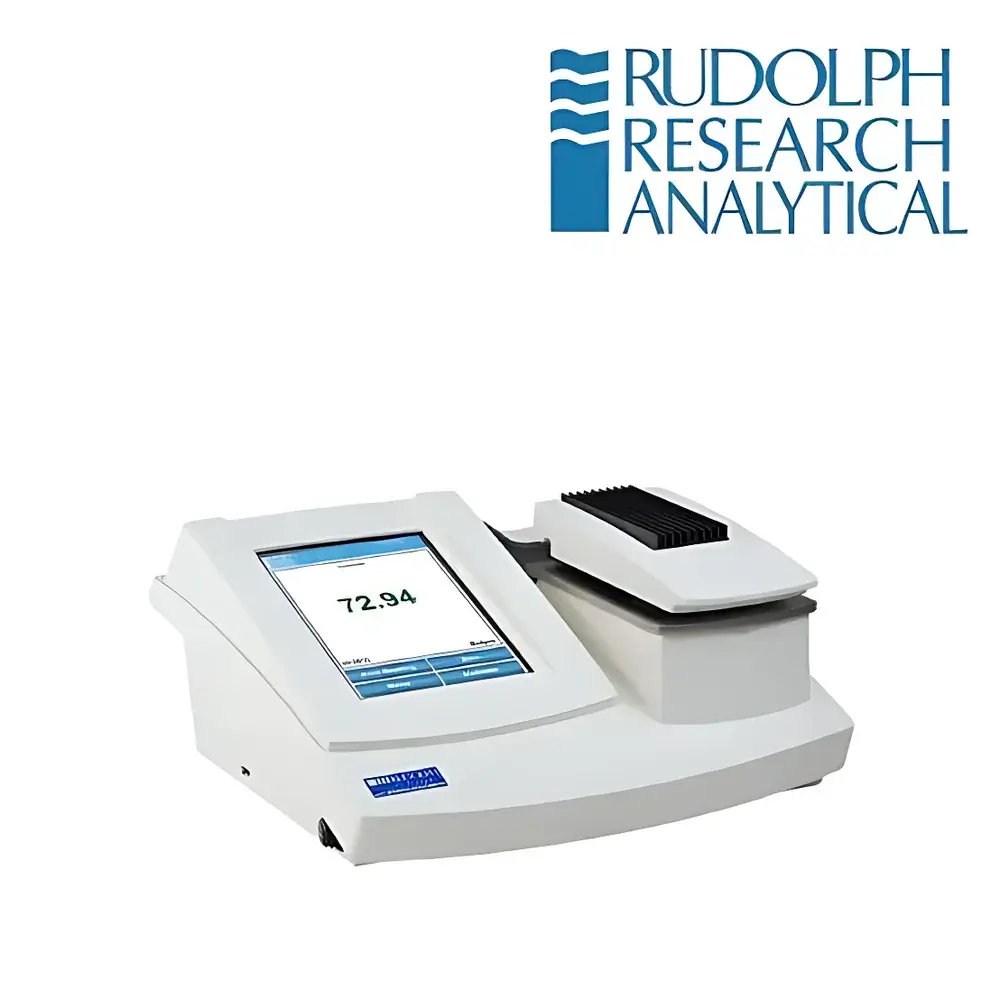
Rudolph J157 Desktop Digital Refractometer (WR Option Available)
| Brand | Rudolph |
|---|---|
| Origin | USA |
| Model | J157 |
| Product Type | Benchtop Refractometer |
| Temperature Control | Yes |
| Digital Display | Yes |
| Measurement Range | 1.33–1.53 RI, 0–100 °Brix |
| Measurement Accuracy | ±0.00002 RI, ±0.01 °Brix |
| Resolution | 0.00001 RI, 0.01 °Brix |
| Wavelength | 589.3 nm (Na-D line), optional alternate wavelengths available |
| Temperature Control Range | 10–90 °C |
| Temperature Stability | ±0.01 °C |
| Sample Interface Options | Dropper, Flow Cell, and Pour-in Configurations |
Overview
The Rudolph J157 Desktop Digital Refractometer is a precision optical instrument engineered for high-accuracy refractive index (RI) and Brix measurements in quality control, research, and regulatory-compliant laboratory environments. Based on the fundamental principle of total internal reflection at the prism–sample interface, the J157 employs a high-stability sodium D-line LED source (589.3 nm) to determine RI with traceable metrological integrity. Its optical architecture integrates a sapphire measurement prism, thermally stabilized via integrated Peltier elements, ensuring minimal thermal drift during extended analysis cycles. Designed and manufactured in the United States by Rudolph Research Analytical—a pioneer in optical analytics since 1940—the J157 represents the culmination of over five decades of refinement in digital refractometry, building upon the company’s legacy in polarimetry and optical metrology. It is optimized for routine analysis of aqueous solutions, beverages, syrups, pharmaceutical excipients, and purified water systems where reproducible, temperature-corrected RI data are critical for specification conformance.
Key Features
- Integrated Peltier-based temperature control system (10–90 °C) with ±0.01 °C stability—eliminates dependency on external water baths
- Dual-point temperature sensing: independent probes mounted directly on both prism surface and sample contact zone ensure accurate thermal equilibration reporting
- High-resolution 7-inch capacitive touchscreen display showing real-time RI, °Brix, sample temperature, date/time, and method ID without menu navigation
- Chemical-resistant tactile keypad and sealed optical chamber compliant with ISO 17025 environmental requirements
- Modular sample handling: supports dropper-mode (manual single-drop), flow-cell mode (for inline process monitoring or automated sample changers), and pour-in mode (for viscous or particulate-containing samples)
- Factory-calibrated using NIST-traceable sucrose standards; user calibration verification routines support ASTM D1218 and ISO 21630 compliance
Sample Compatibility & Compliance
The J157 accommodates a broad range of liquid and low-viscosity semi-liquid samples including fruit juices, soft drinks, saline solutions, ethanol–water mixtures, glycerol dilutions, and purified water (PW) or water-for-injection (WFI) streams. Its sapphire prism and corrosion-resistant fluid path materials enable reliable operation with mildly acidic or alkaline matrices (pH 2–12). Instrument design adheres to IEC 61010-1 safety standards and meets electromagnetic compatibility (EMC) requirements per EN 61326-1. For regulated environments, the J157 supports 21 CFR Part 11-compliant software configurations (when paired with Rudolph’s WinRef™ Suite), including electronic signatures, audit trails, and user-access level management. It is routinely deployed in GLP and GMP laboratories performing USP , EP 2.2.39, and JP 2.05 testing for optical purity and concentration verification.
Software & Data Management
When connected to Rudolph’s WinRef™ PC software (v5.2+), the J157 enables full method definition, result trending, statistical process control (SPC) charting, and PDF report generation with embedded metadata (operator ID, timestamp, calibration status, environmental logs). All measurement data—including raw analog signals, temperature gradients, and convergence diagnostics—are stored in encrypted SQLite databases with configurable retention policies. Audit trail functionality records every parameter change, calibration event, and user login in immutable chronological order. Export formats include CSV, XML, and LIMS-ready ASTM E1384-compliant files. Remote instrument monitoring and firmware updates are supported via secure HTTPS endpoints.
Applications
- Concentration monitoring of sugar solutions in beverage and dairy QC labs (e.g., soft drink syrup blending, milk solids non-fat validation)
- Alcohol content estimation in fermented products via empirical RI–ethanol correlations (per OIV Method OA21)
- Pharmaceutical formulation development: excipient concentration checks, solvent recovery validation, and osmolality proxy assessment
- Water purity verification in biopharma clean steam condensate and purified water loops (USP )
- Quality release testing of glycols, propylene glycol, and polyethylene glycol solutions in chemical manufacturing
- Educational use in university analytical chemistry laboratories for teaching optical property–composition relationships
FAQ
What wavelength does the J157 use for RI measurement, and is wavelength selection customizable?
The standard configuration uses a stabilized 589.3 nm sodium D-line LED. Optional narrowband LEDs at 488 nm, 633 nm, or 830 nm are available for specialized applications requiring dispersion analysis or UV-transparent matrix compatibility.
Does the J157 meet regulatory requirements for pharmaceutical QC documentation?
Yes—when operated with WinRef™ in 21 CFR Part 11 mode, it provides full audit trail, electronic signature support, and data integrity features required for FDA, EMA, and PMDA submissions.
Can the J157 measure samples with suspended particles or high viscosity?
It supports pour-in sampling for moderately turbid or viscous liquids (up to ~10,000 cP); however, highly scattering or opaque samples require centrifugation or filtration prior to analysis to avoid signal noise.
Is temperature calibration traceable to national standards?
Yes—internal temperature sensors are factory calibrated against NIST-traceable dry-block calibrators; certificate of calibration is provided with each instrument.
How frequently should the instrument be recalibrated for routine use?
Daily verification with certified sucrose standards is recommended; full recalibration is advised every 3–6 months depending on usage intensity and environmental conditions, per ISO/IEC 17025 Clause 7.7.




