
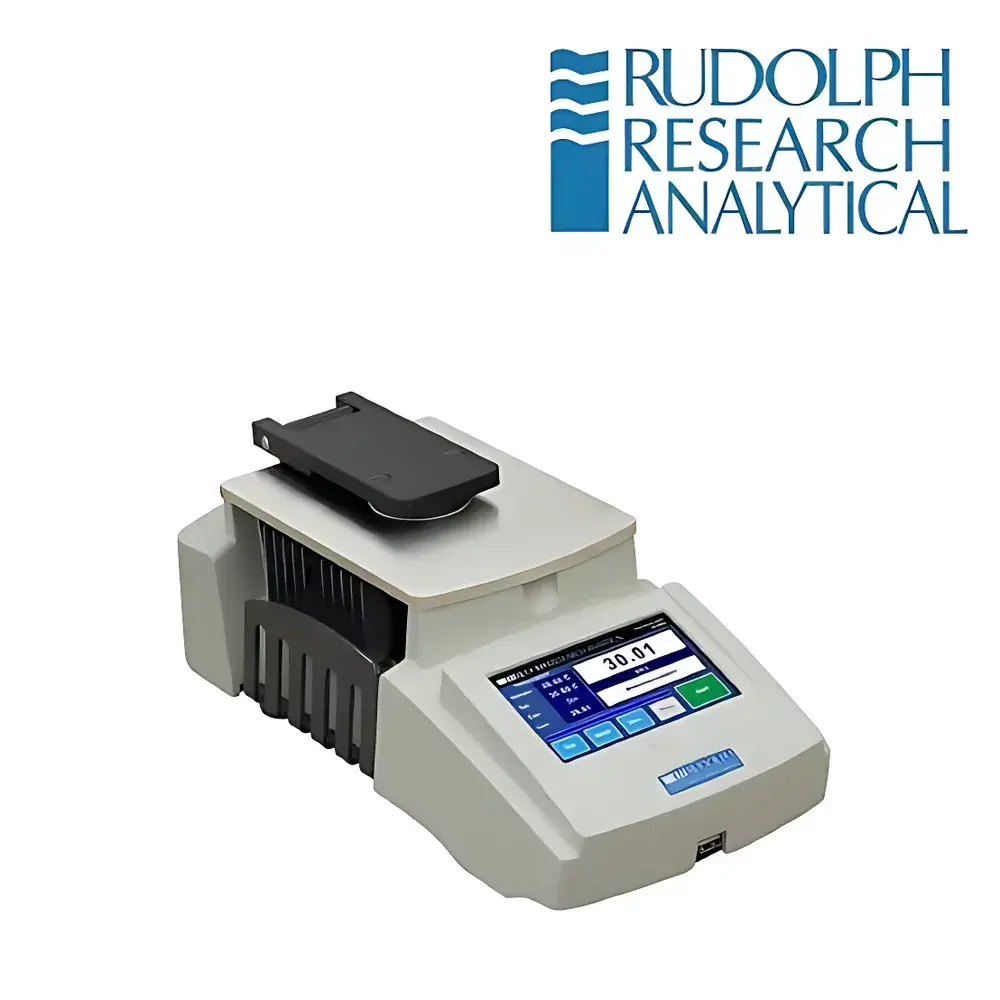
Rudolph J57-VT Desktop Digital Refractometer (WR Option Available)
| Brand | Rudolph |
|---|---|
| Origin | USA |
| Model | J57-VT |
| Product Type | Benchtop Refractometer |
| Temperature Control | Yes |
| Digital Display | Yes |
| Measurement Range | 1.33–1.53 RI, 0–100 °Brix |
| Measurement Accuracy | ±0.00002 RI, ±0.01 °Brix |
| Resolution | 0.00001 RI, 0.01 °Brix |
| Wavelength | 589.3 nm (Na-D line, other wavelengths optional) |
| Temperature Control Range | 10–65 °C |
| Temperature Stability | ±0.01 °C |
| Compliance | ASTM D1218, ISO 2163, USP <781>, AOAC 932.12 |
Overview
The Rudolph J57-VT is a high-precision benchtop digital refractometer engineered for rigorous laboratory and industrial quality control environments. It operates on the principle of total internal reflection at the prism-sample interface, measuring the critical angle of refraction to determine the refractive index (RI) with sub-micro-RI resolution. Calibrated to the sodium D-line (589.3 nm), the instrument delivers traceable, repeatable results essential for regulatory compliance in pharmaceutical, food & beverage, chemical, and biotechnology applications. Its integrated Peltier-based thermostatic system enables precise temperature control from 10 °C to 65 °C—critical for eliminating thermal drift and ensuring measurement reproducibility per ISO 2163 and USP . Unlike traditional analog refractometers or water-bath-dependent systems, the J57-VT eliminates external cooling units and manual temperature stabilization steps, reducing operator dependency and measurement variability.
Key Features
- Integrated dual-sensor temperature monitoring: Independent platinum resistance thermometers (PRTs) mounted directly on both the prism surface and sample contact zone ensure real-time, spatially accurate temperature feedback—critical for thermally sensitive samples such as syrups, APIs, or polymer solutions.
- High-resolution optical detection: A stabilized LED light source coupled with a linear CCD array enables RI resolution of 0.00001 and ±0.00002 accuracy—validated against NIST-traceable sucrose standards.
- Multi-mode sample introduction: Supports drop-in, flow-through (with optional WR module), and pour-in configurations—enabling seamless adaptation to viscous, volatile, or particulate-laden samples without cross-contamination.
- Large backlit LCD display: Simultaneously presents RI, °Brix, temperature, date/time, and method ID—no menu navigation required. All data are displayed in SI-compliant units with configurable decimal places.
- Chemical-resistant touchscreen interface: Sealed membrane keypad rated IP65; resistant to ethanol, acetone, HCl, NaOH, and common cleaning agents used in GMP cleanrooms.
- Internal memory and USB export: Stores up to 1,000 measurement records with full audit trail metadata (operator ID, timestamp, temperature, method name)—supports 21 CFR Part 11–compliant data integrity when paired with Rudolph’s validated software suite.
Sample Compatibility & Compliance
The J57-VT accommodates aqueous solutions, organic solvents, emulsions, and semi-viscous liquids (up to ~10,000 cP with flow-cell configuration). Its prism assembly—fabricated from sapphire-coated BK7 glass—resists scratching and chemical etching during routine cleaning with isopropanol or diluted nitric acid. The instrument conforms to international standard test methods including ASTM D1218 (hydrocarbon liquids), ISO 2163 (dairy products), AOAC 932.12 (fruit juices), and USP (refractive index in pharmaceutical excipients). For regulated environments, optional IQ/OQ documentation packages and hardware lockout features support GLP and GMP validation protocols.
Software & Data Management
Rudolph’s WinRef™ software (v5.2+) provides method-driven operation, automated calibration verification, statistical process control (SPC) charting, and raw data export to CSV, PDF, or LIMS-compatible XML. Audit trails record all user actions—including parameter changes, calibration events, and result edits—with immutable timestamps and electronic signatures. Data encryption, role-based access control, and configurable retention policies align with FDA 21 CFR Part 11 and EU Annex 11 requirements. Optional network integration enables centralized instrument fleet monitoring via Ethernet or Wi-Fi.
Applications
- Pharmaceutical QC: Verification of solvent purity (e.g., ethanol/water blends), concentration of active pharmaceutical ingredients (APIs) in liquid formulations, and excipient identity testing per USP monographs.
- Food & Beverage: Brix quantification in fruit juices, soft drinks, and dairy concentrates; detection of adulteration (e.g., water dilution in honey); batch-to-batch consistency monitoring.
- Chemical Manufacturing: Monitoring polymerization reactions, glycol concentration in heat-transfer fluids, and hydrazine content in aerospace coolants.
- Biotechnology: Cell culture media osmolality estimation (via RI correlation), buffer component verification, and downstream purification fraction analysis.
FAQ
What wavelength is used for RI measurement, and can it be changed?
The J57-VT is factory-calibrated to the sodium D-line (589.3 nm). Alternate wavelengths—including 488 nm (Ar-ion laser), 633 nm (He-Ne), and 830 nm (NIR)—are available as factory-installed options upon order.
Is the WR (flow-cell) module included by default?
No—the WR flow-cell module is an optional accessory designed for continuous inline sampling or high-throughput batch analysis. It requires separate ordering and installation calibration.
How is temperature uniformity verified across the prism surface?
Each unit undergoes prism thermal mapping during final QA using calibrated micro-thermocouples; temperature gradient across the active measurement area is confirmed to be ≤0.005 °C at setpoint.
Can the instrument be integrated into a LIMS or MES system?
Yes—via RS-232, USB virtual COM port, or TCP/IP Ethernet, supporting ASTM E1384 and HL7-compatible message formatting for bidirectional data exchange.
What maintenance is required to maintain long-term accuracy?
Annual recalibration using NIST-traceable sucrose standards is recommended. Prism cleaning with lint-free wipes and spectroscopic-grade methanol is sufficient between samples; no consumables or service contracts are mandatory.





