
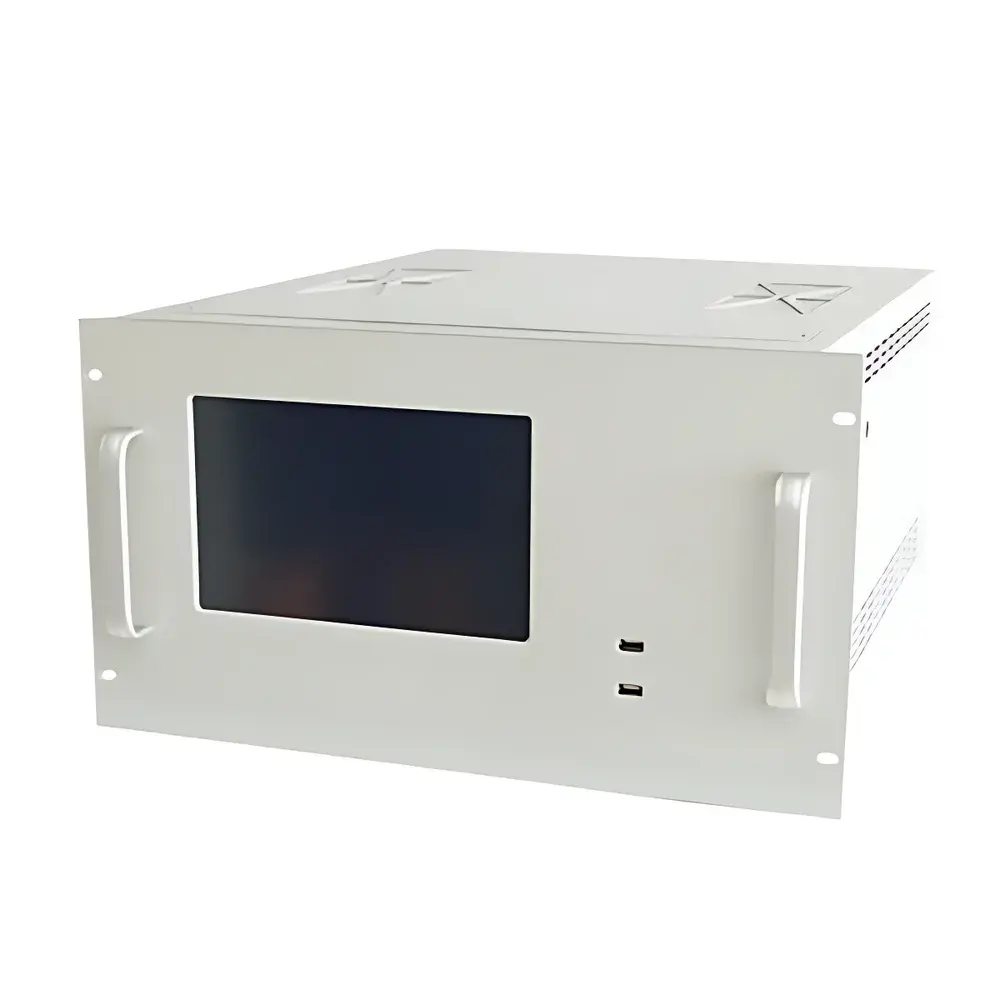
Ruinen GC3900N Online Total Hydrocarbons and Non-Methane Hydrocarbons (NMHC) Analyzer
| Brand | Ruinen Instruments |
|---|---|
| Origin | Shandong, China |
| Manufacturer Type | OEM Manufacturer |
| Product Type | Online Gas Analyzer |
| Model | GC3900N |
| Detection Targets | Total Hydrocarbons (THC), Methane (CH₄), Non-Methane Hydrocarbons (NMHC) |
| Measurement Range | CH₄ (0.1–10,000 ppm), NMHC (0.05–10,000 ppm) |
| LOD | ≤0.1 ppm (CH₄), ≤0.05 ppm (NMHC) |
| Repeatability | RSD ≤2% |
| Cycle Time | ≤40 s (single-channel), ≤20 s (dual-channel) |
| Detector | FID (Flame Ionization Detector) |
| Carrier Gas | Ultra-High-Purity Nitrogen or Zero-Air (≥99.999%) |
| Fuel Gas | Ultra-High-Purity Hydrogen (≥99.999%) |
| Make-up/Support Air | Zero-Air (hydrocarbon <20 ppb) |
| Sampling | Automated Six-Port Valve with Fixed-Volume Loop |
| Sample Temp. Range | Ambient to 180 °C |
| Sample Flow Rate | ≥0.5 L/min or Pressure ≥0.1 MPa |
| Particle-Free Requirement | Yes |
| Form Factor | 6U 19″ Rack-Mount Chassis |
| Power | <400 W, 220 V AC / 50 Hz |
| Analog Output | 4–20 mA |
| Digital Interface | RS232 / RS485 |
| Operating Environment | –10 to +50 °C, 10–100% RH |
Overview
The Ruinen GC3900N is a dedicated online gas chromatographic analyzer engineered for continuous, real-time quantification of total hydrocarbons (THC), methane (CH4), and non-methane hydrocarbons (NMHC) in ambient air, stack emissions, and industrial process streams. It employs dual-column gas chromatography coupled with a flame ionization detector (FID) — a method recognized under EPA Method 25A, ISO 12039, and EN 12619 for regulatory-grade NMHC monitoring. The system separates methane from other C2–C12 hydrocarbons using a packed or capillary pre-separation column, followed by selective elution and FID detection. Its design emphasizes stability under unattended operation, minimizing baseline drift and retention time variability through temperature-controlled oven architecture and high-precision electronic pressure control (EPC) of carrier and combustion gases.
Key Features
- Dual-channel configuration enabling parallel analysis: one channel for methane quantification, the other for NMHC summation — reducing cycle time to ≤20 seconds without compromising chromatographic resolution.
- FID detector with linear dynamic range >107, optimized for low-level hydrocarbon detection (LOD ≤0.05 ppm NMHC) and robust against humidity and particulate-laden sample matrices when paired with integrated heated filtration and moisture removal.
- Automated six-port sampling valve with stainless-steel quantitative loop (e.g., 0.25–1.0 mL), ensuring precise, reproducible injection volumes independent of upstream pressure fluctuations.
- Heated sample path (up to 180 °C) prevents condensation of higher-boiling hydrocarbons and maintains sample integrity from probe to detector.
- 6U 19-inch rack-mount chassis compliant with IEC 60297-3-100, designed for integration into centralized environmental monitoring stations or distributed emission monitoring systems (EMS/CEMS).
- Comprehensive onboard diagnostics including gas pressure monitoring, flame status verification, detector gain calibration tracking, and leak detection via baseline noise analysis.
Sample Compatibility & Compliance
The GC3900N accepts gaseous samples within a temperature range of ambient to 180 °C, provided they are free of solid particulates and liquid aerosols. A heated particulate filter (optional) and Nafion-based dryer (optional) may be integrated upstream to meet stringent sampling requirements per EPA Performance Specification 8 (PS-8) and China’s HJ 1012-2018 standard for NMHC analyzers. The instrument complies with electromagnetic compatibility (EMC) per IEC 61326-1 and safety standards per IEC 61010-1. Data output supports traceability under GLP and GMP frameworks when configured with audit-trail-enabled software (see Software & Data Management). While not intrinsically safe, it may be deployed in Zone 2 hazardous areas when installed within an approved purged enclosure meeting IEC 60079-2 requirements.
Software & Data Management
Control and data acquisition are managed via Ruinen’s proprietary GC-Link software, compatible with Windows 10/11 (64-bit). The software provides method scheduling, real-time chromatogram visualization, automatic peak integration using ASTM D1945-compliant algorithms, and configurable reporting templates aligned with local regulatory formats (e.g., China’s HJ 75-2017 CEMS data reporting). Raw chromatographic data (.CDF or .CSV) and system logs are timestamped and stored locally with optional network backup. For regulated environments, optional 21 CFR Part 11 compliance modules provide electronic signature capability, user role-based access control, and immutable audit trails for all method changes, calibration events, and data exports.
Applications
- Continuous emission monitoring (CEM) of NMHC from chemical manufacturing, petrochemical refining, and coating facilities per local environmental protection bureau requirements.
- Ambient air quality stations measuring background NMHC levels for ozone precursor assessment and photochemical modeling.
- Leak detection and repair (LDAR) program support through rapid screening of fugitive emissions at valves, flanges, and connectors.
- Process optimization in biogas upgrading plants, where real-time CH4/NMHC ratio informs membrane or PSA separation efficiency.
- Calibration verification and reference standard generation in metrology labs accredited to ISO/IEC 17025.
FAQ
What gas purity specifications are required for reliable FID operation?
Ultra-high-purity hydrogen (≥99.999%), carrier gas (N2 or zero-air ≥99.999%), and zero-air for combustion (hydrocarbon content <20 ppb) are mandatory to prevent baseline noise, ghost peaks, and detector contamination.
Can the GC3900N operate without external calibration gases?
No — periodic calibration using certified CH4 and propane (or equivalent NMHC) standards is required per HJ 75-2017 and EPA PS-8; the system supports automated multi-point calibration sequences via its built-in gas selection manifold.
Is remote diagnostics and firmware update supported?
Yes — GC-Link software enables secure remote access via VPN or TLS-encrypted web interface for real-time status monitoring, log retrieval, and over-the-air firmware updates (subject to network policy approval).
How is data integrity ensured during power interruption?
The embedded controller retains last valid calibration parameters and method settings in non-volatile memory; upon restart, it performs self-checks and resumes scheduled analysis without manual intervention.
Does the system meet Chinese national emission monitoring certification requirements?
The GC3900N is type-approved under China’s Environmental Protection Product Certification (CCEP) framework and listed in the Ministry of Ecology and Environment’s (MEE) Recommended Equipment Catalog for VOCs and NMHC monitoring (2023 edition).
Related Products







