
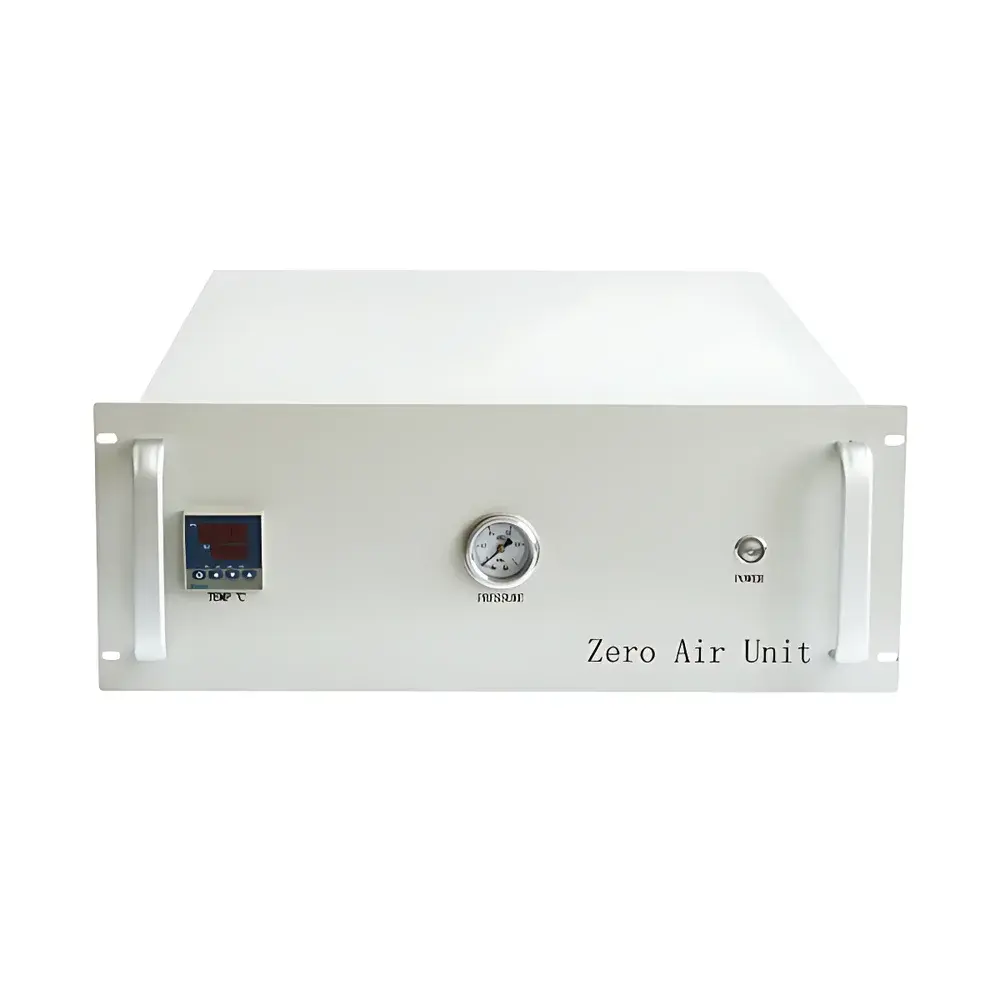
Ruinen Instruments RNZ-1000Z Digital Display Zero Air Generator
| Brand | Ruinen Instruments |
|---|---|
| Origin | Shandong, China |
| Manufacturer Type | OEM Manufacturer |
| Model | RNZ-1000Z |
| Zero Air Purity | NO < 0.1 ppb |
| Flow Rate | 1000 mL/min |
| Output Pressure Range | 0–0.6 MPa |
| Dew Point | −20 °C |
| Hydrocarbon Content (Output) | < 0.1 ppm |
| Max. Inlet Hydrocarbon Concentration | < 100 ppm |
| Inlet Pressure Range | 0–0.6 MPa |
| Power Supply | 220 V ±10%, 50–60 Hz |
| Power Consumption | 350 W |
| Catalyst Operating Temperature | 350–400 °C |
| Ambient Operating Temperature | 0–40 °C |
| Ambient Humidity | < 85 % RH |
| Required Inlet Air | Clean, Dry Compressed Air |
| Communication Interface | RS-485 |
Overview
The Ruinen Instruments RNZ-1000Z Digital Display Zero Air Generator is an engineered solution for laboratories and continuous-emission monitoring systems requiring ultra-low hydrocarbon and nitrogen oxide background air. It employs high-temperature catalytic oxidation—using a dual-metal platinum-palladium supported catalyst—to quantitatively convert residual hydrocarbons and CO in compressed air to CO₂ and H₂O, followed by precision desiccant and chemical scrubbing to remove moisture, NOₓ, and trace organics. The resulting zero air meets stringent analytical requirements for calibration gas dilution, GC carrier gas supplementation, ambient air quality analyzers (e.g., chemiluminescence NOₓ analyzers, UV photometric O₃ monitors), and EPA Method 205-compliant zero-air verification. Designed for uninterrupted 24/7 operation, the RNZ-1000Z integrates robust thermal management, dual-stage pressure regulation, and real-time digital monitoring—ensuring stable output flow (1000 mL/min), consistent dew point (≤ −20 °C), and certified NO concentration < 0.1 ppb.
Key Features
- High-efficiency catalytic oxidation chamber operating at 350–400 °C, utilizing Pt/Pd-loaded ceramic honeycomb catalyst for complete hydrocarbon and CO abatement
- Dual-stage filtration architecture: pre-filter + high-capacity activated carbon/chemical absorbent cartridge + desiccant bed for comprehensive removal of particulates, VOCs, NOₓ, and moisture
- Dual independent pressure regulators delivering precise, pulse-free output pressure control across 0–0.6 MPa range with ≤ ±0.01 MPa stability
- Microcontroller-based temperature management system with dual redundant thermal cutoffs (hardware + software) and RS-485 Modbus RTU interface for remote status monitoring and integration into SCADA or LIMS platforms
- Compact benchtop footprint (W × D × H ≈ 320 × 380 × 520 mm) and low acoustic signature (< 52 dB(A)) suitable for shared laboratory environments and mobile monitoring trailers
- Digital LED front panel displaying real-time output flow, pressure, catalyst temperature, and system fault codes with intuitive navigation buttons
Sample Compatibility & Compliance
The RNZ-1000Z accepts clean, oil-free, desiccated compressed air (ISO 8573-1 Class 2:2:2 or better) as feed gas—typically sourced from membrane or refrigerated dryers paired with coalescing filters. It is validated for compatibility with standard inlet pressures up to 0.6 MPa and tolerates transient inlet hydrocarbon loads up to 100 ppm without performance degradation. Output zero air complies with ISO 8573-1:2010 Class 0 for hydrocarbons and meets U.S. EPA Trace-Level Zero Air specifications (40 CFR Part 53, Appendix A) for reference gas generation. All internal wetted materials are 316 stainless steel and fluoropolymer-sealed to prevent leaching or adsorption artifacts—critical for low-level VOC and speciated NOₓ measurement traceability.
Software & Data Management
While the RNZ-1000Z operates autonomously via its embedded microcontroller, its RS-485 port enables seamless integration into facility-wide data acquisition networks. Using standard Modbus RTU protocol (addressable slave ID, configurable baud rate), users can log catalyst temperature, outlet pressure, flow rate, and operational alarms into historian databases (e.g., Ignition, Siemens Desigo, or custom Python/Node-RED pipelines). Audit trails—including power-on cycles, thermal excursion events, and filter replacement timestamps—are stored in non-volatile memory. For GLP/GMP-regulated environments, optional firmware upgrades support time-stamped event logging compliant with FDA 21 CFR Part 11 requirements when paired with validated third-party SCADA software.
Applications
- Zero air supply for chemiluminescence NO/NO₂ analyzers (e.g., Thermo Scientific 42i, Teledyne API 200EU) requiring sub-ppb NO background
- Carrier and make-up gas source for GC-FID, GC-MS, and PTR-MS systems where hydrocarbon contamination compromises baseline stability
- Calibration gas dilution systems (e.g., Environics 4000 series) demanding consistent 1000 mL/min flow and < 0.1 ppm THC purity
- Continuous emissions monitoring systems (CEMS) and ambient air monitoring stations (AQS) adhering to EU EN 14625 or Chinese HJ 1042–2019 standards
- Research laboratories conducting kinetic studies of atmospheric oxidation pathways or sensor validation under ultra-clean air conditions
FAQ
What inlet air quality is required for optimal RNZ-1000Z performance?
Clean, oil-free, and desiccated compressed air meeting ISO 8573-1 Class 2:2:2 (≤ 0.1 µm particles, ≤ 0.1 mg/m³ oil aerosol, dew point ≤ −40 °C) is strongly recommended. Use of inadequate inlet air accelerates catalyst deactivation and filter saturation.
How often must the catalyst and filters be replaced?
Under typical lab use (24/7 operation, inlet air meeting spec), the catalyst lasts ≥ 18 months; dual-stage filters require replacement every 6–12 months depending on inlet hydrocarbon load and humidity exposure. System alerts display “FILTER” or “CAT” maintenance flags.
Does the RNZ-1000Z support regulatory audit requirements?
Yes—when integrated with validated data acquisition software supporting electronic signatures and immutable audit logs, it fulfills core elements of ISO/IEC 17025, EPA 40 CFR Part 60 PS-11, and FDA 21 CFR Part 11 for instrument qualification and traceability.
Can output pressure be regulated independently of flow rate?
Yes—the dual-stage pressure regulation system maintains setpoint pressure (0–0.6 MPa) regardless of downstream flow demand fluctuations within the 0–1000 mL/min range, ensuring stable analyzer inlet conditions.
Is external cooling required for continuous operation?
No—integrated forced-air convection and thermally isolated catalyst housing enable safe, unattended 24/7 operation at ambient temperatures up to 40 °C without auxiliary chillers or water cooling.
Related Products







