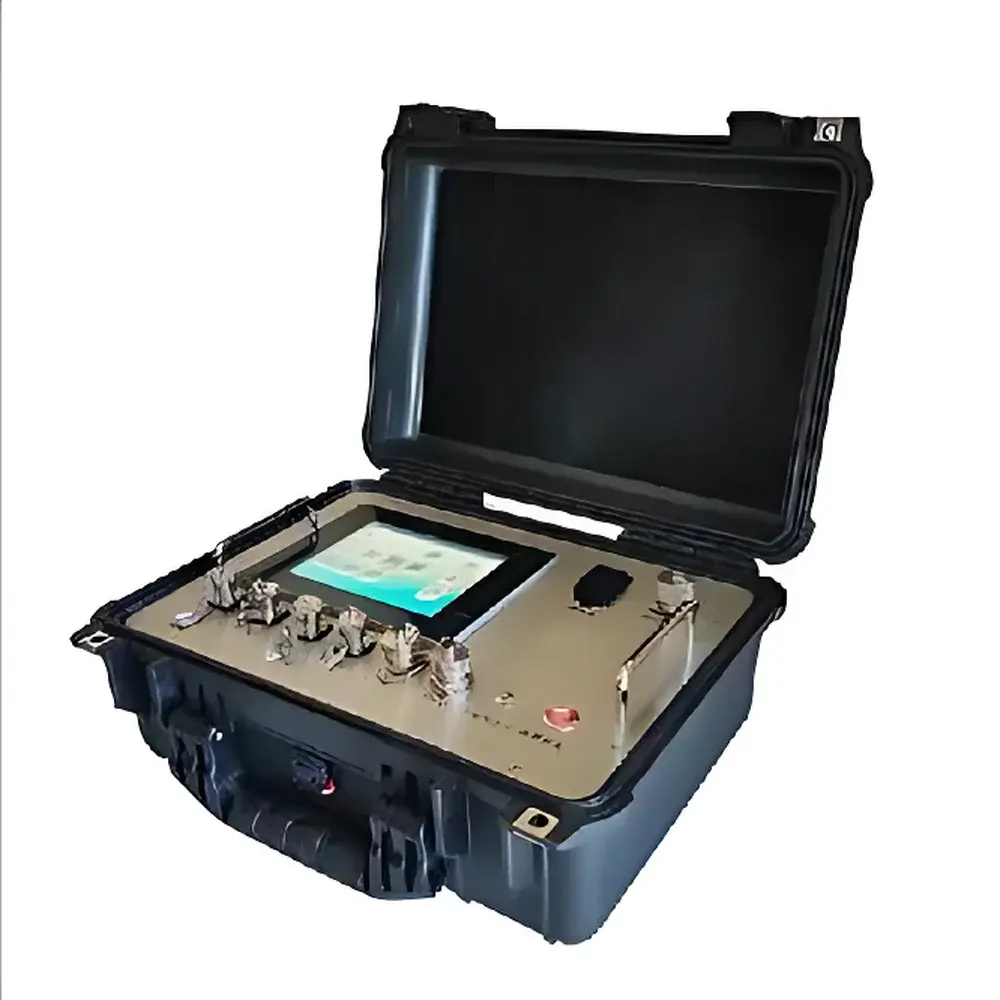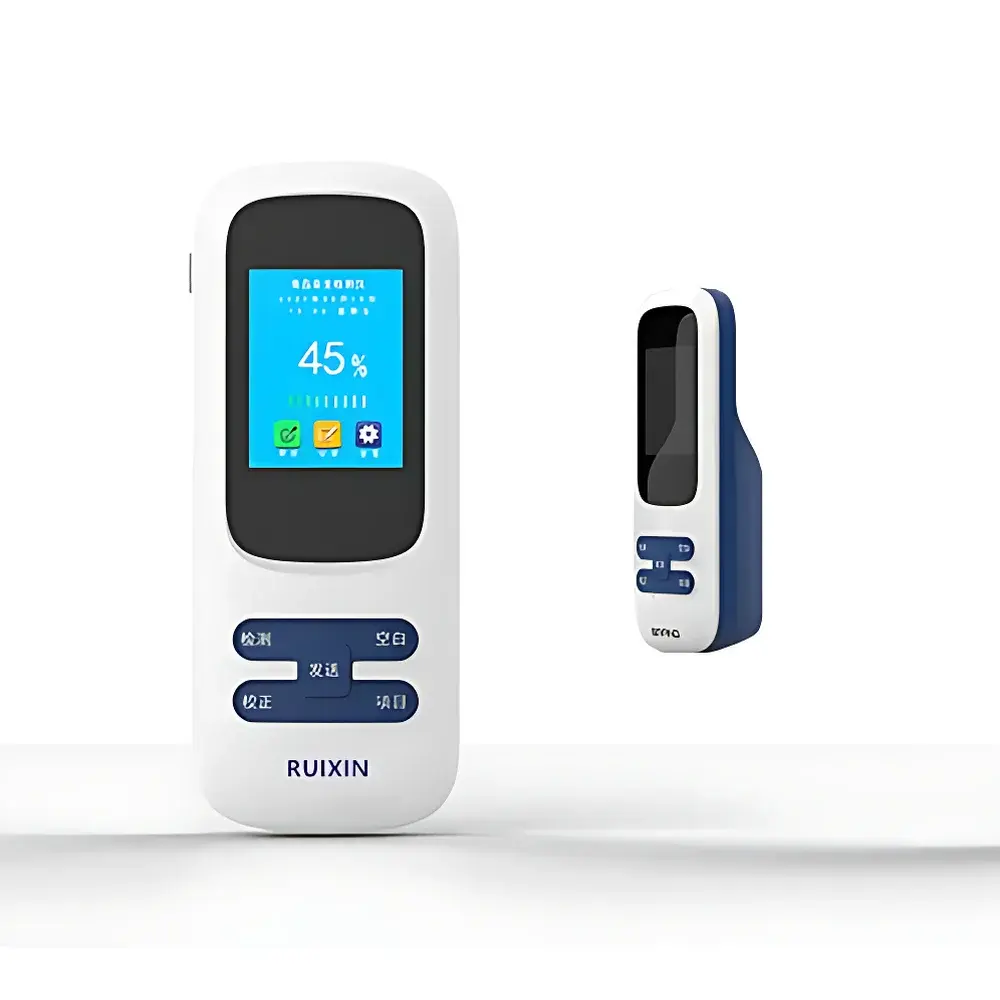
Ruixin CNY-100C Handheld Pesticide Residue Analyzer
| Brand | Ruixin |
|---|---|
| Origin | Shanghai, China |
| Model | CNY-100C |
| Detection Method | Enzyme Inhibition (Test Strip-Based) |
| Measurement Range | 0–99.9% inhibition rate |
| Detection Limit | 0.05 ppm |
| Accuracy | ±10% |
| Repeatability | ≤5% |
| Channel Count | 1 |
| Display | Color LCD |
| Power Supply | Integrated Lithium Battery (8 h continuous operation) |
| Dimensions | 175 × 100 × 85 mm |
| Connectivity | Bluetooth 4.0 |
| Data Output | Wireless transmission to regulatory platforms & mobile app integration for traceability and certificate generation |
Overview
The Ruixin CNY-100C Handheld Pesticide Residue Analyzer is a field-deployable, single-channel quantitative immunoassay support instrument engineered for rapid screening of organophosphorus and carbamate pesticide residues in fresh produce—including leafy vegetables, fruits, and herbs. It operates on the well-established biochemical principle of acetylcholinesterase (AChE) enzyme inhibition: in the presence of target pesticides, enzymatic activity is suppressed, leading to a measurable reduction in chromogenic reaction intensity on standardized test strips. The device quantifies this effect via optical reflectance spectroscopy—capturing reflected light intensity at specific wavelengths (typically 610 ± 10 nm) from the dried reaction zone of disposable enzymatic test cards. Unlike subjective visual interpretation, the CNY-100C employs calibrated photodiode-based reflectance detection with temperature-compensated signal processing, delivering objective, numerical inhibition rate values (0–99.9%) aligned with national food safety screening protocols.
Key Features
- Compact handheld form factor (175 × 100 × 85 mm) with ergonomic design and integrated carrying case for field mobility and on-site deployment.
- Optical reflectance detection system optimized for standardized pesticide test strips—eliminating inter-operator variability associated with visual assessment.
- High-contrast color LCD display providing real-time inhibition rate calculation, pass/fail status per sample, and timestamped result logging.
- Onboard rechargeable lithium battery supporting ≥8 hours of continuous operation without external power—suitable for extended market inspections or rural agricultural audits.
- Bluetooth 4.0 wireless interface enabling secure, low-power data transmission to iOS/Android companion applications for centralized recordkeeping.
- One-touch assay initiation workflow: automatic calibration upon strip insertion, thermal stabilization, and reflectance measurement—all completed within 3 minutes per sample.
- Firmware supports firmware-upgradable calibration profiles to accommodate evolving test strip formulations and regional regulatory thresholds.
Sample Compatibility & Compliance
The CNY-100C is validated for use with commercially available AChE-inhibition test strips compliant with GB/T 5009.199–2003 (China National Standard for Rapid Detection of Organophosphorus and Carbamate Pesticides in Vegetables and Fruits). It accommodates homogenized aqueous extracts prepared from common food matrices including cabbage, spinach, tomatoes, apples, and citrus fruits—requiring no solvent extraction or centrifugation. While not intended for quantitative confirmation (e.g., LC-MS/MS), its performance meets the sensitivity and reproducibility requirements for primary screening under China’s Food Safety Law (Article 112) and the State Administration for Market Regulation’s “Guidelines for Rapid Testing in Food Circulation.” The instrument’s measurement uncertainty (±10% inhibition rate) and repeatability (CV ≤5%) are consistent with AOAC Official Method 2007.01 validation criteria for rapid enzymatic assays.
Software & Data Management
The CNY-100C interfaces exclusively via the proprietary Ruixin FoodScan mobile application (iOS and Android), which functions as a lightweight data hub compliant with basic GLP-aligned documentation practices. Each test record includes operator ID, GPS-tagged location (optional), sample ID, inhibition rate, pass/fail determination against configurable threshold (default: ≥50% inhibition = positive), and digital signature capture. Data syncs automatically to cloud-hosted dashboards used by municipal food safety supervision centers. The app supports batch export in CSV format for audit trail reconstruction and generates QR-coded “Commitment Certificates of Compliance” (per MOH Order No. 36) directly printable via Bluetooth-enabled thermal printers. All communications adhere to TLS 1.2 encryption; local device storage retains logs for ≥90 days.
Applications
- Frontline food safety inspections at wholesale markets, farmers’ cooperatives, and supermarket receiving docks.
- Pre-harvest residue monitoring by agritech extension services and cooperative quality assurance teams.
- Institutional food service verification in school cafeterias, hospital kitchens, and government canteens.
- Consumer-facing self-testing in community food safety demonstration zones and rural township service stations.
- Training and capacity-building for grassroots inspectors where access to laboratory infrastructure is limited.
FAQ
What types of pesticides does the CNY-100C detect?
It detects organophosphorus and carbamate pesticides—including chlorpyrifos, dimethoate, omethoate, methomyl, and carbofuran—via their shared inhibition of acetylcholinesterase activity.
Can it quantify absolute pesticide concentration?
No. It reports percent inhibition relative to a blank control. Quantitative concentration estimation requires correlation with reference standards and is outside its scope per GB/T 5009.199–2003.
Is calibration required before each use?
Yes—a built-in blank strip calibration is performed automatically upon insertion of the first test card in each session.
How often should test strips be replaced?
Strips must be stored desiccated at 2–8°C and used within 12 months of manufacture; once opened, they remain stable for ≤30 days under sealed conditions.
Does the device meet international regulatory requirements?
It conforms to Chinese national standards and is widely deployed in domestic food safety surveillance systems; however, it is not CE-marked or FDA-cleared for use in EU or U.S. regulatory contexts.