
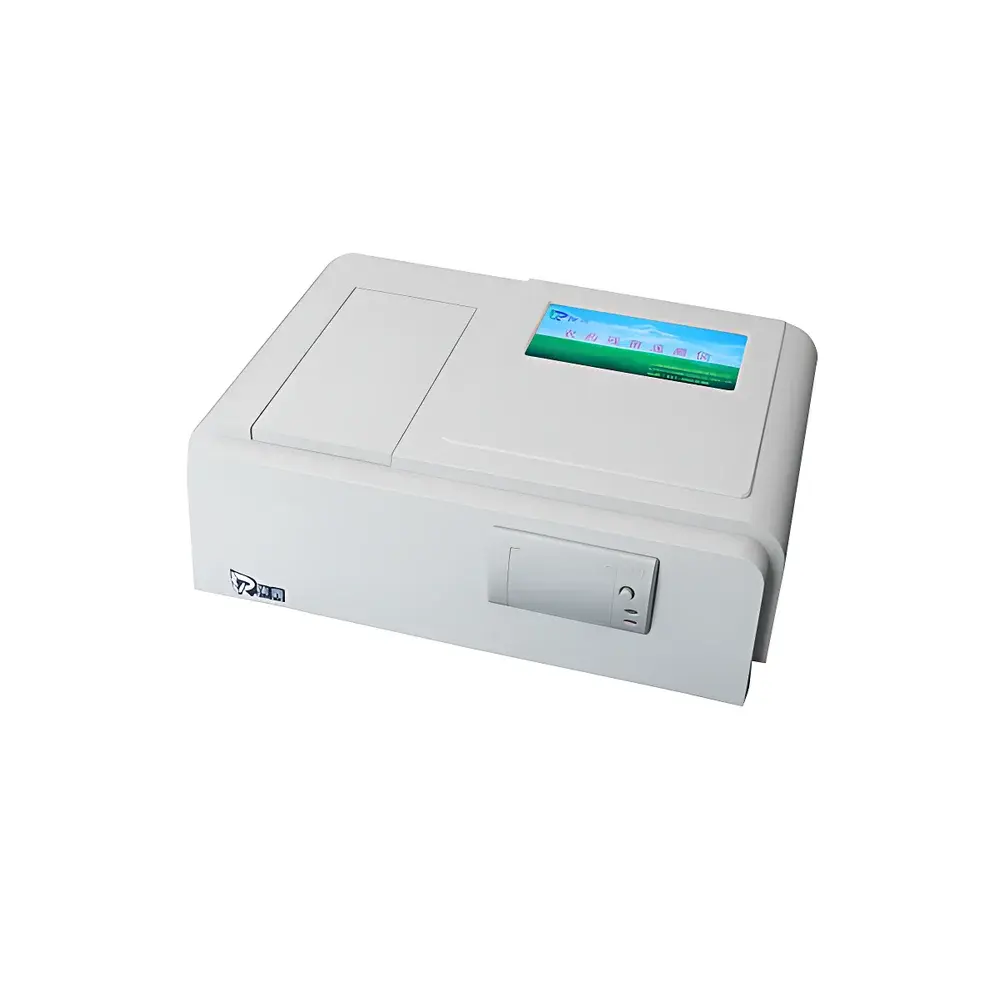
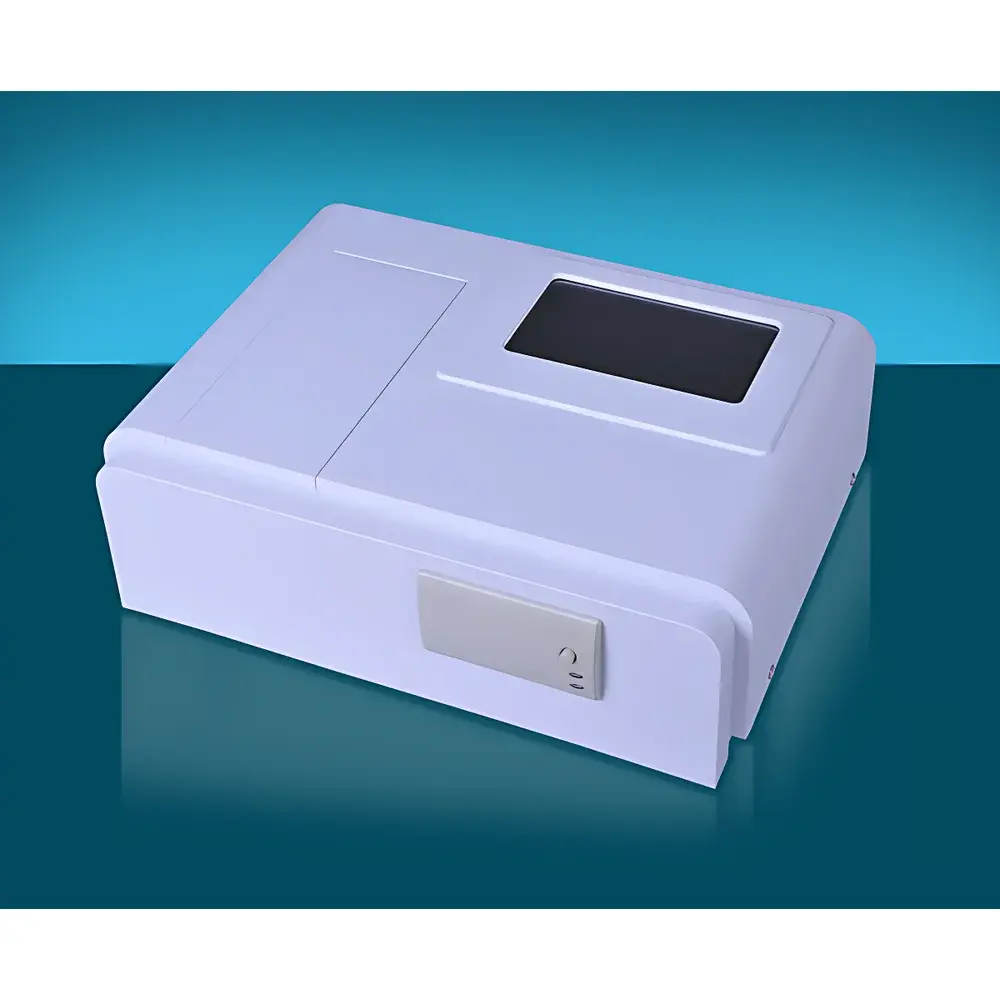

Ruixin CNY-1217C Pesticide Residue Rapid Tester
| Brand | Ruixin |
|---|---|
| Origin | Shanghai, China |
| Manufacturer Type | Authorized Distributor |
| Country of Origin | China |
| Model | CNY-1217C |
| Detection Method | Enzyme Inhibition Assay |
| Measurement Range | 0–100% inhibition |
| Number of Channels | 12 |
| Measurement Error | ≤10% |
| Limit of Detection (LOD) | 0.3 ppm |
| Display | 7-inch color TFT touchscreen |
| Wavelength | 410 nm |
| Absorbance Range | 0.000–4.000 |
| Absorbance Resolution | 0.001 |
| Transmittance Range | 0.00–100.00% |
| Transmittance Resolution | 0.01% |
| Photometric Accuracy (Transmittance) | ≤2.0% |
| Photometric Repeatability (Transmittance) | ≤0.2% |
| Photocurrent Drift | ≤0.2% (within 3 min) |
| Inhibition Rate Accuracy | ±10% |
| Inhibition Rate Repeatability | ≤5% |
| Internal Data Storage Capacity | 10,000 test records |
| Communication Interfaces | RS-232 and USB |
| Power Supply | 220 V ±10% AC |
| Dimensions (W×D×H) | 410 × 290 × 150 mm |
Overview
The Ruixin CNY-1217C Pesticide Residue Rapid Tester is a benchtop photometric analyzer engineered for high-throughput screening of organophosphorus and carbamate pesticide residues in fresh fruits and vegetables. It operates on the principle of acetylcholinesterase (AChE) or butyrylcholinesterase (BChE) inhibition assay — a standardized biochemical method referenced in GB 5009.199–2016 (replacing GB 5009.199–2003) and NY/T 448–2001. In this assay, active cholinesterase hydrolyzes chromogenic substrates (e.g., indoxyl acetate), producing a measurable color change; pesticide presence inhibits enzyme activity proportionally, resulting in reduced color development. The instrument quantifies inhibition rate (%) by measuring absorbance at 410 nm using a stable LED-based optical path with built-in self-calibration — eliminating manual zero/100% adjustment and minimizing operator-induced variability. Designed for routine use in food safety laboratories, it delivers rapid qualitative and semi-quantitative results within 10–15 minutes per batch, supporting early-stage risk assessment prior to confirmatory analysis by GC-MS or LC-MS/MS.
Key Features
- 12-channel simultaneous detection architecture enables parallel processing of up to 12 samples per run, significantly improving laboratory throughput.
- 7-inch high-resolution color TFT touchscreen with full Chinese GUI supports intuitive navigation, on-screen keyboard input, and stylus-enabled data entry — facilitating accurate sample annotation without external peripherals.
- Preloaded database of 72 common fruit and vegetable names, editable directly on-device or via batch import through companion software.
- Integrated thermal printer provides immediate hard-copy reporting compliant with internal QA documentation requirements.
- Optical self-calibration system ensures long-term photometric stability; automatic baseline correction compensates for lamp aging and ambient drift.
- Configurable reaction timing (1–30 min) and customizable inhibition threshold settings allow method adaptation across diverse matrix types and regulatory thresholds.
- Dual-enzyme compatibility: validated for both AChE and BChE reagents, ensuring alignment with national standard protocols and inter-laboratory comparability.
- Low operational cost: average reagent consumption per test is less than USD $0.05, making it suitable for high-volume screening programs.
Sample Compatibility & Compliance
The CNY-1217C is validated for homogenized extracts prepared from leafy greens, tomatoes, cucumbers, apples, pears, and other commonly traded produce. Sample preparation follows standardized homogenization, centrifugation, and supernatant dilution procedures outlined in GB 5009.199–2016. While not a confirmatory technique, its performance meets the sensitivity and reproducibility criteria specified for rapid screening in national food safety monitoring plans. The instrument’s inhibition rate measurement uncertainty (±10%) and repeatability (≤5%) satisfy typical field-deployable assay requirements under ISO/IEC 17025–compliant quality management systems. Data integrity is supported by time-stamped storage and audit-ready export logs — compatible with GLP-aligned recordkeeping practices.
Software & Data Management
The included PC-based Ruixin Pesticide Data Manager software enables centralized result archiving, statistical analysis (mean inhibition, pass/fail classification), and report generation in PDF/Excel formats. Raw absorbance values, inhibition percentages, timestamps, operator IDs, and sample metadata are stored with traceability. USB and RS-232 interfaces support direct data transfer to LIMS or enterprise databases. Software features include user-access-level controls, electronic signature capability, and optional integration with networked lab environments — facilitating compliance with basic data governance expectations in regulated food testing operations.
Applications
- Routine surveillance testing at municipal food safety inspection centers and provincial agricultural commodity markets.
- On-site verification at wholesale distribution hubs, supermarket QA labs, and farm-to-market cooperatives.
- Pre-harvest residue monitoring in certified organic and conventional production zones.
- Training and capacity building in regional agricultural extension services and vocational colleges.
- Supplemental screening prior to submission of suspect samples for reference laboratory confirmation.
FAQ
What pesticides does the CNY-1217C detect?
It detects organophosphorus (e.g., chlorpyrifos, diazinon) and carbamate (e.g., carbaryl, methomyl) compounds that inhibit cholinesterase activity. It does not detect neonicotinoids, pyrethroids, or glyphosate.
Is the instrument suitable for regulatory reporting?
It is intended for rapid screening only. Positive results require confirmation by chromatographic methods per GB 2763–2021 maximum residue limits (MRLs) enforcement protocols.
Can the device be calibrated with NIST-traceable standards?
While no certified reference materials are required for enzyme inhibition assays, users may validate performance using spiked control samples prepared according to ISO 17025 guidance documents.
How is data security ensured during transfer?
Data export files contain no embedded executable code; all transfers occur via authenticated local connections — no cloud upload or remote telemetry is implemented.
What maintenance is required?
Routine cleaning of cuvette holders and optical windows; annual verification of photometric accuracy using neutral density filters recommended.





