
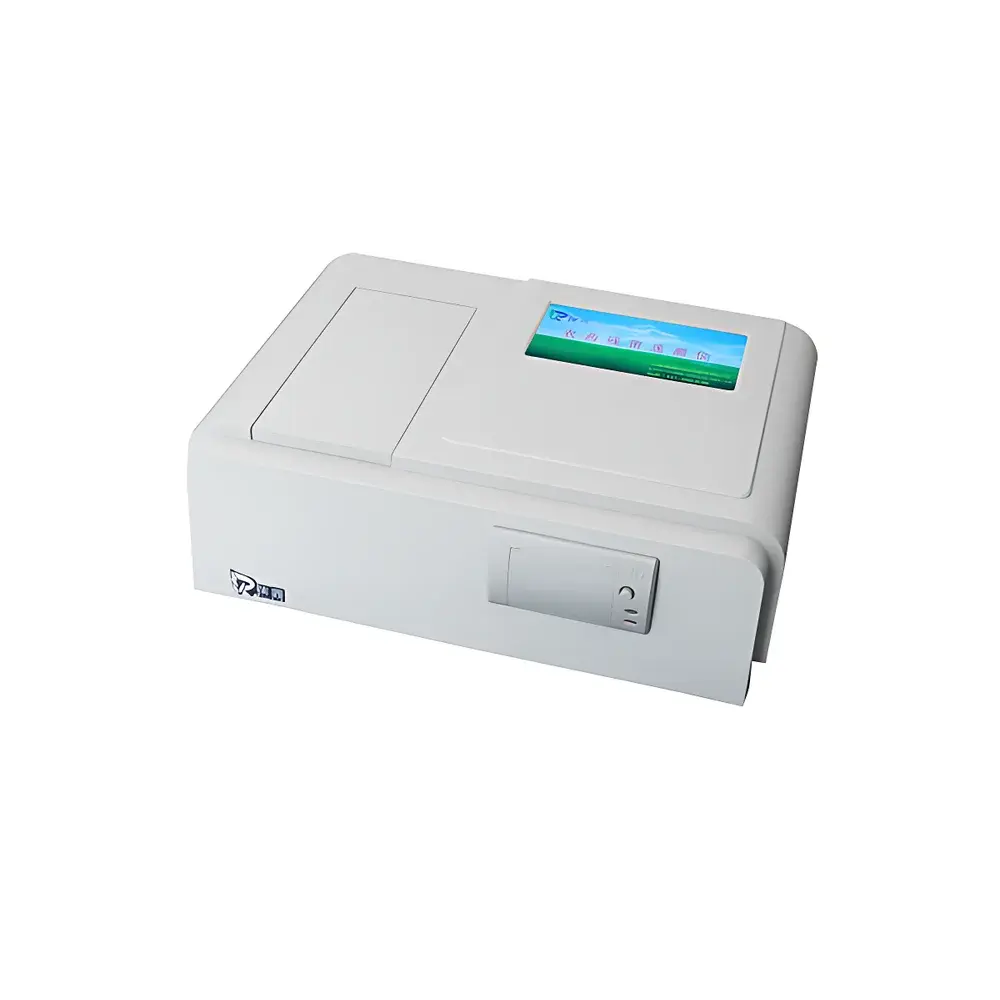
Ruixin CNY-1217LS Pesticide Residue Rapid Tester for Grains
| Brand | Ruixin |
|---|---|
| Origin | Shanghai, China |
| Manufacturer Type | Authorized Distributor |
| Country of Manufacture | China |
| Model | CNY-1217LS |
| Detection Method | Enzyme Inhibition (Spectrophotometric) |
| Measurement Range | 0–100% inhibition |
| Number of Channels | 12 |
| Measurement Error | <10% |
| Limit of Detection (LOD) | 0.2 ppm |
| Display | 7-inch color TFT touchscreen |
| Wavelength | 410 nm |
| Absorbance Range | 0.000–4.000 A |
| Transmittance Range | 0.00–100.00% T |
| Transmittance Resolution | 0.01% T |
| Absorbance Resolution | 0.001 A |
| Photometric Accuracy (T) | ±2.0% |
| Photometric Repeatability (T) | ≤0.2% |
| Photocurrent Drift (3 min) | ≤0.3% |
| Inhibition Rate Accuracy | ±10% |
| Inhibition Rate Repeatability | ≤5% |
| Interface | RS232 & USB |
| Power Supply | 220 V ±10% |
Overview
The Ruixin CNY-1217LS Pesticide Residue Rapid Tester is a dedicated benchtop spectrophotometric analyzer engineered for the quantitative screening of organophosphorus and carbamate pesticide residues in cereal grains—including wheat, rice, corn, barley, and oats. It operates on the principle of acetylcholinesterase (AChE) or butyrylcholinesterase (BChE) enzyme inhibition, where pesticide presence reduces enzymatic hydrolysis of substrate (e.g., acetylthiocholine iodide), resulting in measurable changes in chromogenic product formation at 410 nm. This method aligns with national standard GB/T 5009.199–2003 and Ministry of Agriculture standard NY/T 448–2001 for rapid field and laboratory-based food safety screening. Designed for grain procurement centers, storage facilities, and regional food safety laboratories, the instrument delivers semi-quantitative inhibition rate values (%) correlated to residue concentration, enabling compliance-driven pass/fail decisions within 10–15 minutes per batch.
Key Features
- 12 independent optical detection channels with automatic sample presence recognition—channels without samples remain idle, minimizing reagent consumption and cross-contamination risk.
- Integrated 7-inch high-resolution color TFT touchscreen with full Chinese GUI, supporting stylus and on-screen QWERTY input for direct annotation of sample names, operator IDs, and testing units.
- Self-calibrating optical path system: automatic zero and 100% T calibration at startup eliminates manual calibration steps and improves inter-day reproducibility.
- Dual-mode photometric display: simultaneous real-time readout of absorbance (0.000–4.000 A) and transmittance (0.00–100.00% T), facilitating method transfer and secondary assay validation.
- Embedded thermal printer with channel-specific report generation—including channel ID, inhibition rate (%), qualitative result (Pass/Fail), Chinese-labeled sample name, test date, analyst ID, and institutional stamp field.
- Configurable reaction timing (1–15 min) and inhibition threshold criteria (e.g., ≥50% inhibition = positive), supporting site-specific SOP adaptation per local regulatory guidance.
- Onboard data storage capacity for ≥10,000 test records with time-stamped metadata; searchable by date range, sample ID, or operator.
- Supports both AChE and BChE reagents—validated against reference standards traceable to CNAS-accredited reference materials.
Sample Compatibility & Compliance
The CNY-1217LS accepts homogenized grain extracts prepared via standardized QuEChERS-derived extraction protocols (e.g., 10 g ground sample + 10 mL acetonitrile + NaCl/Citrate buffer). Extracts are clarified by centrifugation (≥3,000 × g, 5 min) prior to assay. The system meets functional requirements outlined in ISO/IEC 17025:2017 for non-accredited screening instruments and supports GLP-aligned documentation practices. While not FDA 21 CFR Part 11-compliant out-of-the-box, audit trails, electronic signatures, and secure user access can be implemented via optional software integration modules compliant with EU Annex 11 and USDA-FNS Food Safety Monitoring Program reporting formats.
Software & Data Management
Bundled Ruixin LabLink™ software enables bidirectional data exchange via RS232 or USB. It provides centralized database management for multi-instrument networks, including batch-level statistical summaries (mean inhibition %, CV%, outlier detection), geographic mapping of hotspot results, and export to CSV, Excel, or LIMS-compatible XML. The software architecture supports API-based integration with third-party enterprise systems (e.g., SAP QM, LabVantage) using RESTful endpoints and HL7 v2.x message schemas. All data transfers are encrypted (AES-128), and local backups adhere to NIST SP 800-88 Rev. 1 sanitization guidelines.
Applications
- Routine surveillance of inbound grain shipments at state-owned grain reserves and central purchasing hubs.
- Pre-storage screening to identify contaminated lots before silo entry, reducing downstream processing risks.
- Verification testing during Good Agricultural Practice (GAP) and HACCP plan implementation audits.
- Training and capacity building in county-level agricultural extension labs with limited access to GC-MS or LC-MS/MS infrastructure.
- Emergency response deployment during regional pesticide misuse incidents (e.g., unauthorized application pre-harvest).
FAQ
What pesticides does the CNY-1217LS detect?
It detects organophosphorus (e.g., chlorpyrifos, malathion, diazinon) and carbamate (e.g., carbaryl, methomyl, carbofuran) compounds that inhibit cholinesterase activity. It does not detect neonicotinoids, pyrethroids, or glyphosate.
Is calibration verification required daily?
No—optical self-calibration occurs automatically at power-on. However, users must perform reagent blank verification and inhibition control checks (using 0.5 ppm paraoxon standard) at the start of each testing session per GB/T 5009.199–2003 Annex B.
Can raw absorbance data be exported for external analysis?
Yes—LabLink™ exports unprocessed A410 values, reaction kinetics curves (A vs. time), and inhibition calculation logs in tab-delimited format.
What is the shelf life of the enzyme reagents?
Lyophilized AChE/BChE kits retain activity for ≥18 months when stored at –20 °C; reconstituted solutions are stable for 72 hours at 4 °C under argon blanket.
Does the instrument support multi-language firmware?
Firmware is preloaded with Simplified Chinese only; English-language interface requires factory firmware upgrade and is available upon request for international distributors.
Related Products






