
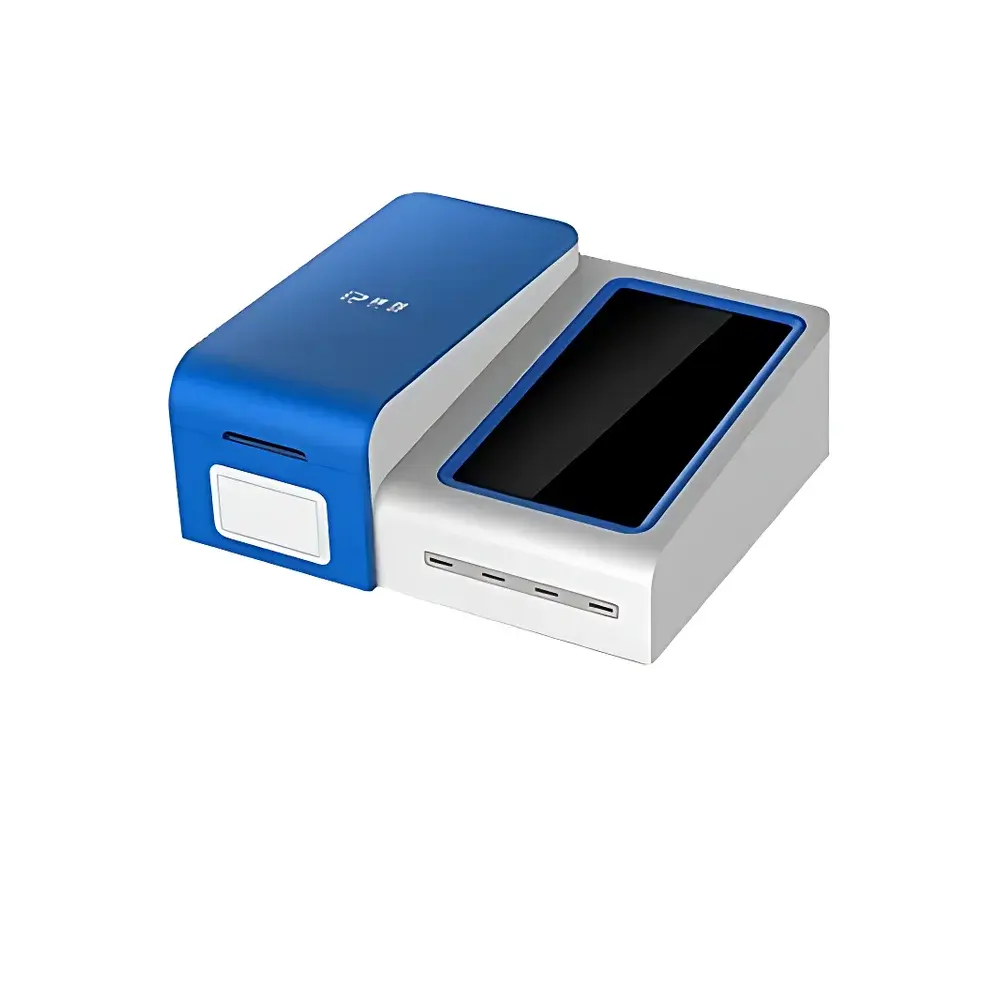
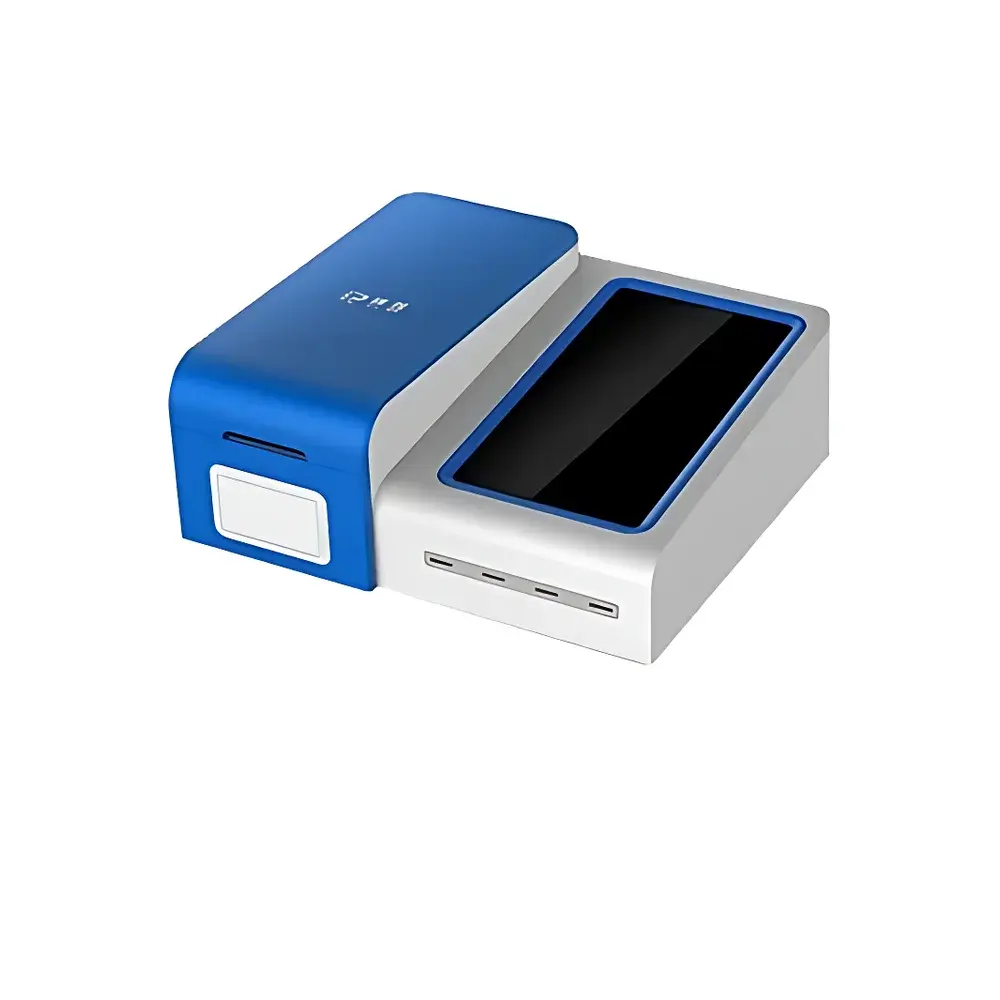
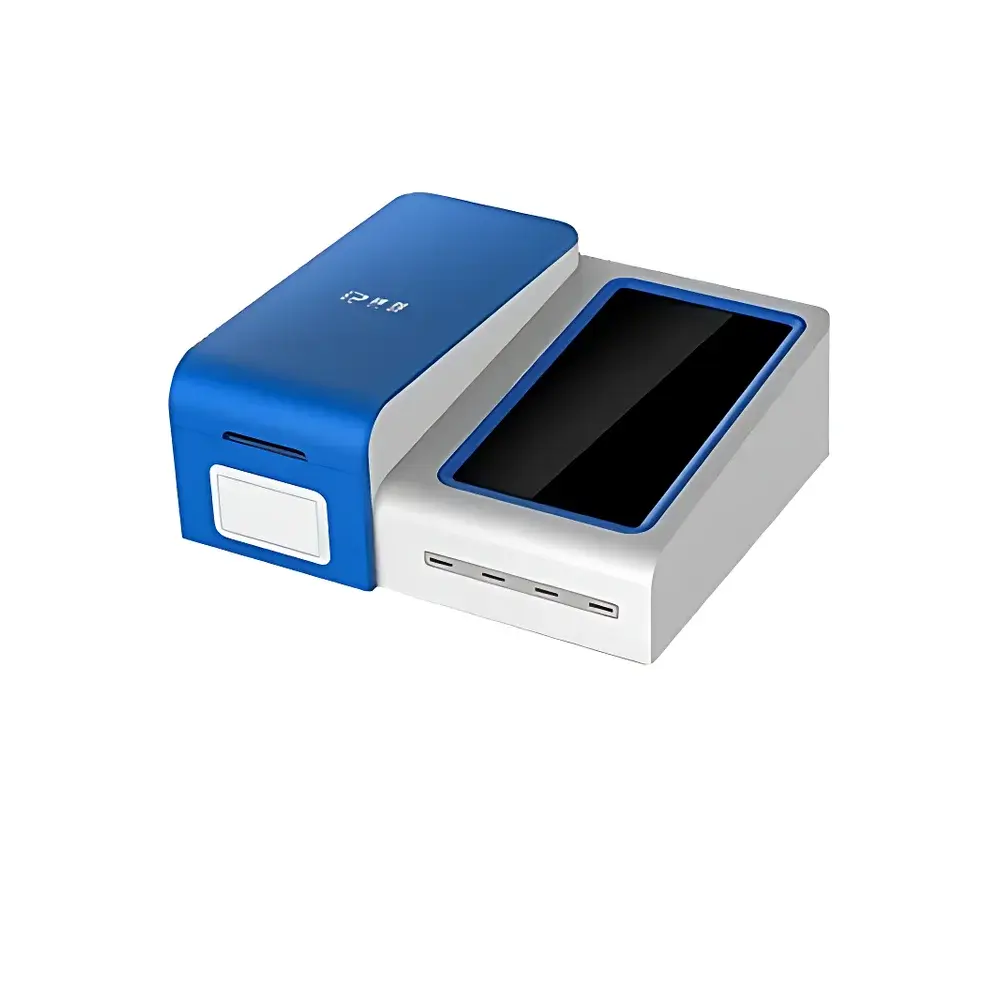
Ruixin CNY-1218D Multifunctional Pesticide Residue Rapid Tester
| Brand | Ruixin |
|---|---|
| Origin | Shanghai, China |
| Manufacturer Type | Authorized Distributor |
| Country of Origin | China |
| Model | CNY-1218D |
| Detection Method | Enzyme Inhibition Rate (Spectrophotometric) |
| Measurement Range | 0–100% inhibition |
| Number of Spectrophotometric Channels | 12 |
| Number of Colloidal Gold Lateral Flow Channels | 3 (expandable to 10) |
| Measurement Accuracy | ±5% |
| Absorbance Range | 0.000–4.000 A |
| Transmittance Range | 0.00–100.00% T |
| Transmittance Resolution | 0.01% T |
| Absorbance Resolution | 0.001 A |
| Photometric Accuracy (T) | ±2.0% |
| Photometric Repeatability (T) | ≤0.2% |
| Photocurrent Drift | ≤0.2% (over 3 min) |
| LOD for Organophosphates & Carbamates | 0.2 ppm |
| Display | 10.1-inch capacitive touchscreen (Android OS) |
| Connectivity | Dual USB, Wi-Fi, RJ45 Ethernet, optional 3G/4G/5G module |
| Power Supply | 220 V ±10% |
Overview
The Ruixin CNY-1218D Multifunctional Pesticide Residue Rapid Tester is an integrated analytical platform engineered for high-throughput, field-deployable screening of pesticide residues in fresh agricultural commodities. It combines dual-detection architecture—spectrophotometric enzyme inhibition assay and colloidal gold immunochromatographic lateral flow analysis—within a single, ruggedized instrument. The spectrophotometric module operates on the principle of acetylcholinesterase (AChE) inhibition kinetics: organophosphate and carbamate pesticides reversibly inhibit AChE activity, resulting in reduced hydrolysis of chromogenic substrates (e.g., indoxyl acetate), thereby producing quantifiable absorbance changes at 412 nm. This method conforms to national standard GB/T 5009.199–2003 and AOAC Official Method 2007.01. The colloidal gold module enables qualitative or semi-quantitative detection of non-cholinesterase-inhibiting pesticides—including pyrethroids, triazoles, strobilurins, and systemic fungicides—via antigen–antibody binding on nitrocellulose membranes. Designed for decentralized use, the CNY-1218D supports real-time data acquisition, traceability, and regulatory reporting aligned with China’s National Food Safety Standard (GB 2763) and the Ministry of Agriculture and Rural Affairs’ “Edible Agricultural Products Qualification Certificate System”.
Key Features
- Integrated dual-mode detection: 12-channel photometric measurement for enzyme inhibition assays + 3 independent colloidal gold readers (expandable to 10), enabling parallel analysis of cholinesterase-inhibiting and non-inhibiting pesticides.
- 10.1-inch industrial-grade capacitive touchscreen running Android OS (v9.0 or higher), supporting intuitive icon-driven workflows, embedded video tutorials, and audio-guided operation via built-in speaker.
- Onboard thermal label printer with auto-label positioning, capable of printing qualification certificates (with QR-code-based traceability), test reports, and adhesive labels at 127 mm/s; supports both direct thermal and thermal-transfer media.
- Built-in database of >1,000 standardized agricultural commodity names (aligned with GB/T 2260–2007), enabling rapid sample identification and context-aware result interpretation.
- Comprehensive connectivity suite: dual USB 2.0 ports, IEEE 802.11 b/g/n Wi-Fi, 10/100 Mbps RJ45 Ethernet, and optional LTE/5G modem integration for secure cloud synchronization and remote firmware updates.
- Robust optical system featuring precision LED light sources, interference-filtered photodiodes, and temperature-compensated signal processing to maintain ≤0.2% transmittance repeatability over repeated measurements.
Sample Compatibility & Compliance
The CNY-1218D is validated for homogenized extracts from leafy vegetables (e.g., spinach, lettuce), fruits (e.g., apples, strawberries), cereals (e.g., rice, wheat), tea leaves, and edible fungi. Sample preparation follows standardized QuEChERS-compatible extraction protocols using phosphate buffer (pH 7.0–7.5) and acetone/water mixtures. The instrument meets electromagnetic compatibility (EMC) requirements per GB/T 18268.1–2010 and safety specifications under GB 4793.1–2007. Its software architecture supports audit-trail generation, user role management (admin/operator/auditor), and export of CSV/Excel-formatted datasets compliant with GLP documentation practices. Data transmission to provincial food safety surveillance platforms (e.g., Jiangsu, Zhejiang, Guangdong provincial cloud systems) adheres to MQTT-based secure API protocols with TLS 1.2 encryption.
Software & Data Management
The embedded Android application provides full lifecycle data handling: sample registration, method selection (predefined or custom), calibration curve generation, automatic inhibition rate calculation, pass/fail classification per GB 2763 thresholds, and QR-coded certificate generation. All operations are timestamped and logged with operator ID, instrument serial number, and environmental metadata (ambient temperature/humidity if external sensors are connected). Cloud synchronization enables centralized dashboard visualization, cross-site statistical analysis (e.g., regional residue prevalence mapping), and automated report generation for regulatory submissions. Raw absorbance values, chromatographic line scans, and image captures of lateral flow strips are stored locally on microSD (up to 128 GB) and optionally mirrored to AWS S3 or Alibaba Cloud OSS buckets with configurable retention policies.
Applications
- Routine screening at farm gates, wholesale markets, and supermarket receiving docks for compliance with maximum residue limits (MRLs) for organophosphates (e.g., chlorpyrifos, parathion-methyl), carbamates (e.g., carbofuran, methomyl), and pyrethroids (e.g., deltamethrin, cypermethrin).
- Verification testing during Good Agricultural Practice (GAP) certification audits and HACCP plan implementation.
- Field-level validation of post-harvest decontamination efficacy (e.g., ozonated water treatment, UV-C exposure).
- Extension service support for smallholder farmers conducting self-assessment prior to market entry.
- Integration into municipal food safety early-warning systems for hotspot identification and targeted enforcement actions.
FAQ
What pesticides does the CNY-1218D detect by enzyme inhibition?
It quantitatively detects acetylcholinesterase-inhibiting compounds—including organophosphates (e.g., malathion, diazinon) and carbamates (e.g., carbaryl, propoxur)—with detection limits as low as 0.2 ppm in extract solutions.
Can the instrument validate negative results for non-cholinesterase inhibitors?
Yes—the colloidal gold module provides confirmatory testing for pyrethroids, neonicotinoids (e.g., imidacloprid), fungicides (e.g., thiophanate-methyl, procymidone), and plant growth regulators (e.g., 6-benzylaminopurine), using certified monoclonal antibodies.
Is the software compliant with FDA 21 CFR Part 11 requirements?
While not formally validated for Part 11 in its base configuration, the system supports electronic signatures, audit trails, and role-based access control—enabling customers to implement supplementary procedural controls to meet Part 11 readiness criteria.
How is calibration verified during daily operation?
Users perform blank and reference standard checks using supplied AChE reagent kits and certified control strips; instrument self-diagnostic routines verify photometer stability, thermal drift, and printer alignment before each assay batch.
Does the device support third-party LIMS integration?
Yes—via RESTful API endpoints and HL7-compliant message formatting; integration templates are available for Thermo Fisher SampleManager, LabVantage, and domestic platforms such as Shenzhen Yitian LIMS.




