
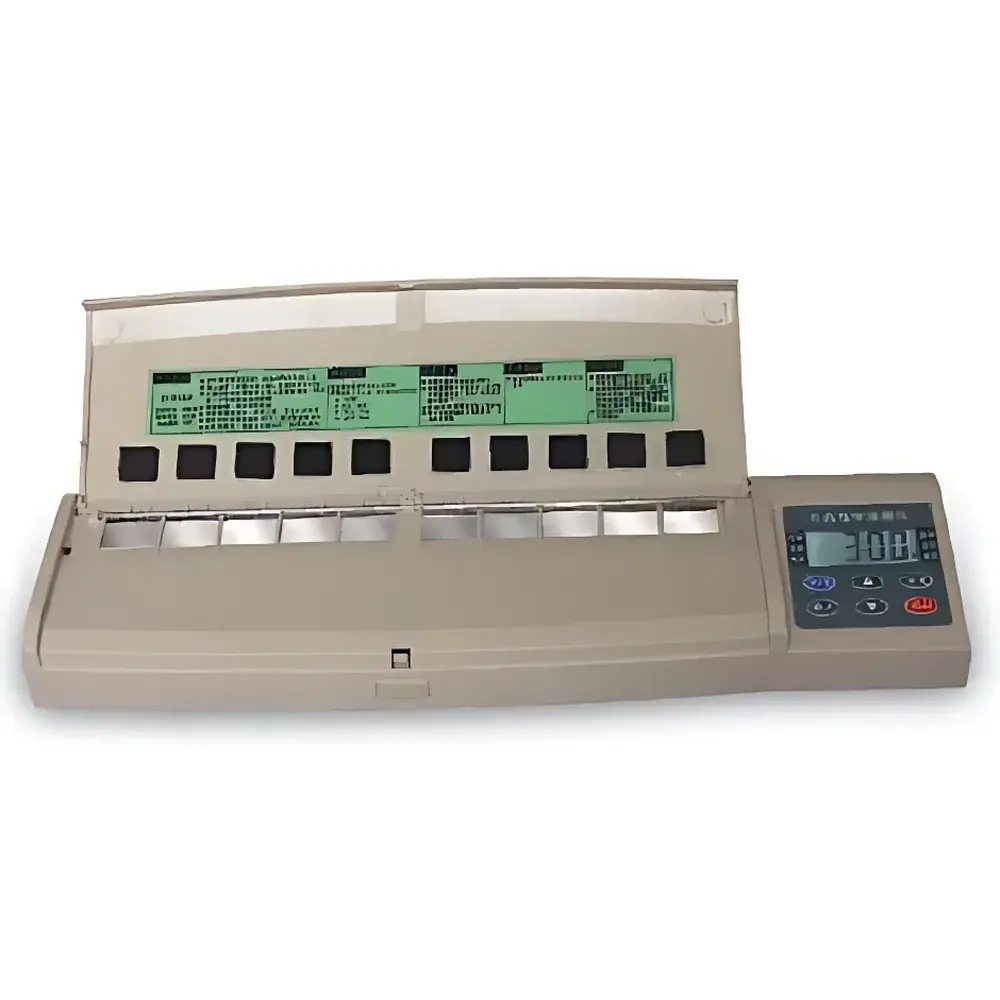
Ruixin CNY-12K Portable Pesticide Residue Rapid Tester
| Brand | Ruixin |
|---|---|
| Origin | Shanghai, China |
| Model | CNY-12K |
| Detection Method | Enzyme Inhibition Rate Method |
| Measurement Range | 0–100% |
| Number of Channels | 12 |
| Measurement Error | ≤10% |
| Limit of Detection (LOD) | 0.3 ppm |
| Temperature Control Range | 30–50 °C ±0.5 °C |
| Preheating Time Setting | 1–99 min |
| Reaction Time Setting | 1–99 min |
| Power Supply | AC 220 V / DC 12 V / Internal Rechargeable Battery (3.6 V / 1400 mAh) |
| Dimensions | 325 × 100 × 40 mm |
| Weight | ~600 g |
| Carrying Case Dimensions | 400 × 290 × 120 mm |
Overview
The Ruixin CNY-12K Portable Pesticide Residue Rapid Tester is a field-deployable analytical instrument engineered for the qualitative and semi-quantitative screening of organophosphorus and carbamate pesticide residues in agricultural commodities. It operates on the well-established enzyme inhibition rate principle—based on the suppression of acetylcholinesterase (AChE) or butyrylcholinesterase (BChE) activity by target pesticides—measured photometrically via colorimetric reaction kinetics on standardized test strips (GB/T 5009.199–2003). Unlike laboratory-based chromatographic methods (e.g., GC-MS or LC-MS/MS), the CNY-12K delivers rapid, on-site results within 10–20 minutes per batch, making it suitable for high-throughput preliminary triage rather than definitive regulatory quantification. Its design prioritizes operational robustness, low power consumption, and environmental adaptability—enabling reliable use in mobile laboratories, farm gate inspection points, wholesale markets, catering facilities, and food safety outreach programs under variable ambient conditions.
Key Features
- 12 independent detection channels with synchronized temperature-controlled incubation—ensuring uniform reaction kinetics across all samples.
- Microcontroller-driven thermal regulation (30–50 °C ±0.5 °C), with user-configurable preheating and reaction timing (1–99 minutes each) to accommodate diverse matrix interferences and reagent formulations.
- Triple-power architecture: compatible with standard AC mains (220 V), vehicle-mounted DC (12 V), and internal rechargeable Li-ion battery (3.6 V / 1400 mAh), supporting >8 hours of continuous operation after full charge.
- Compact, lightweight chassis (325 × 100 × 40 mm; ~600 g) housed in an impact-resistant aluminum carrying case (400 × 290 × 120 mm) with integrated foam padding for transport and field deployment.
- No specialized training required: intuitive push-button interface, visual status indicators, and automated calibration routines reduce operator dependency and minimize procedural variability.
Sample Compatibility & Compliance
The CNY-12K is validated for homogenized extracts from fresh fruits, leafy vegetables, tea leaves, cereal grains, surface water, and soil slurries—provided sample preparation adheres to GB/T 5009.199–2003 protocols (e.g., acetone extraction, centrifugation, dilution). It meets national Chinese food safety screening requirements for routine surveillance at primary production and distribution nodes. While not intended for compliance reporting under ISO/IEC 17025 or FDA 21 CFR Part 11, its methodology aligns with AOAC Official Method 992.11 (enzyme inhibition assay) and supports Good Agricultural Practice (GAP) and Hazard Analysis Critical Control Point (HACCP) verification workflows. Instrument performance is traceable to reference standards (e.g., dichlorvos, carbofuran) and subject to daily blank and control strip validation per internal quality assurance procedures.
Software & Data Management
The CNY-12K operates without external software or PC connectivity—data output is displayed in real time on a built-in LCD screen showing inhibition percentage (%) per channel, pass/fail thresholds (typically ≥50% inhibition = positive), and elapsed time. Results are manually recorded or exported via optional RS-232 serial interface (with compatible terminal or data logger). No onboard storage or audit trail functionality is implemented; therefore, the device does not fulfill electronic record requirements under GLP or GMP environments. For regulated settings, users must implement paper-based logbooks with operator signature, date/time stamp, and raw strip images as supplementary evidence.
Applications
- Rapid pre-market screening at farmers’ cooperatives, agro-processing hubs, and wholesale produce terminals.
- In-field verification during Good Agricultural Practice (GAP) audits and third-party certification inspections.
- On-site testing in school cafeterias, hospital kitchens, and corporate canteens to verify vendor-provided produce safety documentation.
- Mobile food safety campaigns conducted by municipal health departments and rural extension services.
- Training and capacity building for frontline inspectors where access to centralized labs is limited or delayed.
FAQ
What types of pesticides does the CNY-12K detect?
It detects organophosphorus (e.g., chlorpyrifos, diazinon) and carbamate (e.g., carbaryl, methomyl) compounds that inhibit cholinesterase enzymes—excluding neonicotinoids, pyrethroids, or fungicides.
Is the instrument compliant with international food safety standards?
It conforms to China’s GB/T 5009.199–2003 and supports AOAC-endorsed enzyme inhibition principles, but lacks formal ISO/IEC 17025 accreditation or FDA clearance for regulatory submission.
Can test strips from other manufacturers be used?
Only certified Ruixin-branded test strips are calibrated for the CNY-12K’s optical path and thermal profile; third-party strips may yield non-reproducible results due to substrate variability.
How often should the instrument be recalibrated?
No hardware calibration is required; however, daily functional verification using negative (blank extract) and positive (0.5 ppm dichlorvos) control strips is mandatory before sample analysis.
Does the device support data export for LIMS integration?
Not natively—RS-232 output requires external terminal configuration; no USB, Bluetooth, or cloud upload capability is embedded.





