
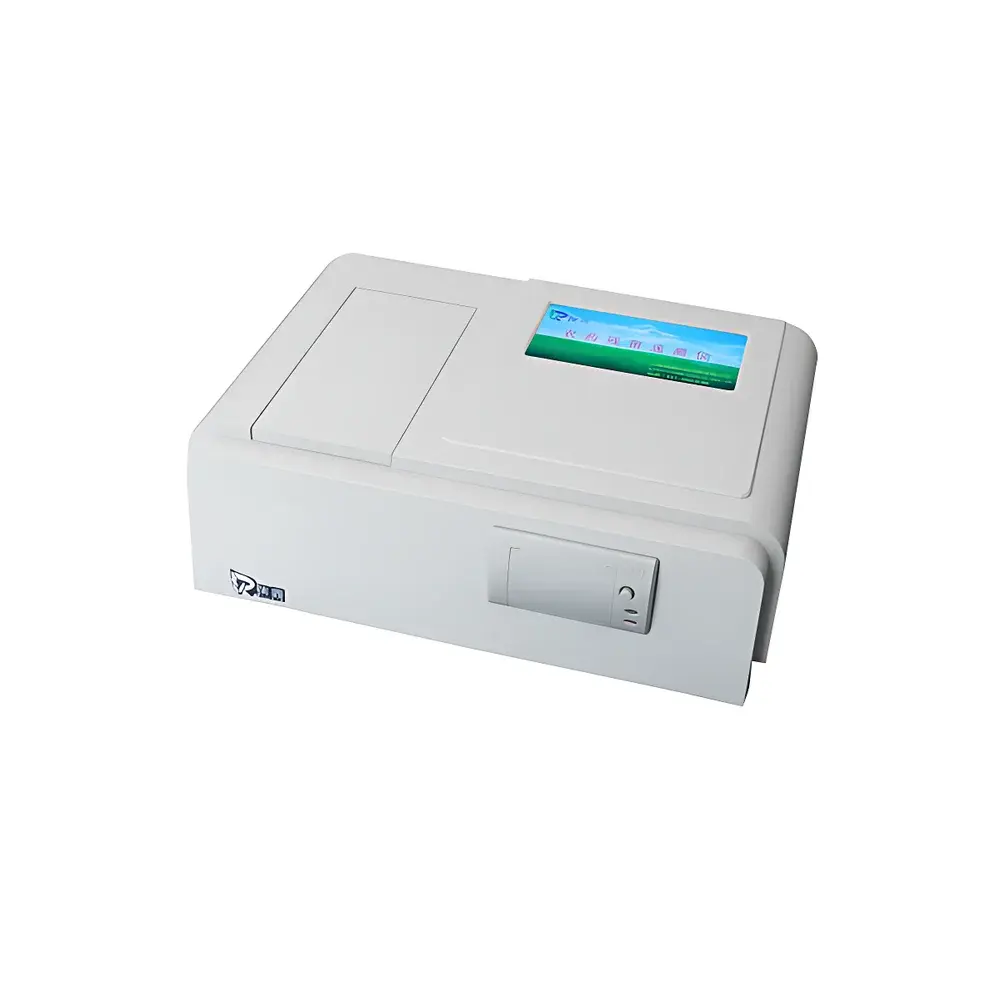
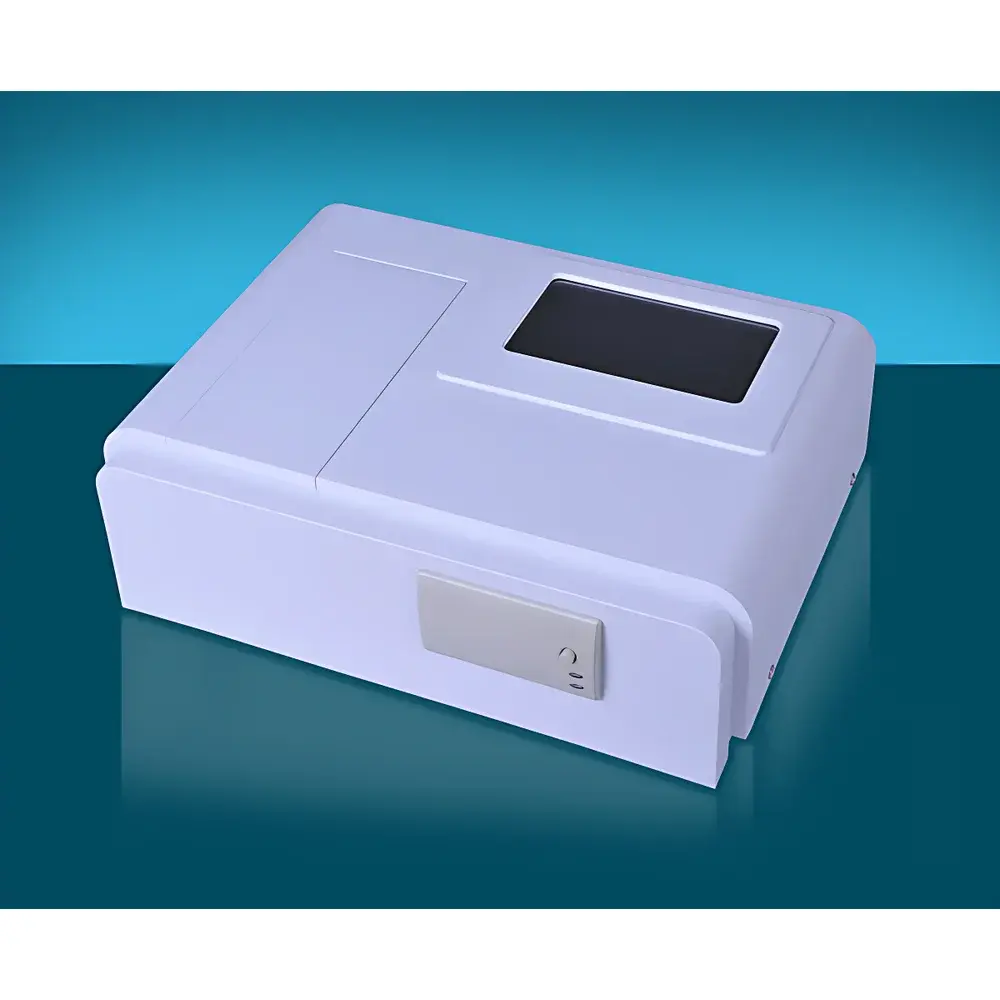

Ruixin CNY-1617C Pesticide Residue Rapid Tester
| Brand | Ruixin |
|---|---|
| Origin | Shanghai, China |
| Manufacturer Type | Authorized Distributor |
| Country of Origin | China |
| Model | CNY-1617C |
| Price | USD 2,500 (FOB Shanghai) |
| Detection Method | Enzyme Inhibition Assay |
| Measurement Range | 0–100% Inhibition Rate |
| Number of Channels | 16 |
| Measurement Error | ≤ ±10% |
| Limit of Detection (LOD) | 0.3 ppm for organophosphates and carbamates |
| Wavelength | 410 nm |
| Absorbance Range | 0.000–4.000 |
| Absorbance Resolution | 0.001 |
| Transmittance Range | 0.00–99.99% |
| Transmittance Resolution | 0.01% |
| Photometric Accuracy (Transmittance) | ≤ ±2.0% |
| Photometric Repeatability (Transmittance) | ≤ ±0.2% |
| Photocurrent Drift | ≤ ±0.2% (within 3 min) |
| Inhibition Rate Display Range | 0.00–99.99% |
| Inhibition Rate Repeatability | ≤ ±5% |
| Internal Data Storage Capacity | 10,000 test records |
| Communication Interface | USB |
| Power Supply | AC 220 V ±10%, 50/60 Hz |
| Dimensions (W×D×H) | 410 × 290 × 150 mm |
| Display | 7-inch color TFT LCD touchscreen with full Chinese GUI |
Overview
The Ruixin CNY-1617C Pesticide Residue Rapid Tester is a dedicated benchtop photometric analyzer engineered for the quantitative screening of organophosphate and carbamate pesticide residues in fresh fruits and vegetables. It operates on the principle of acetylcholinesterase (AChE) or butyrylcholinesterase (BChE) inhibition assay—a well-established biochemical method standardized under GB 5009.199–2003 (National Food Safety Standard – Determination of Organophosphorus and Carbamate Pesticide Residues in Fruits and Vegetables) and NY/T 448–2001 (Agricultural Industry Standard – Rapid Detection Method for Pesticide Residues in Vegetables). The instrument measures the degree of enzymatic inhibition induced by residual anticholinesterase compounds, converting the resulting colorimetric change—generated via hydrolysis of chromogenic substrates such as indoxyl acetate—into an inhibition rate (%) correlated to residue concentration. With a fixed optical path at 410 nm and integrated self-calibration optics, the CNY-1617C eliminates manual zeroing and 100% transmittance adjustment, ensuring consistent photometric baseline stability across daily operation.
Key Features
- 16-channel simultaneous detection architecture enables high-throughput batch analysis of up to 16 samples per run, optimizing workflow efficiency in centralized testing environments.
- 7-inch high-resolution color TFT touchscreen with intuitive Chinese-language GUI supports direct touch navigation, handwriting input, and on-screen keyboard entry—streamlining operator interaction and record annotation.
- Built-in sample library containing 72 preloaded fruit and vegetable names; editable via touchscreen or bulk import through companion software.
- Integrated thermal micro-printer delivers immediate hard-copy reports compliant with internal QA documentation requirements.
- Automated photometric self-calibration system performs optical alignment at power-on, reducing operator dependency and minimizing drift-related measurement variance.
- Configurable reaction time and inhibition threshold settings allow method adaptation to diverse matrix types and regulatory reporting criteria.
- Onboard storage retains up to 10,000 complete test records—including sample ID, inhibition rate, timestamp, operator ID, and raw absorbance values—with searchable indexing and USB-exportable CSV files.
- Supports both AChE and BChE reagents, aligning with dual-enzyme validation protocols specified in GB 5009.199–2003 and NY/T 448–2001.
- Low operational cost: average reagent consumption per test is less than USD 0.05, enabling sustainable routine monitoring without compromising analytical integrity.
Sample Compatibility & Compliance
The CNY-1617C is validated for homogenized aqueous extracts prepared from common produce matrices including leafy greens (e.g., spinach, lettuce), solanaceous fruits (e.g., tomatoes, peppers), cucurbits (e.g., cucumber, zucchini), and pome/stone fruits (e.g., apples, peaches). Sample preparation follows standardized extraction procedures outlined in GB 5009.199–2003, requiring minimal centrifugation and filtration prior to assay. While not intended for regulatory enforcement-level quantification, the instrument meets performance thresholds for rapid prescreening in accordance with national food safety surveillance frameworks. Its photometric accuracy (≤ ±2.0% transmittance error) and repeatability (≤ ±0.2%) satisfy GLP-aligned internal quality control benchmarks. Data output formats support traceability requirements under China’s Food Safety Law and provincial agricultural inspection guidelines.
Software & Data Management
The CNY-1617C interfaces with Ruixin’s proprietary Pesticide Residue Data Management Software (v3.2), a Windows-based application supporting USB-connected data synchronization, report generation (PDF/Excel), and database backup. Software features include role-based user access control, audit trail logging (operator actions, parameter changes, result modifications), and customizable report templates aligned with municipal food safety inspection forms. Raw absorbance and inhibition rate datasets are exportable in ISO/IEC 17025-compliant structured format, facilitating integration into LIMS environments. Firmware updates are delivered via USB drive, ensuring long-term compatibility with evolving national reference methods.
Applications
- Frontline screening at municipal vegetable inspection centers and provincial agricultural commodity markets.
- Routine monitoring in supermarket QA laboratories and HACCP-critical zones of food service establishments.
- Pre-harvest verification in certified organic and GAP-compliant vegetable production bases.
- Field-deployable use in mobile food safety units operated by county-level market regulation bureaus.
- Educational demonstration in food science curricula focusing on rapid analytical methodologies and enzyme kinetics.
FAQ
What pesticides does the CNY-1617C detect?
It detects organophosphate (e.g., chlorpyrifos, diazinon) and carbamate (e.g., carbaryl, methomyl) pesticides based on their inhibitory effect on cholinesterase activity.
Is the instrument suitable for regulatory compliance reporting?
It is designed for rapid prescreening and internal quality assurance—not for definitive confirmatory analysis. Positive results should be verified using GC-MS or LC-MS/MS per GB 23200 series standards.
Can inhibition rate data be exported to third-party LIMS?
Yes—CSV exports contain timestamped sample IDs, raw absorbance, transmittance, and calculated inhibition rates, compatible with common LIMS ingestion protocols.
Does the device require external calibration standards?
No. The built-in optical self-calibration system eliminates the need for daily blank/standard checks; however, periodic verification with control solutions is recommended per internal SOP.
What is the typical assay time per batch?
Total assay duration—including incubation, color development, and measurement—is approximately 12–15 minutes for a full 16-channel run.





