
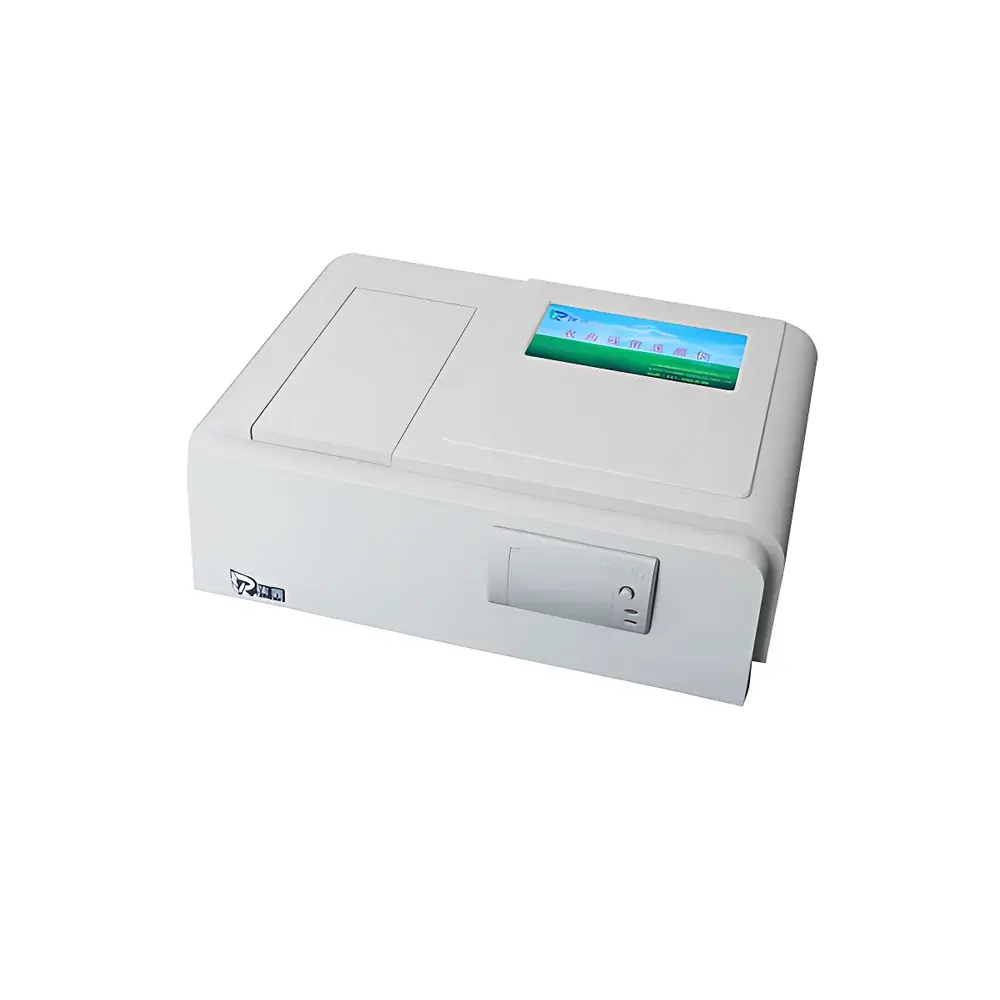
Ruixin CNY-2417C Pesticide Residue Rapid Tester
| Brand | Ruixin |
|---|---|
| Origin | Shanghai, China |
| Manufacturer Type | Authorized Distributor |
| Country of Origin | China |
| Model | CNY-2417C |
| Detection Method | Enzyme Inhibition Assay |
| Measurement Range | 0–100% inhibition |
| Number of Channels | 24 |
| Measurement Error | ≤10% |
| Limit of Detection (LOD) | 0.3 ppm |
| Display | 7-inch color TFT touchscreen |
| Wavelength | 410 nm |
| Absorbance Range | 0.000–4.000 |
| Absorbance Resolution | 0.001 |
| Transmittance Range | 0.00–99.00% |
| Transmittance Resolution | 0.01% |
| Photometric Accuracy (Transmittance) | ≤2.0% |
| Photometric Repeatability (Transmittance) | ≤0.2% |
| Photocurrent Drift | ≤0.2% (within 3 min) |
| Inhibition Rate Accuracy | ±10% |
| Inhibition Rate Repeatability | ≤5% |
| Internal Data Storage Capacity | 10,000 test records |
| Communication Interface | USB |
| Power Supply | 220 V ±10% AC |
| Dimensions (L×W×H) | 410 × 290 × 150 mm |
Overview
The Ruixin CNY-2417C Pesticide Residue Rapid Tester is a benchtop photometric analyzer engineered for the quantitative determination of organophosphorus and carbamate pesticide residues in fresh fruits and vegetables. It operates on the principle of acetylcholinesterase (AChE) or butyrylcholinesterase (BChE) inhibition assay—a well-established biochemical method standardized under GB 5009.199–2003 (National Food Safety Standard – Determination of Organophosphorus and Carbamate Pesticides in Foods) and NY/T 448–2001 (Agricultural Industry Standard – Rapid Detection Method for Pesticide Residues in Vegetables). In this assay, residual pesticides inhibit the enzymatic hydrolysis of chromogenic substrates (e.g., indoxyl acetate), resulting in a measurable decrease in color development proportional to inhibitor concentration. The instrument quantifies inhibition rates (%) via absorbance measurement at 410 nm using a stable LED light source and precision photodiode detection system.
Key Features
- 24-channel parallel detection architecture enabling high-throughput screening of up to 24 samples per run with independent optical paths and real-time signal acquisition.
- 7-inch high-resolution color TFT touchscreen with full Chinese GUI—supports touch-pen input, intelligent Chinese character recognition, and on-screen editing of sample names and metadata.
- Preloaded database of 72 common fruit and vegetable entries; supports user-defined sample name management via on-device editing or batch import via USB.
- Integrated thermal micro-printer for immediate hardcopy reporting compliant with internal QA documentation requirements.
- Self-calibrating optical path system—automated zero and 100% transmittance calibration at power-on eliminates manual baseline adjustment and improves inter-day reproducibility.
- Configurable reaction timing (1–15 min) and inhibition threshold settings (e.g., 50% cutoff for regulatory pass/fail decisions), supporting method flexibility across diverse matrix types and regulatory contexts.
- Onboard data storage capacity of 10,000 test records with timestamp, sample ID, inhibition rate, absorbance/transmittance values, and operator notes—accessible via intuitive scroll-and-search interface.
- Compatible with both AChE and BChE reagents, ensuring alignment with national standard protocols and enabling cross-validation where required.
Sample Compatibility & Compliance
The CNY-2417C is validated for homogenized extracts prepared from leafy greens (e.g., spinach, lettuce), solanaceous produce (e.g., tomatoes, peppers), cucurbits (e.g., cucumber, zucchini), and pome/stone fruits (e.g., apples, peaches). Sample preparation follows standardized homogenization, extraction, and centrifugation procedures outlined in GB 5009.199–2003. While not certified for GLP or ISO/IEC 17025 accreditation out-of-the-box, the instrument’s traceable photometric performance (≤2.0% transmittance accuracy, ≤0.2% repeatability), audit-ready data logging, and export-capable software infrastructure support integration into regulated environments requiring documented method validation and data integrity controls (e.g., FDA 21 CFR Part 11–aligned workflows when paired with validated LIMS).
Software & Data Management
A dedicated Windows-based data management software is supplied for bidirectional USB transfer of test records, statistical analysis (mean inhibition rate, CV%, trend charts), and customizable report generation (PDF/CSV/XLSX). The software enables batch export of raw absorbance values, inhibition calculations, and operator metadata—facilitating traceability, internal review, and submission to regional food safety authorities. All stored records include immutable timestamps, channel identifiers, and instrument serial number tagging—supporting basic ALCOA+ principles (Attributable, Legible, Contemporaneous, Original, Accurate) in routine monitoring applications.
Applications
- Frontline screening at municipal agricultural commodity markets and wholesale distribution hubs.
- Routine surveillance in supermarket quality assurance labs and HACCP-critical foodservice procurement units.
- Field-deployable use in cooperative farming associations and certified organic production zones for pre-harvest residue verification.
- Supplemental testing in provincial food safety inspection centers conducting rapid triage prior to confirmatory GC-MS or LC-MS/MS analysis.
- Training and capacity-building programs for agro-extension officers and rural food safety inspectors.
FAQ
What pesticides does the CNY-2417C detect?
It detects organophosphorus (e.g., chlorpyrifos, diazinon) and carbamate (e.g., carbaryl, methomyl) pesticides based on their shared inhibition of cholinesterase enzymes.
Is reagent compatibility limited to Ruixin-branded kits?
No—any AChE/BChE-based rapid test kit conforming to GB 5009.199–2003 specifications may be used, provided substrate concentration and incubation conditions are matched to instrument protocol parameters.
Can inhibition rate data be exported to LIMS?
Yes—via USB-connected PC using the included software, which supports CSV and Excel formats compatible with most laboratory information management systems.
Does the instrument require annual photometric calibration by a third party?
While not mandatory, periodic verification using NIST-traceable neutral density filters is recommended every 6–12 months to maintain long-term photometric fidelity in high-utilization settings.
What is the typical operational lifetime of the optical components?
The 410 nm LED light source and silicon photodiode detector are rated for ≥50,000 hours of continuous operation under standard ambient conditions (20–25°C, <60% RH).




