
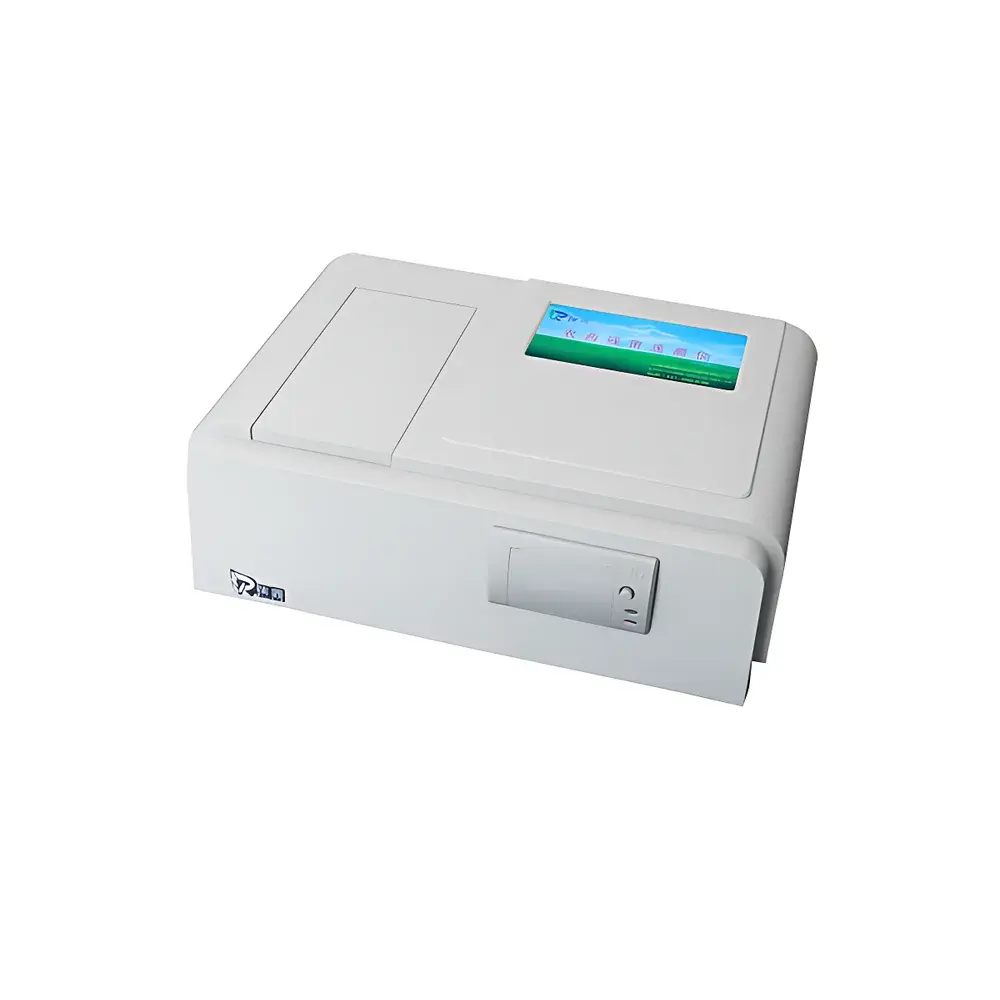
Ruixin CNY-3217C Pesticide Residue Rapid Tester
| Brand | Ruixin |
|---|---|
| Origin | Shanghai, China |
| Manufacturer Type | Authorized Distributor |
| Country of Origin | China |
| Model | CNY-3217C |
| Detection Method | Enzyme Inhibition Assay |
| Measurement Range | 0–100% Inhibition Rate |
| Number of Detection Channels | 24 |
| Measurement Error | ≤10% |
| Limit of Detection (LOD) | 0.3 ppm |
| Display | 7-inch Color TFT Touchscreen |
| Wavelength | 410 nm |
| Absorbance Range | 0.000–4.000 |
| Transmittance Range | 0.00–100.00% |
| Transmittance Resolution | 0.01% |
| Absorbance Resolution | 0.001 |
| Photometric Accuracy (Transmittance) | ≤2.0% |
| Photometric Repeatability (Transmittance) | ≤0.2% |
| Photocurrent Drift | ≤0.2% (within 3 min) |
| Inhibition Rate Accuracy | ±10% |
| Inhibition Rate Repeatability | ≤5% |
| Internal Data Storage Capacity | 10,000 test records |
| Communication Interfaces | RS-232 and USB |
| Power Supply | AC 220 V ±10% |
| Dimensions (L×W×H) | 410 × 290 × 150 mm |
Overview
The Ruixin CNY-3217C Pesticide Residue Rapid Tester is a dedicated benchtop photometric analyzer engineered for the quantitative screening of organophosphorus and carbamate pesticide residues in fresh fruits and vegetables. It operates on the principle of acetylcholinesterase (AChE) or butyrylcholinesterase (BChE) inhibition—where residual pesticides reversibly inhibit the enzymatic hydrolysis of chromogenic substrates (e.g., indoxyl acetate), resulting in measurable changes in absorbance at 410 nm. This method aligns with internationally recognized rapid screening protocols and is validated per Chinese national standard GB 5009.199–2016 (replacing GB 5009.199–2003) and agricultural industry standard NY/T 448–2001. Designed for high-throughput field and laboratory environments, the instrument delivers semi-quantitative inhibition rate results (0–100%) within 10–15 minutes per batch, supporting preliminary risk assessment prior to confirmatory analysis by GC-MS or LC-MS/MS.
Key Features
- 24-channel simultaneous detection architecture enables parallel analysis of up to 24 samples per run, significantly improving workflow efficiency in centralized testing labs and market-level screening stations.
- 7-inch high-resolution color TFT touchscreen with full Chinese GUI supports intuitive navigation, real-time data visualization, and direct on-screen input via virtual keyboard or stylus—eliminating dependency on external peripherals.
- Preloaded database of 72 common fruit and vegetable matrices; editable via touchscreen or bulk import through PC software—ensuring traceable sample identification and standardized reporting.
- Integrated thermal mini-printer generates compliant hard-copy reports containing sample ID, test time, inhibition rate, pass/fail status, and operator signature—meeting basic GLP documentation requirements.
- Self-calibrating optical path system performs automatic zero and 100% transmittance calibration at startup, minimizing manual intervention and reducing inter-operator variability.
- Configurable reaction timing (1–15 min) and inhibition threshold settings (e.g., 50% cutoff for regulatory screening) allow method adaptation across diverse regulatory frameworks and internal QA protocols.
- Dual-enzyme compatibility: supports both AChE and BChE reagents, ensuring compliance with multiple national reference methods and enabling cross-validation studies.
- Low operational cost: average reagent consumption per test is below USD $0.05, making it suitable for routine surveillance in resource-constrained settings.
Sample Compatibility & Compliance
The CNY-3217C is validated for homogenized extracts prepared from leafy greens (e.g., spinach, lettuce), solanaceous crops (tomato, pepper), cucurbits (cucumber, zucchini), and pome/stone fruits (apple, peach) using standardized extraction buffers (e.g., phosphate buffer, pH 7.0–7.5). Sample preparation follows AOAC Official Method 2007.01 principles for rapid enzyme-based assays. While not a confirmatory technique, its performance meets the sensitivity and reproducibility benchmarks outlined in GB/T 27404–2008 (Laboratory Quality Control Guidelines) for rapid screening instruments. The device supports audit-ready data integrity through timestamped storage, user-accessible history logs, and exportable CSV files—facilitating alignment with ISO/IEC 17025 documentation practices.
Software & Data Management
Embedded firmware includes a built-in data management module capable of storing ≥10,000 test records with full metadata (date/time, operator ID, sample name, channel ID, inhibition rate, pass/fail flag). Data export is supported via USB mass storage mode or RS-232 serial transmission to Windows-based desktop software (provided separately). The companion Ruixin Pesticide Data Manager v3.x enables hierarchical data sorting, statistical summary (mean inhibition, CV%), PDF report generation, and networked synchronization across local area networks—supporting centralized monitoring in municipal food safety surveillance systems. All data fields are immutable post-acquisition, satisfying basic ALCOA+ (Attributable, Legible, Contemporaneous, Original, Accurate) expectations for regulated environments.
Applications
- Frontline screening at wholesale markets, farmers’ cooperatives, and supermarket quality control checkpoints.
- Routine monitoring in provincial and municipal CDC food safety laboratories performing Tier-1 surveillance.
- On-site verification during Good Agricultural Practice (GAP) audits and organic certification inspections.
- Educational use in food science and agricultural extension training programs focusing on rapid diagnostics.
- Supporting national residue monitoring programs requiring high-volume, low-cost triage prior to instrumental confirmation.
FAQ
What pesticides does the CNY-3217C detect?
It detects organophosphorus (e.g., chlorpyrifos, dimethoate) and carbamate (e.g., carbaryl, methomyl) pesticides that inhibit cholinesterase activity. It does not detect neonicotinoids, pyrethroids, or fungicides.
Is the instrument compliant with ISO/IEC 17025 requirements?
While the hardware itself is not accredited, its documented performance characteristics (LOD, repeatability, photometric accuracy), data traceability features, and calibration protocol support method validation under ISO/IEC 17025 Clause 7.2 for non-accredited laboratories.
Can test data be integrated into LIMS?
Yes—CSV exports and RS-232 ASCII output enable integration with most legacy and modern LIMS platforms via custom scripting or middleware adapters.
What is the shelf life of the enzyme reagents?
Lyophilized AChE/BChE reagents retain activity for ≥12 months when stored at –20 °C; reconstituted solutions remain stable for 7 days at 2–8 °C.
Does the device require annual calibration by a certified technician?
No formal recalibration is required; however, users must perform daily optical verification using supplied neutral density filters and document results as part of routine QC procedures.






