
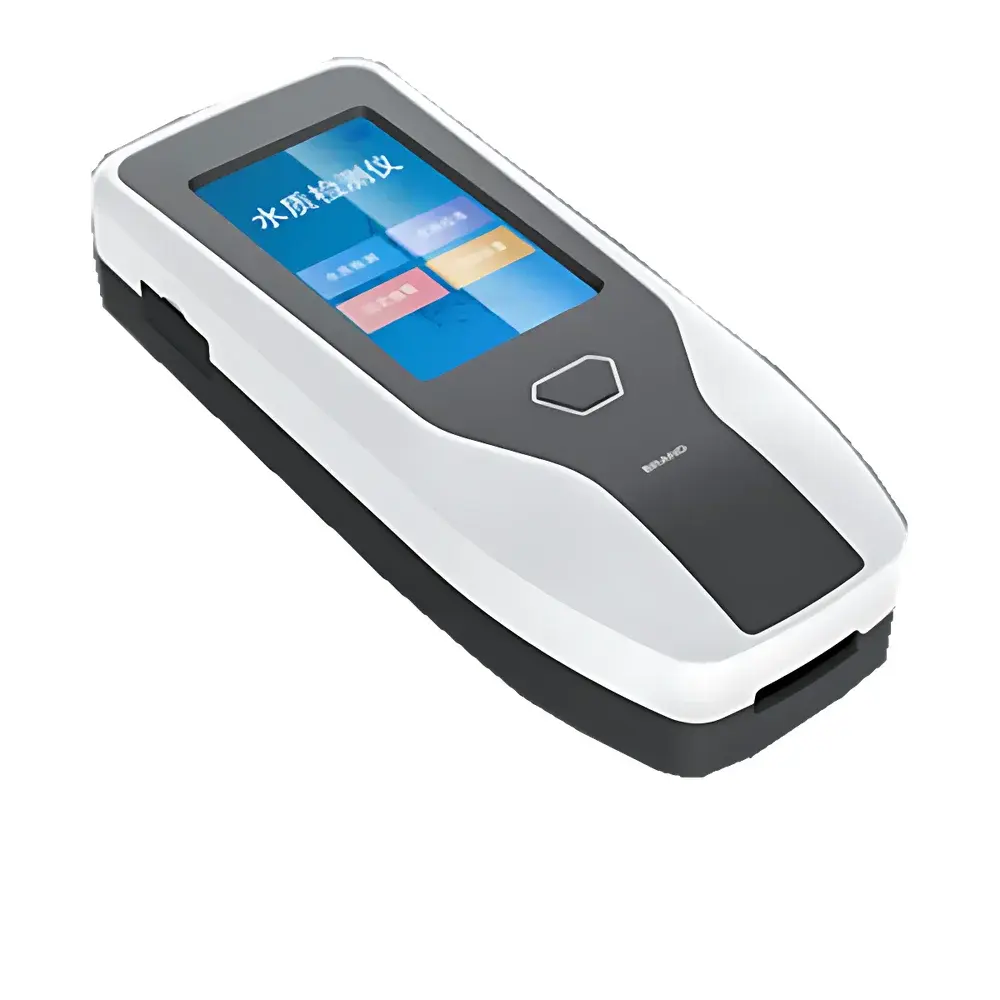
Ruixin JT-DB10NY Portable Colloidal Gold-Based Pesticide Residue Analyzer
| Brand | Ruixin |
|---|---|
| Origin | Shanghai, China |
| Manufacturer Type | Authorized Distributor |
| Country of Manufacture | China |
| Model | JT-DB10NY |
| Price | USD 1,050 (FOB Shanghai) |
| Measurement Range | 0–1000 ppm |
| Number of Detection Channels | 1 |
| Detection Method | Colloidal Gold Immunochromatography |
| Measurement Accuracy | ±5% |
| Limit of Detection (LOD) | 0.01 ppm |
| Detection Time | <2 s per test |
| Display | 5-inch capacitive touchscreen (Android OS) |
| Power Supply | Rechargeable Li-ion battery (operational autonomy ≥8 h) |
| Data Output | C/T line intensity ratio, chromaticity value, qualitative/quantitative result classification |
| Connectivity | Wi-Fi, Bluetooth 4.2, USB 2.0 |
| Data Management | Cloud synchronization, local storage (≥10,000 records), CSV export |
| Compliance | Aligned with MOA Notice No. 102 (2022), “Three-Year Action Plan for Illegal Drug Control and Residue Reduction in Edible Agricultural Products”, and Technical Guidance for Quality & Safety Control of Cowpea, Leek, and Celery (MOA, 2023) |
Overview
The Ruixin JT-DB10NY Portable Colloidal Gold-Based Pesticide Residue Analyzer is a field-deployable optical quantification instrument engineered for rapid, on-site interpretation of lateral flow immunoassay (LFIA) strips using colloidal gold conjugates. It operates on the principle of reflectance photometry and digital image analysis: a high-resolution CCD sensor captures the visible-light reflectance profile of test (T) and control (C) lines on commercial pesticide-specific immunochromatographic strips, followed by AI-assisted pixel-intensity quantification to convert qualitative strip signals into semi-quantitative concentration estimates (ppm). Designed explicitly for agricultural commodity testing—particularly fresh vegetables, fruits, and tobacco leaves—the instrument eliminates subjective visual interpretation, reducing inter-operator variability while maintaining full compatibility with widely distributed, regulatory-endorsed colloidal gold test kits. Its architecture complies with the technical validation framework outlined in China’s Ministry of Agriculture and Rural Affairs (MOA) Notice No. 102 (2022) and supports traceability requirements under the national “Control Illegal Drugs, Reduce Residues, Enhance Quality” Three-Year Action Plan (2021–2024).
Key Features
- High-fidelity 5-megapixel CCD imaging module with auto-exposure and ambient light compensation for consistent strip illumination and colorimetric reproducibility
- Real-time AI-powered image segmentation: automatic identification and exclusion of invalid strips (e.g., missing C-line, physical damage, or insufficient migration)
- Single-channel plug-and-play detection—no sample loading, pipetting, or calibration required; accepts standard 3-mm-wide lateral flow cassettes from multiple manufacturers
- Integrated Android 9.0 operating system with intuitive touch interface; preloaded instructional video library accessible offline
- On-device result classification: outputs T/C ratio, normalized chromaticity index, and pass/fail status against user-defined thresholds (e.g., MRL-based cutoffs)
- Embedded rechargeable lithium-ion battery (7800 mAh) enabling continuous operation for ≥8 hours without external power
- Dual-mode connectivity: Wi-Fi 802.11 b/g/n for cloud upload; Bluetooth 4.2 for pairing with portable thermal printers (optional)
- Local database stores ≥10,000 test records with timestamp, GPS-tagged location (when enabled), operator ID, and strip lot number
Sample Compatibility & Compliance
The JT-DB10NY is validated for use with commercially available colloidal gold-based rapid test kits targeting organophosphates (e.g., methamidophos, omethoate), carbamates (e.g., carbaryl, methomyl), and pyrethroids (e.g., cypermethrin, deltamethrin) in homogenized extracts of leafy vegetables, solanaceous fruits, and air-cured tobacco. Sample preparation follows AOAC Official Method 2012.01 and GB/T 5009.199–2003 protocols: extraction with acetonitrile/buffer, centrifugation, and dilution to bring analyte concentrations within the 0.01–1000 ppm linear dynamic range. Instrument performance meets the repeatability (RSD ≤8%) and accuracy (±5% bias vs. reference LC-MS/MS) criteria specified in MOA Document No. 102 (2022) and aligns with Good Laboratory Practice (GLP) documentation standards for field screening data.
Software & Data Management
Firmware v3.2 supports encrypted local storage compliant with ISO/IEC 27001 data integrity principles. All test results—including raw image files, processed intensity values, and metadata—are timestamped and signed with a device-specific cryptographic hash prior to cloud synchronization via HTTPS to Ruixin’s secure SaaS platform (RUINEX Cloud v2.4). The platform provides role-based access control (RBAC), audit trails per FDA 21 CFR Part 11 Annex A guidelines, and automated generation of summary reports (daily/weekly residue prevalence, regional hotspot mapping, batch-level compliance dashboards). CSV and PDF exports are compatible with LIMS integration (HL7/FHIR-ready API endpoints available upon enterprise licensing).
Applications
- Pre-harvest field screening at cooperative farms and agro-processing hubs
- Regulatory inspection during wholesale market entry and border quarantine checkpoints
- Quality assurance verification in cold-chain distribution centers prior to retail dispatch
- Extension service training: real-time demonstration of residue threshold exceedance using annotated strip images
- Multi-year trend analysis of pesticide usage patterns across geographic zones (via aggregated anonymized cloud data)
FAQ
Does the JT-DB10NY require consumables beyond standard colloidal gold test strips?
No. The instrument uses no proprietary reagents, cartridges, or calibration kits—it relies solely on third-party CE- or NMPA-certified lateral flow devices.
Can test results be exported directly to government reporting portals?
Yes. RUINEX Cloud supports automated XML/JSON submission to China’s National Agri-Food Safety Information System (NASIS) via certified API gateway.
Is firmware upgradable in the field?
Yes. Over-the-air (OTA) updates are delivered via Wi-Fi; version history and changelogs are accessible in Settings > System Maintenance.
What environmental conditions affect measurement stability?
Optimal operation occurs at 10–35°C and ≤80% RH. The CCD module includes thermal drift compensation; however, direct sunlight exposure during scanning is discouraged.
How is data privacy enforced during cloud transmission?
All communications use TLS 1.3 encryption; device authentication employs X.509 certificates; and raw image data is retained on-device unless explicitly uploaded by authorized users.





