
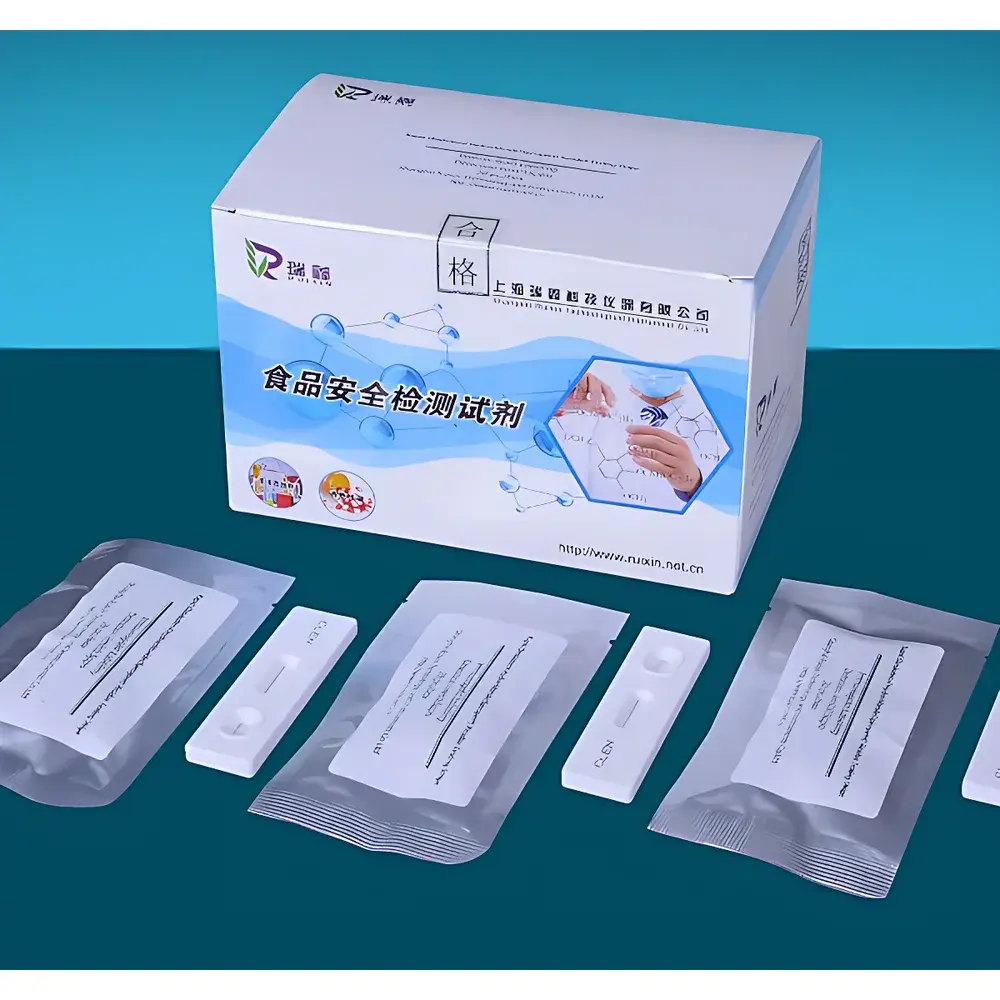
Ruixin JT-K100 Colloidal Gold-Based Pesticide Residue Rapid Test Kit
| Brand | Ruixin |
|---|---|
| Origin | Shanghai, China |
| Manufacturer Type | Authorized Distributor |
| Country of Origin | China |
| Model | JT-K100 |
| Detection Method | Colloidal Gold Immunochromatography |
| Measurement Range | 0.5–1000 ppb |
| Number of Test Lines | 1 |
| Quantitative Accuracy (CV) | ≤1% |
| Limit of Detection (LOD) | 0.5 ppb |
Overview
The Ruixin JT-K100 Colloidal Gold-Based Pesticide Residue Rapid Test Kit is a single-use, lateral-flow immunoassay device engineered for on-site, qualitative and semi-quantitative screening of over 120 pesticide residues in fresh produce—including fruits, vegetables, herbs, and leafy greens. It operates on the principle of competitive colloidal gold immunochromatography: target analytes in extracted samples bind to gold-conjugated antibodies, inhibiting their migration to the test line; signal intensity at the test zone is inversely proportional to analyte concentration. The kit delivers results within 5–10 minutes without instrumentation, making it suitable for field deployment, farm gate inspection, market surveillance, and internal quality control laboratories where rapid triage precedes confirmatory analysis by LC-MS/MS or GC-MS.
Key Features
- Single-channel, single-test-line architecture optimized for high reproducibility and minimal cross-reactivity across diverse chemical classes (organophosphates, carbamates, organochlorines, pyrethroids, neonicotinoids, triazoles, strobilurins, and plant growth regulators).
- Validated LODs ranging from 0.5 ppb (e.g., thiamethoxam, clothianidin, cyazofamid) to 2 ppm (e.g., residual organochlorine mixtures), aligned with Codex Alimentarius MRL thresholds and national regulatory limits in China (GB 2763), the EU (Regulation (EC) No 396/2005), and the USA (EPA tolerance levels).
- Pre-coated nitrocellulose membrane with immobilized antigen-protein conjugates ensures batch-to-batch consistency; lyophilized gold-antibody conjugates are stable at 4–30 °C for ≥18 months.
- No external power, reader, or reagent dilution required—only sample extract (aqueous acetonitrile or buffer-based extraction per AOAC 2007.01 or GB/T 20769–2006 protocols) and pipette.
- Complies with ISO/IEC 17025 pre-screening guidance for rapid methods and supports GLP-aligned documentation when used with standardized SOPs and operator training records.
Sample Compatibility & Compliance
The JT-K100 kit is validated for homogenized extracts from >85 matrix types, including apple, cucumber, tomato, lettuce, spinach, cabbage, celery, green pepper, strawberry, and tea leaves. Extraction efficiency is optimized using 1:1 (v/v) acetonitrile–water with 1% formic acid (pH ~4.5) and centrifugation at ≥4000 × g. Cross-reactivity studies confirm <5% interference from common co-extractives (e.g., chlorogenic acid, ascorbic acid, malic acid, glucose). Each lot undergoes independent verification against reference standards traceable to NIST SRM 3171a (pesticide residue in spinach) and CRM-PEST-101 (multi-residue calibration set). The system meets requirements for preliminary screening under China’s AQSIQ Inspection and Quarantine Procedures (SN/T 1845–2006) and supports audit readiness for BRCGS Food Safety Issue 9 and IFS Food 7.1 clause 4.12.3 (rapid testing validation).
Software & Data Management
While the JT-K100 is a reader-free visual assay, optional integration with Ruixin’s RX-Scan Pro Digital Reader (sold separately) enables objective, image-based quantification via grayscale intensity analysis calibrated against internal reference strips. The accompanying RX-DataLink v3.2 software (Windows/Linux/macOS) stores timestamped test images, operator ID, sample ID, batch number, and environmental metadata (temperature/humidity). Audit trails comply with FDA 21 CFR Part 11 requirements—including electronic signatures, user access controls, and immutable log files—facilitating traceability during regulatory inspections or internal GMP reviews.
Applications
- Pre-harvest scouting and post-harvest sorting at packing houses and cold storage facilities.
- Regulatory field screening by municipal food safety bureaus and customs inspection units.
- Supplier qualification programs for retail chains requiring documented residue compliance prior to delivery.
- Training tools for agricultural extension officers and cooperative QA staff in low-resource settings.
- Complementary use alongside HPLC/GC systems to prioritize samples for confirmatory testing—reducing lab workload by ≥60% in high-volume screening scenarios.
FAQ
What is the shelf life and storage condition for unopened JT-K100 test cards?
Unopened kits retain full performance for 18 months when stored at 4–30 °C in sealed aluminum pouches with desiccant. Do not freeze.
Can the same extraction solution be used for multiple pesticide classes?
Yes—the standardized QuEChERS-compatible extraction protocol (acetonitrile/water/formic acid) is validated for simultaneous recovery of polar and non-polar analytes across all 129 listed targets.
Is operator training required for reliable interpretation?
Visual reading requires minimal training (<30 min); however, ISO/IEC 17025-compliant use mandates documented competency assessment per clause 6.2.5.
How does the JT-K100 compare to ELISA-based rapid tests?
Colloidal gold offers faster kinetics (≤10 min vs. 60–120 min), no enzyme substrate incubation, and greater thermal stability—critical for ambient-temperature field deployment.
Are certified reference materials included with each kit?
No—CRM standards must be procured separately (e.g., AccuStandard PEST-MIX-129). Each kit includes one negative control strip and one positive control strip (spiked at 2× LOD) for daily verification.





