
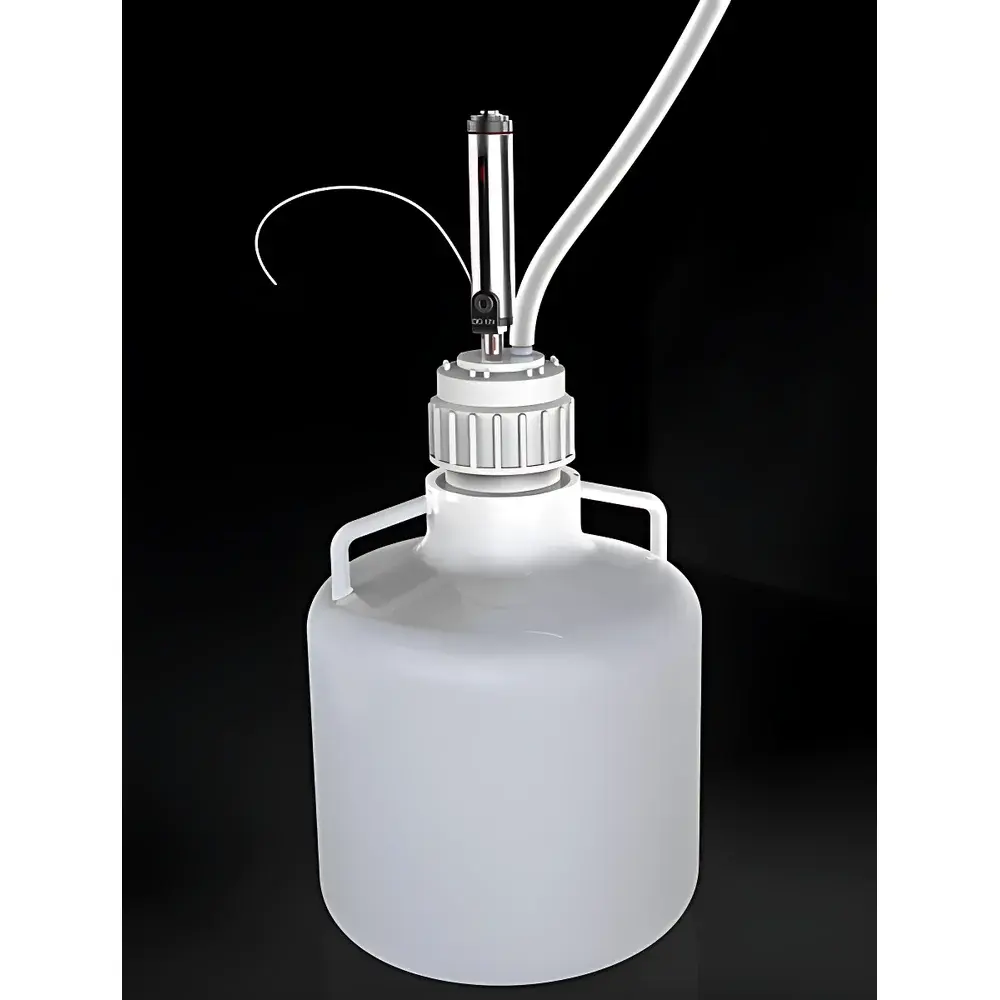
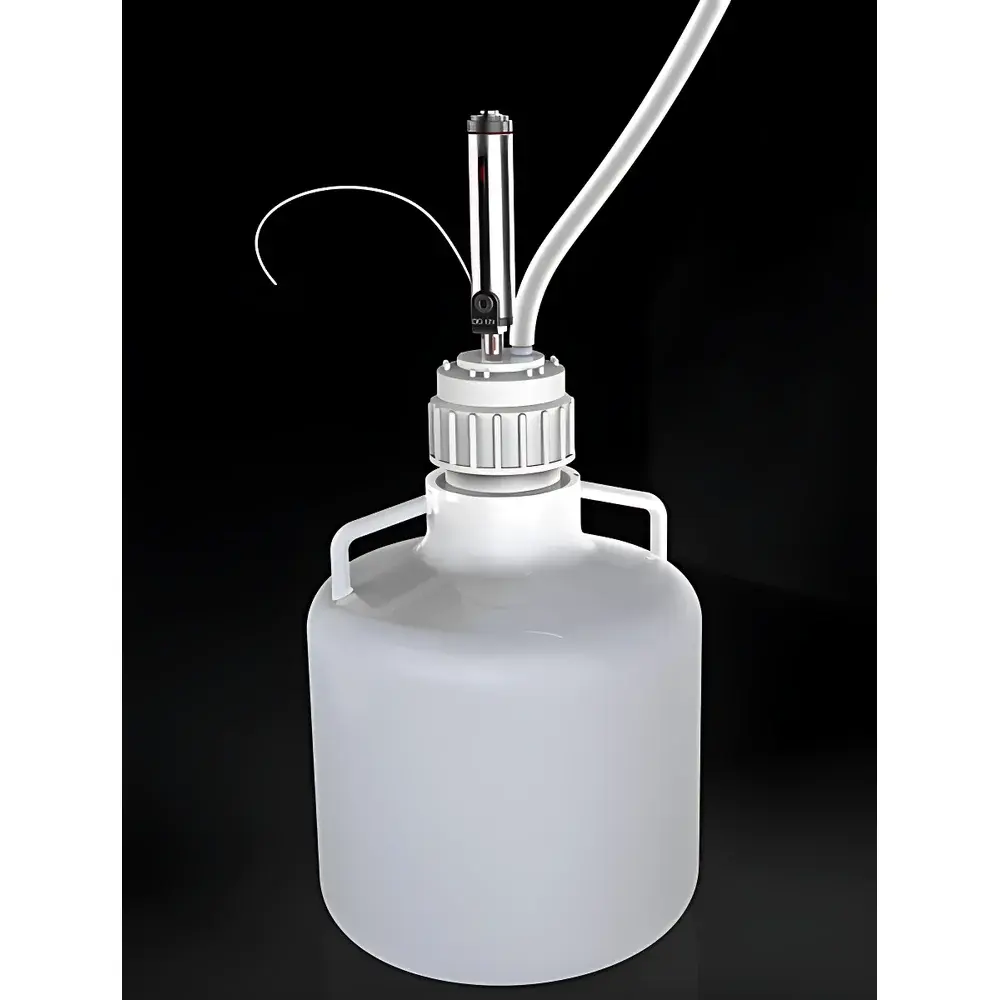
RWAI Waste Liquid Level Alarm System by LabTech
| Brand | LabTech |
|---|---|
| Model | RWAI |
| Origin | Beijing, China |
| Manufacturer Type | Direct Manufacturer |
| Equipment Category | Domestic |
| Sample Handling | Waste Liquid Monitoring and Overflow Prevention |
| Compatibility | Universal for Chromatography Systems and Sample Preparation Instruments |
| Pressure Equalization | Integrated Micro-Ventilation Port in Sealed Lid |
| Customization | OEM-Compatible Sealing Adapters and Drain Fittings for Existing Instrument Tubing |
| Container Support | 10 L, 20 L, and Other Standard Waste Carboys |
Overview
The RWAI Waste Liquid Level Alarm System is an engineered safety interface designed specifically for laboratories operating chromatographic systems (e.g., HPLC, GC, LC-MS), automated sample preparators, and other analytical instruments generating organic or aqueous waste streams. It functions on the principle of non-contact capacitive or conductive level sensing—depending on configuration—to continuously monitor liquid accumulation inside sealed waste collection carboys. When the waste volume reaches a preconfigured threshold—typically set at 85–90% of nominal capacity—the system triggers an audible and visual alarm, interrupting further discharge if integrated with instrument control logic. This real-time monitoring architecture mitigates risks associated with overflow-induced floor contamination, volatile organic compound (VOC) release, corrosion of lab infrastructure, and noncompliance with OSHA 29 CFR 1910.120 and ISO 14001 environmental management requirements.
Key Features
- Multi-sensor compatibility: Supports both conductive probes (for aqueous/ionic waste) and capacitance-based sensors (for low-conductivity organic solvents such as acetonitrile, methanol, or hexane)
- Sealed-carboy integration: Designed for use with standard HDPE or stainless-steel waste containers; pressure equalization achieved via a calibrated 0.5 mm micro-ventilation orifice in the lid to prevent vacuum lock during active aspiration
- Modular alarm interface: Configurable dry-contact relay output (NO/NC) for integration into building management systems (BMS) or instrument interlock circuits
- OEM adaptability: Includes customizable sealing adapters and tapered drain fittings compatible with common tubing diameters (ID 6 mm, 8 mm, 10 mm) and connector standards (e.g., Swagelok® 1/4″-28 UNF, Camozzi push-to-connect)
- IP65-rated enclosure: Housing meets IEC 60529 ingress protection for dust and low-pressure water jet resistance—suitable for wet-lab environments
- No internal battery dependency: Powered via standard 24 V DC input with reverse-polarity and overvoltage protection
Sample Compatibility & Compliance
The RWAI system accommodates heterogeneous waste streams typical in analytical labs—including mixed aqueous buffers, acidic/basic eluents, and halogenated or nonhalogenated organic solvents. Its sensor design avoids direct immersion where possible, reducing fouling and enabling long-term stability without recalibration. The device complies with CE marking directives (2014/30/EU EMC Directive and 2014/35/EU Low Voltage Directive) and supports audit-ready documentation per GLP (Good Laboratory Practice) Annex 11 and FDA 21 CFR Part 11 when paired with validated logging software. It does not process or treat waste chemically; rather, it serves as a critical engineering control within a broader waste management hierarchy aligned with ISO 14040 life cycle assessment principles.
Software & Data Management
While the base RWAI unit operates as a standalone hardware alarm, optional RS-485 Modbus RTU or Ethernet/IP interfaces enable connection to centralized laboratory information management systems (LIMS) or SCADA platforms. Event logs—including timestamped alarm triggers, sensor status, and power-on cycles—are retained locally for ≥30 days and exportable as CSV. All firmware updates follow signed binary verification protocols to ensure integrity. Audit trails include operator ID (when authenticated via network login), action type, and system response—fully traceable for regulatory inspection under ISO/IEC 17025 Clause 7.10.
Applications
- Preventing overflow incidents during unattended overnight HPLC gradient runs
- Securing solvent waste lines from automated SPE or ASE extraction systems
- Integrating with robotic liquid handlers discharging wash solutions into shared waste manifolds
- Supporting compliance in pharmaceutical QC labs subject to EMA Annex 15 and USP Analytical Instrument Qualification
- Enabling safe operation of multi-instrument waste consolidation hubs in core facilities
FAQ
Does the RWAI system require calibration after installation?
No routine calibration is required. Sensor sensitivity is factory-set for standard waste compositions; drift compensation occurs automatically via baseline stabilization algorithms during idle periods.
Can it be installed on existing waste carboys without modification?
Yes—provided the carboy lid accepts threaded or compression-mounted probe inserts. LabTech supplies universal mounting kits for common 10 L and 20 L HDPE carboys (e.g., Nalgene® 2152-0010, Chemglass CG-1220-10L).
Is explosion-proof certification available?
The standard unit is not ATEX-certified; however, intrinsically safe variants (II 2G Ex ib IIB T4 Gb) are available upon request for Class I, Division 1 environments.
What maintenance intervals are recommended?
Visual inspection every 90 days; sensor cleaning with isopropanol if residue buildup is observed; annual verification of relay contact resistance and vent orifice integrity.
How does the system handle viscous or particulate-laden waste?
For suspensions or high-viscosity effluents (e.g., >500 mPa·s), LabTech recommends the optional ultrasonic proximity sensor variant (RWAI-U), which eliminates contact-based fouling mechanisms entirely.
Related Products



