
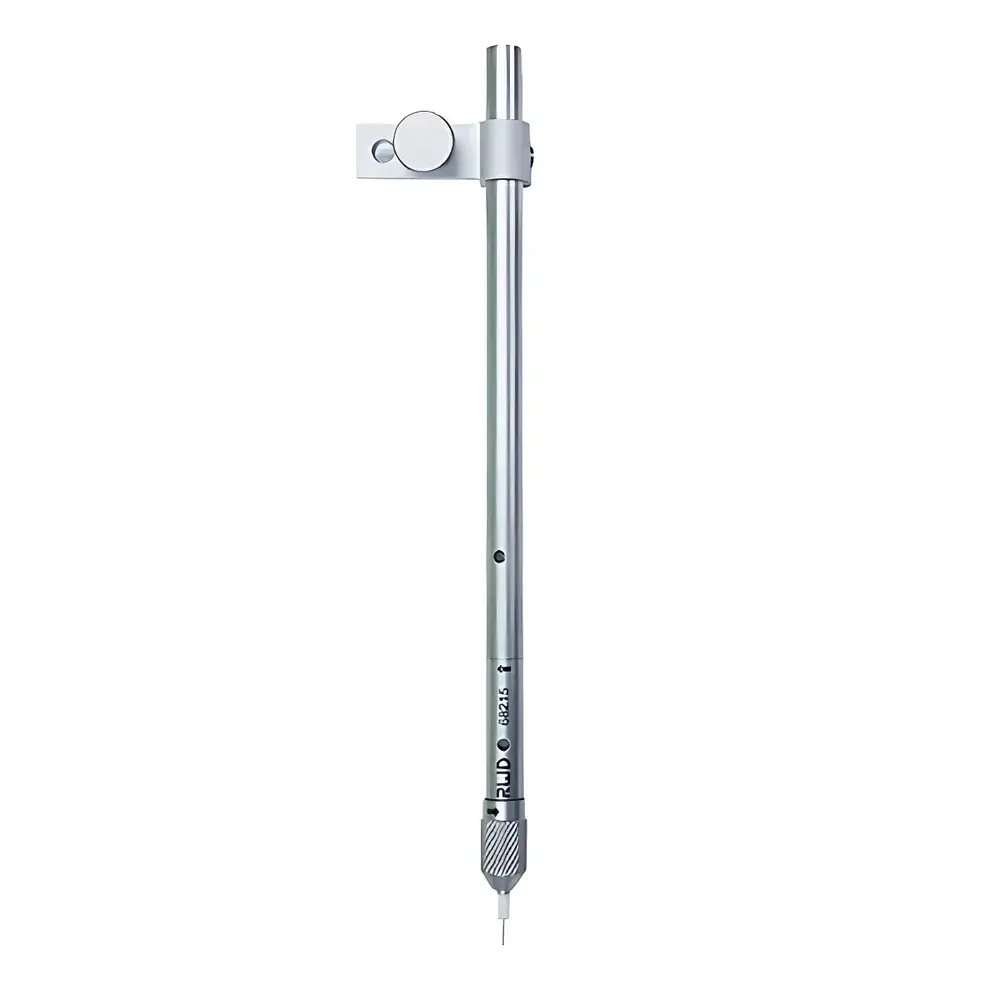
RWD 68214 Ceramic Ferrule Holder for Optogenetics
| Brand | RWD |
|---|---|
| Origin | Shenzhen, China |
| Manufacturer Type | Direct Manufacturer |
| Region of Origin | Domestic (China) |
| Model | 68214 |
| Pricing | Upon Request |
| Compatible Ferrule Diameters | 1.25 mm or 2.5 mm |
| Material Compatibility | Ceramic and Metallic Ferrules |
| Application-Specific Design | Optogenetic Implantation & Retrieval |
Overview
The RWD 68214 Ceramic Ferrule Holder is an engineered mechanical interface device designed specifically for precision optogenetic experiments requiring reliable, repeatable handling of optical fiber assemblies during stereotactic implantation in rodent models. It operates on a passive mechanical clamping principle—utilizing calibrated radial compression force to secure ferrule-terminated optical fibers (commonly used with 200 µm or 400 µm core multimode fibers) without inducing axial stress, torsional strain, or micro-fracture risk to the fragile ceramic or stainless-steel ferrule. Unlike generic micro-manipulator adapters, the 68214 integrates a dual-diameter compatibility system (1.25 mm and 2.5 mm) with standardized outer geometry that aligns with widely adopted stereotaxic frame mounting interfaces (e.g., Kopf, Stoelting, and custom 3D-printed baseplates). Its design prioritizes post-implantation reversibility: the holder enables rapid, tool-free disengagement of the fiber assembly after craniotomy and durotomy, preserving tissue integrity and minimizing chronic inflammation triggers associated with prolonged mechanical retention.
Key Features
- Dual-ferrule-diameter support: Interchangeable inserts accommodate both 1.25 mm and 2.5 mm outer diameter ceramic (zirconia) and metallic (stainless steel) ferrules—ensuring compatibility with standard FC/PC, FC/APC, and custom optogenetic cannula configurations.
- Zero-slip clamping mechanism: Precision-machined brass collet with integrated PTFE-lined compression sleeve delivers uniform circumferential pressure distribution, eliminating lateral slippage during insertion and reducing coupling loss variability (< ±0.3 dB across repeated insertions).
- Stereotaxic integration-ready: 8-32 threaded base and 12 mm diameter footprint conform to ANSI/ISO 9001-aligned mechanical interface standards for third-party manipulator arms and digital stereotaxic systems (e.g., Motorized Leica Angle Two, Neurostar Pro).
- Autoclavable and chemically resistant: Anodized aluminum body with medical-grade surface finish withstands repeated sterilization cycles (134 °C, 2 bar saturated steam, 18 min) and exposure to ethanol, isopropanol, and 70% hydrogen peroxide—fully compliant with GLP-compliant surgical suite protocols.
- Modular retrieval function: Integrated quick-release lever allows single-hand disengagement of the fiber assembly within <2 seconds post-implantation, supporting longitudinal optogenetic studies where repeated optical access is required without re-craniotomy.
Sample Compatibility & Compliance
The 68214 holder is validated for use with commercially available optogenetic hardware including Doric Lenses’ MFC_1.25 and MFC_2.5 series, Thorlabs’ ADAF1 and ADAF2 ferrule collimators, and custom-built fiber-cannula hybrids fabricated using USP Class VI-certified materials. It meets ISO 13485:2016 requirements for design control documentation and mechanical biocompatibility assessment (ISO 10993-1:2018 Annex A). While not a medical device itself, its design supports adherence to NIH Guide for the Care and Use of Laboratory Animals (8th Edition) and AAALAC International accreditation criteria related to minimally invasive instrumentation. No electrical or optical certification (e.g., IEC 60601) applies, as the device contains no active components.
Software & Data Management
As a purely mechanical holding system, the RWD 68214 requires no firmware, drivers, or software integration. However, its dimensional consistency and interface repeatability enable seamless correlation with digital surgical planning platforms such as Brain Explorer 2 (Allen Institute), QuickNII, or proprietary MATLAB-based trajectory mapping tools. When used in conjunction with motorized stereotaxic systems equipped with encoder feedback (e.g., Scientifica PatchStar), positional metadata—including insertion depth, angle, and holder engagement status—can be logged via TTL-triggered timestamps synchronized to electrophysiology or calcium imaging acquisition software (e.g., Spike2, ScanImage 2023). Audit trails remain under user control; no cloud connectivity or remote data transmission capabilities are present.
Applications
- Chronic optogenetic stimulation in freely moving mice and rats, particularly in behavioral paradigms requiring multi-session light delivery (e.g., fear conditioning, reward learning, sleep-wake modulation).
- Combined opto-fMRI or opto-EEG experiments where mechanical stability during scanning is critical and post-scan fiber removal must avoid motion artifact propagation.
- Validation studies comparing light delivery efficiency across ferrule types (ceramic vs. metal) under identical mechanical loading conditions.
- Training modules for neuroscience core facilities emphasizing aseptic implantation technique, torque-controlled fixation, and ethical endpoint management.
- Integration into closed-loop optogenetic systems where real-time photostimulation is gated by neural signal detection—leveraging the holder’s deterministic release timing.
FAQ
Is the 68214 compatible with non-RWD optical fibers?
Yes—mechanical compatibility depends solely on outer ferrule diameter and concentricity tolerance (±5 µm), not brand-specific encoding. All standard 1.25 mm and 2.5 mm zirconia or stainless-steel ferrules meeting IEC 61754-20 specifications are supported.
Can it be used for acute terminal experiments only?
No—it is explicitly engineered for chronic preparations. The low-profile base and minimal tissue footprint reduce granulation response, and retrieval has been validated over ≥14-day implantation durations in C57BL/6J mice.
Does RWD provide calibration certificates or traceable metrology data?
Yes—each production batch undergoes dimensional verification per ISO/IEC 17025-accredited internal metrology lab procedures. Certificates of Conformance (CoC) with measurement uncertainty budgets (k=2) are available upon request.
What torque specification should be applied when mounting to stereotaxic frames?
Maximum recommended tightening torque is 0.45 N·m (4 in·lb) using a calibrated torque screwdriver. Overtightening may deform the aluminum housing and compromise collet alignment.
Are replacement collets or diameter inserts available separately?
Yes—RWD part numbers 68214-COLLET-1.25 and 68214-COLLET-2.5 are stocked globally and ship with NIST-traceable dimensional inspection reports.
Related Products



