
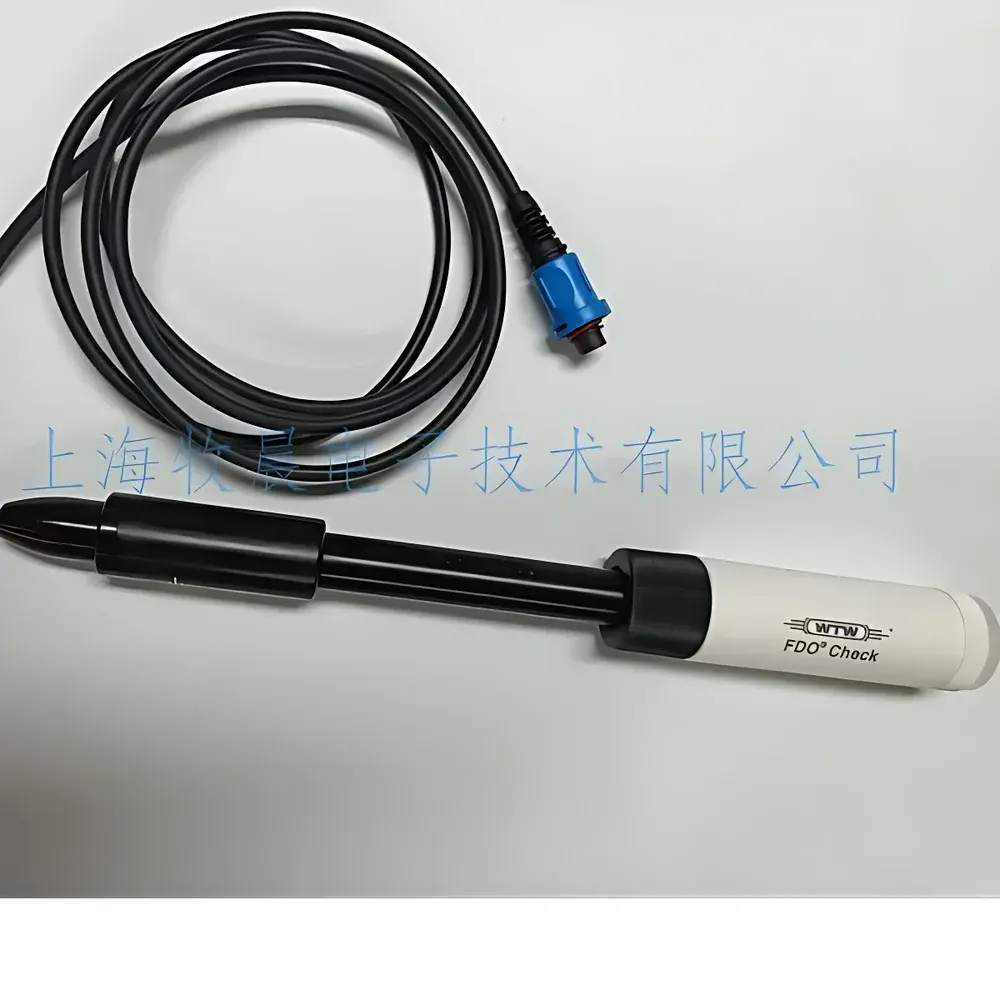
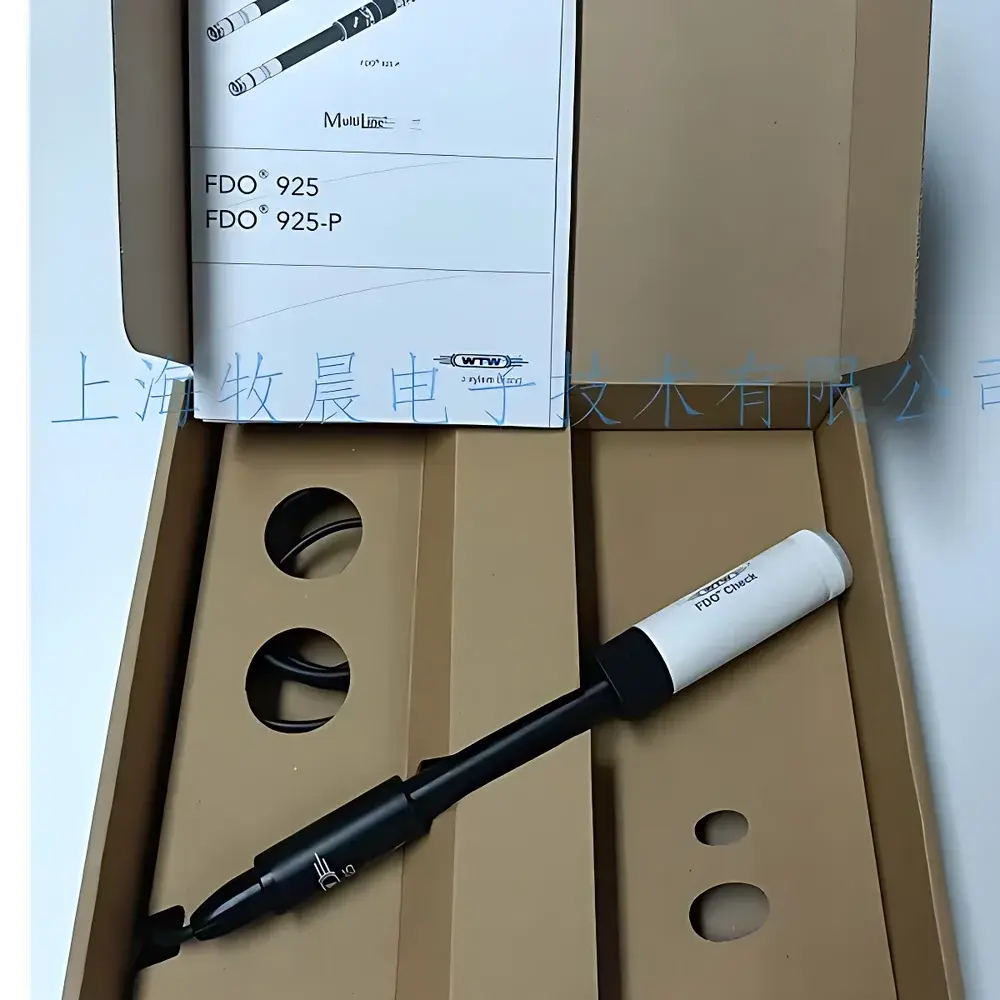
WTW FDO925 Fluorescence-Based Dissolved Oxygen Sensor
| Brand | WTW |
|---|---|
| Origin | Germany |
| Model | FDO925 |
| Instrument Type | Portable |
| Measurement Principle | Fluorescence Quenching |
| Measurement Range | 0.00–20.00 mg/L |
| Response Time (T99) | <60 s |
| Temperature Range | 0–50.0 °C ± 0.2 °C |
| DO Accuracy | ±0.5% of reading |
| Saturation Range | 0–200.0 % |
| Partial Pressure Range | 0–200 hPa ± 0.5% of reading |
| Electrode Material | POM body with stainless steel tip |
| Dimensions | 140 mm ± 1 mm (L) × 15.3 mm ± 0.2 mm (Ø) |
| Cable Options | 1.5 m, 3 m, 6 m, 25 m (Kevlar-reinforced) |
Overview
The WTW FDO925 is a high-precision, portable fluorescence-based dissolved oxygen (DO) sensor engineered for reliable, interference-free measurement across laboratory, field, and wastewater treatment applications. Unlike traditional electrochemical Clark-type sensors, the FDO925 employs optical fluorescence quenching—where molecular oxygen modulates the lifetime and intensity of fluorescent emission from a ruthenium-based luminophore immobilized in a gas-permeable polymer matrix. This principle eliminates oxygen consumption during measurement, removes dependence on sample flow velocity or stirring, and ensures long-term stability without electrolyte refills or membrane replacements. The sensor integrates an NTC 30 temperature probe for automatic thermal compensation and delivers rapid response (T99 < 60 s) with trace-level sensitivity down to sub-1 mg/L—critical for BOD incubation, low-oxygen aquatic studies, and process control in denitrification stages.
Key Features
- Fluorescence quenching technology ensures zero oxygen consumption, enabling true non-invasive measurement in static or low-volume samples (e.g., BOD bottles, microcosms, and small bioreactors).
- 45° beveled sensor tip minimizes bubble adhesion and improves signal consistency in turbulent or aerated environments.
- Integrated data chip stores factory calibration parameters—including temperature compensation coefficients and sensor-specific decay time constants—ensuring traceable, reproducible measurements across instruments and operators.
- Robust mechanical design: POM (polyoxymethylene) housing with stainless steel sensing tip provides chemical resistance to H₂S, chlorine, sulfides, and organic solvents—common interferents in wastewater and anaerobic digesters.
- Kevlar-reinforced cable options (1.5 m, 3 m, 6 m, and 25 m) support deployment in deep lakes, fast-flowing rivers, and submerged process tanks while maintaining tensile strength and abrasion resistance.
- Compact form factor (140 mm × 15.3 mm) enables insertion into narrow-necked vessels, standard BOD bottles (e.g., Karlsruhe-type), and inline process ports without flow cell requirements.
Sample Compatibility & Compliance
The FDO925 is validated for use in freshwater, seawater, activated sludge, digester liquor, fermentation broths, and sterilized media. Its H₂S immunity supports long-term deployment in anaerobic zones and sewer networks where sulfide poisoning would deactivate conventional amperometric sensors. The sensor meets ISO 5814:2012 (Water quality — Determination of dissolved oxygen — Electrochemical probe method) and ASTM D888-22 (Standard Test Methods for Dissolved Oxygen in Water), with performance equivalency confirmed against WTW’s FDO 700IQ online sensor when used with MultiLine handheld or benchtop meters featuring AutoRead functionality. Data integrity complies with GLP and GMP documentation requirements via timestamped, instrument-traceable readings and optional audit trail logging in compatible WTW software platforms.
Software & Data Management
When paired with WTW MultiLine meters (e.g., Multi 3630 IDS, pH/DO/Conductivity models), the FDO925 supports automatic recognition, one-touch calibration, and real-time temperature-compensated output in mg/L, % saturation, and partial pressure (hPa). Raw fluorescence decay data are accessible via WTW LabX® Light software for advanced validation and trend analysis. All calibration events—including date, operator ID, and reference standard values—are stored onboard the sensor chip and synchronized to the host meter, satisfying FDA 21 CFR Part 11 requirements for electronic records and signatures when configured with appropriate user access controls and audit trails.
Applications
- Laboratory Analysis: BOD₅ testing per ISO 5815-1, respirometry assays, microbial growth monitoring, and method validation studies requiring high repeatability in static samples.
- Field Monitoring: Rapid assessment of hypolimnetic oxygen depletion, riverine reaeration rates, and wetland redox profiling using battery-powered MultiLine systems.
- Wastewater Treatment: Process optimization in aeration basins, anoxic zone monitoring, and effluent compliance reporting—especially where H₂S presence compromises electrochemical sensors.
- Research & Education: Teaching labs benefit from plug-and-play operation, minimal maintenance, and direct correlation to theoretical oxygen solubility models (e.g., APHA 4500-O G).
FAQ
Does the FDO925 require membrane replacement or electrolyte refilling?
No—fluorescence-based detection eliminates consumable membranes and internal electrolytes, reducing total cost of ownership and calibration frequency.
Can it be used in saline or brackish water?
Yes; salinity compensation is applied automatically when paired with WTW meters supporting conductivity input or manual salinity entry.
Is the sensor compatible with third-party data loggers?
Only via WTW-certified interfaces (e.g., IDS digital protocol); analog output is not supported—ensuring signal fidelity and calibration traceability.
What is the expected service life of the optical sensing cap?
Typically >2 years under normal use; the integrated data chip retains calibration history and expiration tracking to support preventive maintenance scheduling.
How does it handle biofouling in long-term deployments?
The smooth POM surface and angled tip reduce adhesion; optional stainless steel protective guards (e.g., WTW Guard-FDO) are available for high-fouling environments.







