
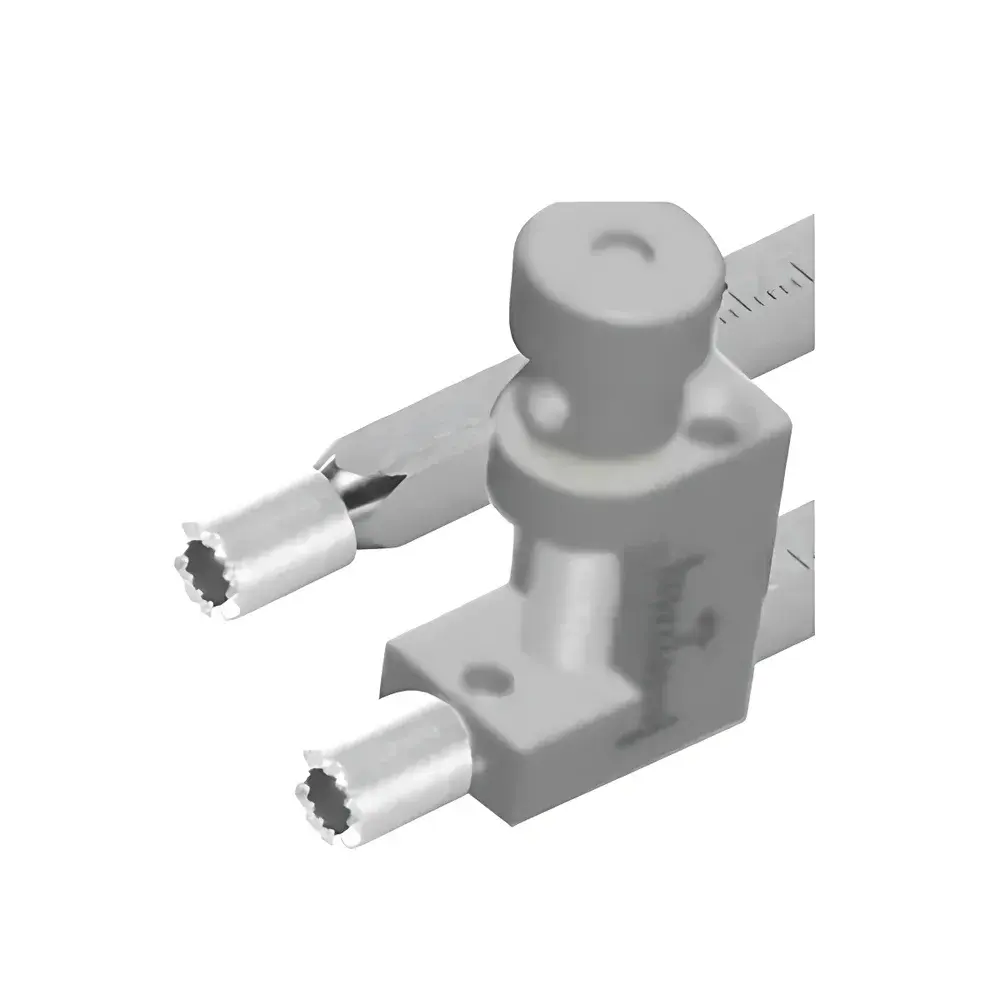
RWD 68314 Adjustable Height Ear Bar
| Brand | RWD |
|---|---|
| Origin | Shenzhen, China |
| Manufacturer Type | OEM/ODM Manufacturer |
| Country of Origin | China |
| Model | 68314 |
| Pricing | Available Upon Request |
Overview
The RWD 68314 Adjustable Height Ear Bar is a precision-engineered stereotaxic accessory designed for consistent and reproducible head fixation in rodent neurosurgical and electrophysiological experiments. Engineered for compatibility with standard small-animal stereotaxic frames—including those from RWD, Stoelting, and Kopf—the device utilizes a dual-screw vertical adjustment mechanism to enable fine-tuned, millimeter-accurate positioning of the ear bar tips relative to the external auditory meatus. This mechanical design ensures stable, non-slip engagement during prolonged procedures while minimizing lateral torque on the temporal bone. The ear bar operates on the principle of bilateral symmetric fixation: by aligning the interaural axis with the stereotaxic baseline (typically the line connecting bregma and lambda), it establishes a reliable anatomical reference plane essential for coordinate-based targeting in brain mapping, electrode implantation, and cranial window surgery.
Key Features
- Stepless height adjustment via dual stainless-steel locking screws—enables precise vertical positioning in 0.1 mm increments without tool dependency
- Interchangeable ear bar tips (included): conical stainless-steel tips for mice and tapered blunt tips for rats, both autoclavable and corrosion-resistant
- Integrated depth-stop collar prevents over-insertion into the external auditory canal, reducing risk of tympanic membrane trauma
- Modular mounting interface compatible with 16 mm and 19 mm stereotaxic rail systems (standard RWD and third-party frames)
- Non-magnetic 316L stainless-steel construction ensures full compatibility with MRI-compatible surgical setups and eliminates interference in electrophysiology recordings
- Calibration traceability: each unit includes a dimensional verification certificate referencing ISO 17025-accredited metrology standards
Sample Compatibility & Compliance
The RWD 68314 supports head fixation across common laboratory rodent models, including C57BL/6, BALB/c, Sprague-Dawley, and Wistar strains (body weight range: 18–500 g). Tip geometry and insertion depth are validated per ASTM F2983-22 guidelines for surgical instrumentation biocompatibility and mechanical safety. The device complies with ISO 13485:2016 requirements for design control and manufacturing documentation, and its materials meet USP Class VI biological safety specifications. All surface finishes conform to ISO 14644-1 Class 5 cleanroom handling protocols prior to packaging. While not classified as an IVD or medical device under FDA 21 CFR Part 809, the ear bar is intended for research-use-only (RUO) applications in GLP-compliant preclinical studies.
Software & Data Management
As a purely mechanical stereotaxic component, the RWD 68314 requires no embedded firmware, drivers, or software integration. Its operational parameters are fully documented in the accompanying Stereotaxic Alignment Protocol Manual (Revision 3.1, 2024), which includes step-by-step alignment workflows, torque specifications for locking screws (0.35–0.45 N·m), and coordinate transformation matrices for bregma-lambda registration. Digital copies of calibration certificates, RoHS/REACH compliance reports, and sterilization validation data (steam autoclaving at 121°C, 15 psi, 20 min) are provided in PDF format via secure download portal access upon purchase. Audit trails for manufacturing batch records are retained for 10 years per ISO 13485 clause 7.5.10.
Applications
- Chronic intracranial electrode array implantation (e.g., Neuropixels, silicon probes) requiring sub-100 µm positional repeatability across sessions
- In vivo two-photon imaging through thinned-skull or cranial windows, where minimal head motion (< 1 µm RMS displacement) is critical
- Stereotaxic microinjection of viral vectors, tracers, or pharmacological agents into discrete nuclei (e.g., hippocampus, amygdala, VTA)
- Functional ultrasound (fUS) and optogenetic stimulation experiments demanding long-duration (>6 hr), vibration-isolated immobilization
- Validation of atlas-based coordinate systems against histological landmarks in post-mortem verification studies
FAQ
Is the RWD 68314 compatible with non-RWD stereotaxic frames?
Yes—the base mounting plate conforms to standardized 16 mm and 19 mm rail pitch dimensions used by Stoelting, Kopf, and David Kopf Instruments models.
What is the maximum recommended insertion depth for mouse use?
For adult C57BL/6 mice (20–30 g), the depth-stop collar limits insertion to ≤ 3.2 mm from the pinna base; this value is empirically derived from micro-CT anatomical studies of murine temporal bone morphology.
Can the ear bar be used in MRI environments?
Yes—its 316L stainless-steel construction is non-ferromagnetic and has been tested for RF-induced heating (< 0.1°C temperature rise at 7T static field, per ASTM F2182-21).
Does RWD provide installation training or alignment verification services?
Yes—on-site or remote technical support includes stereotaxic zero-point calibration, interaural axis verification using digital calipers and optical level, and documentation of alignment uncertainty (±0.05 mm, k=2).





