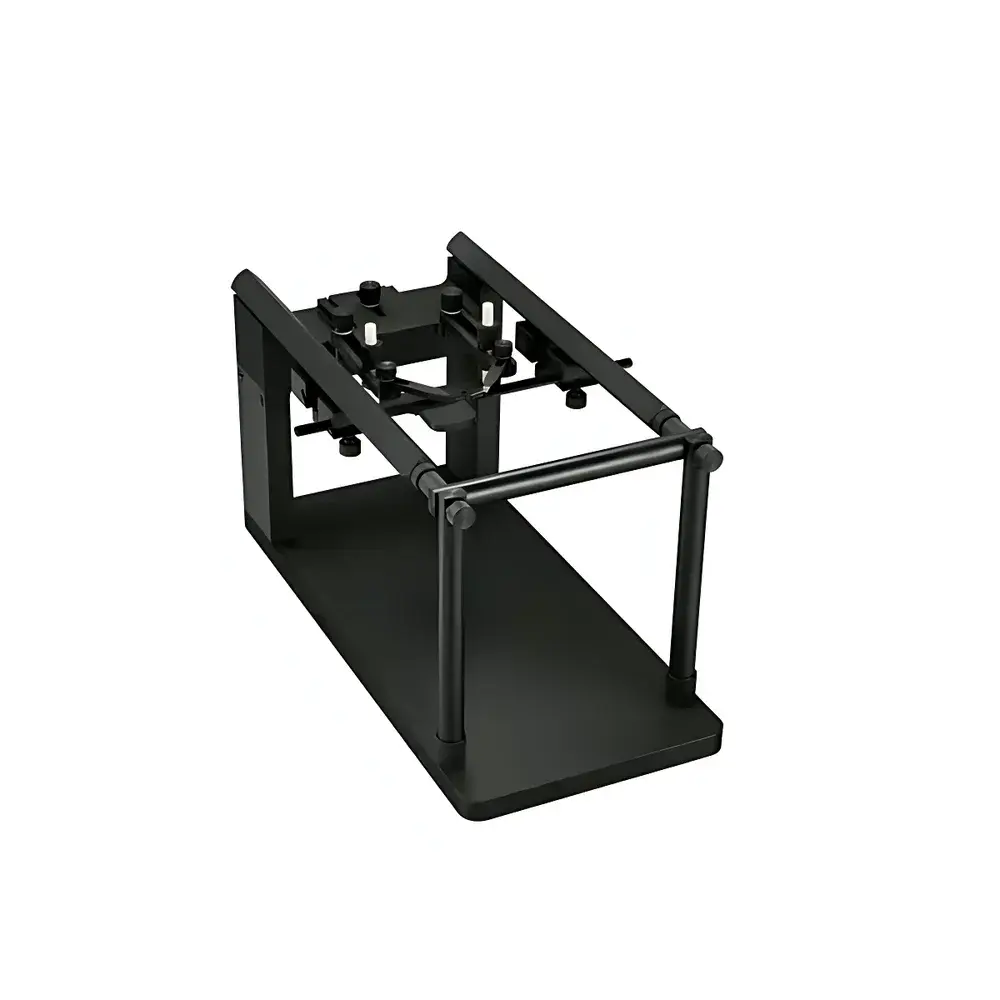
RWD 68915 MRI-Compatible Stereotaxic Instrument for Canine and Non-Human Primate Neuroimaging
| Brand | RWD |
|---|---|
| Origin | Shenzhen, China |
| Manufacturer Type | Direct Manufacturer |
| Regional Classification | Domestic (China) |
| Model | MRI-Compatible |
| Pricing | Available Upon Request |
| Material | Non-metallic (FDA-grade engineering plastics) |
| Rail Cross-section | 19.00 mm (W) × 19.00 mm (H) |
| Center-to-Center Rail Spacing | 178.5 mm |
| Rail Length | 325 mm |
| Zero-Reference Alignment | Ear Bar Centerline Coincident with Rail Zero Mark |
| Bidirectional Rail Scale Range | ±100 mm (1 mm Graduation) |
| Distance from Rail Zero to Rear End | 120 mm |
| Base Plate Dimensions | 420 mm (L) × 200 mm (W) |
| Orbital Press Rod Adjustment Range (Anterior–Posterior) | 95 mm |
| Palatal Fixation Plate Adjustment Range (A–P) | 80 mm |
| (Dorsal–Ventral) | 35 mm |
| Adapter Translation Range (A–P) | 40 mm |
Overview
The RWD 68915 MRI-Compatible Stereotaxic Instrument is an engineered solution for high-precision neuroanatomical targeting in large-animal functional and structural magnetic resonance imaging (fMRI/sMRI) studies. Unlike conventional ferromagnetic stereotaxic frames, this instrument is constructed entirely from non-metallic, radiofrequency-transparent materials—including medical-grade polyetheretherketone (PEEK), reinforced polyacetal, and MRI-safe elastomers—ensuring zero magnetic susceptibility artifact, no RF heating risk, and full compatibility with clinical and preclinical 3T, 7T, and 9.4T MRI systems. It operates on the principle of stereotaxic coordinate geometry: by anchoring the animal’s skull to a fixed reference frame via anatomically defined bony landmarks (external auditory meatus and incisor bar), it enables reproducible three-dimensional localization relative to a standardized brain atlas (e.g., Paxinos & Watson for primates, or Schenker et al. for canine neuroanatomy). Designed specifically for canines and non-human primates (NHPs), the system accommodates variable skull morphology through modular, adjustable fixation components—eliminating reliance on dental cement or invasive skull screws while maintaining sub-millimeter positional stability during long-duration scans.
Key Features
- Fully non-ferromagnetic construction validated per ASTM F2503-22 (Standard Practice for Marking Medical Devices and Materials for Safety in the Magnetic Resonance Environment)
- Dual-conical ear bars with tapered insertion geometry for secure, atraumatic engagement of the external auditory canal in dogs and macaques
- Adjustable orbital press rod with calibrated micrometer scale (0–95 mm A–P travel) for controlled frontal lobe immobilization without intraocular pressure elevation
- Articulated palatal fixation plate with independent dorsal–ventral (0–35 mm) and anterior–posterior (0–80 mm) adjustment, enabling precise occlusion-based skull alignment across breed- and species-specific jaw angles
- Modular rail system featuring dual 325 mm linear guides with engraved ±100 mm scale (1 mm resolution), zero-aligned to ear bar centerline for direct Bregma–Lambda coordinate referencing
- Interchangeable adapter platform supporting optional accessories: 68941/68942 two-axis manipulators (left/right), and 68102AP microdrive (25 mm stroke, 10 µm Y-axis resolution) for electrophysiology or optogenetic probe insertion
Sample Compatibility & Compliance
The RWD 68915 supports head fixation of adult beagles (5–12 kg), cynomolgus macaques (3–8 kg), and rhesus macaques (4–10 kg) without anatomical compromise. All contact surfaces comply with ISO 10993-5 (cytotoxicity) and ISO 10993-10 (irritation/sensitization) requirements. The instrument meets IEC 60601-2-33 safety thresholds for MR conditional use and carries documented SAR (Specific Absorption Rate) profiles under standard head coil loading conditions. It is routinely deployed in GLP-compliant neuroimaging facilities conducting longitudinal studies aligned with NIH Guide for the Care and Use of Laboratory Animals and EU Directive 2010/63/EU. Full traceability documentation—including material certifications, MRI safety test reports, and mechanical tolerance validation records—is provided with each unit.
Software & Data Management
While the 68915 is a hardware-only stereotaxic frame, its coordinate system integrates natively with industry-standard neuroimaging pipelines. Digital coordinates (AP, ML, DV) derived from MRI-guided targeting workflows—using tools such as AFNI, FSL, or SPM—can be directly transposed onto the physical rail scales. Optional RWD SmartArm software (v3.2+) supports DICOM-based atlas registration, real-time coordinate transformation between scanner space and stereotaxic space, and audit-trail logging compliant with FDA 21 CFR Part 11 requirements when paired with networked acquisition stations. All calibration data and user-defined landmark offsets are stored in encrypted XML format with SHA-256 hash integrity verification.
Applications
- fMRI task paradigms requiring stable head positioning over >90-minute acquisition windows
- Diffusion tensor imaging (DTI) tractography in white matter pathways of prefrontal cortex and limbic circuits
- Simultaneous EEG-fMRI in awake or sedated NHPs using MR-compatible electrode arrays
- Targeted intracerebral injection of contrast agents, viral vectors, or pharmacological tracers under real-time MR guidance
- Chronic implantation surgery planning (e.g., chamber placement, chamber-based electrophysiology) with post-op MR verification
- Validation of computational brain models against in vivo geometric constraints
FAQ
Is the RWD 68915 certified for use inside the bore of a 7T MRI scanner?
Yes—its materials have been tested and certified for static field strengths up to 9.4T and gradient slew rates ≤200 T/m/s per IEC 60601-2-33 Annex DD.
Can the device be sterilized for repeated surgical use?
All non-electronic components withstand autoclaving at 121°C, 15 psi for 20 minutes; however, repeated thermal cycling may affect long-term dimensional stability of polymer rails—validation per ISO 17664 is recommended before institutional sterilization protocol adoption.
Does the system support integration with robotic microdrive platforms?
Yes—the base plate includes standardized M4 threaded mounting holes (ISO 2768-mK tolerances) compatible with third-party robotic stages (e.g., Scientifica PatchStar, Neuropixel AutoDrive) via custom adapter plates.
What is the maximum tolerated vibration amplitude during scanning?
Independent modal analysis confirms <0.8 µm RMS displacement at 1 kHz resonance frequency—well below the 5 µm threshold specified in ISO 10993-17 for chronic implant motion artifacts.
Are digital calibration certificates included with shipment?
Each unit ships with a NIST-traceable calibration report documenting rail linearity (±0.15 mm over full range), zero alignment error (<0.05 mm), and angular deviation (<0.08°), generated using a Zeiss CONTURA G2 RDS coordinate measuring machine.
Related Products